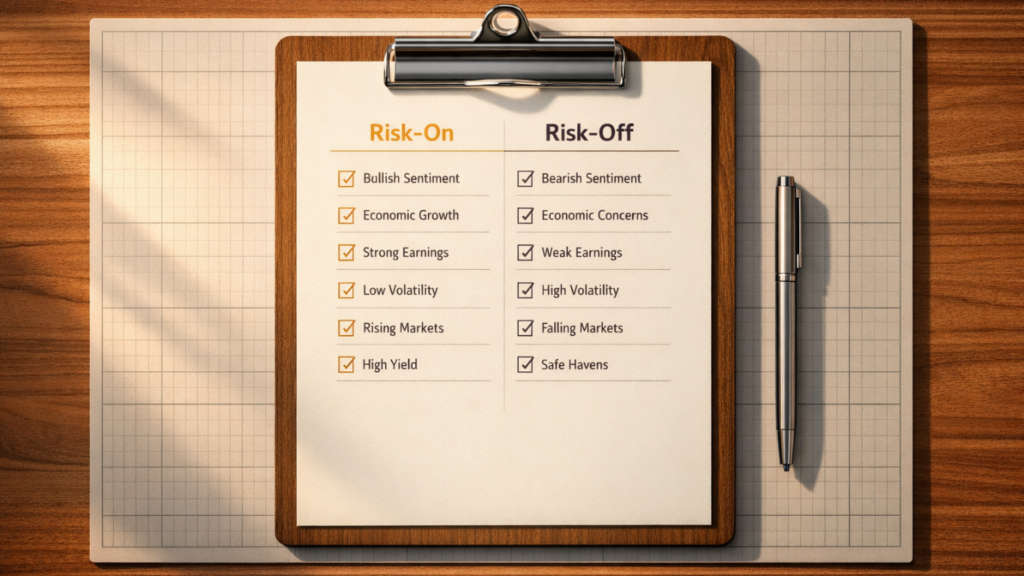
When trading, recognising whether the market is risk-on or risk-off is critical. Risk-on markets favour growth assets like equities and high-yield currencies (e.g., AUD, NZD), while risk-off markets push investors towards safer options like bonds, gold, and safe-haven currencies (e.g., USD, JPY). A systematic trading checklist ensures your trades align with the broader market sentiment, reducing emotional decisions and improving outcomes.
Key Takeaways:
- Risk-On Markets: Focus on growth assets, cyclicals, and high-yield currencies. Examples: S&P 500 surges, AUD/JPY rises, VIX stays below 15.
- Risk-Off Markets: Prioritise safety with bonds, gold, defensive equities, and safe-haven currencies. Examples: USD strengthens, VIX spikes above 25, equities fall.
- Pre-Market Checklist: Analyse macro events, intermarket signals (e.g., VIX, AUD/JPY), and summarise the market regime before trading.
- Risk Management: In risk-on, aim for 1%-2% risk per trade; in risk-off, lower to 0.5%-1%. Adjust stops and position sizes based on volatility.
By following a structured checklist, you can trade confidently, whether markets are trending positively or reacting to uncertainty. Always validate market conditions with multiple signals before entering trades.
sbb-itb-466c9b0
Risk-On and Risk-Off Market Regimes Explained
What Is a Risk-On Market?
A risk-on market is when investors are willing to take on more risk, putting their money into growth-focused assets like equities, high-yield bonds, and cyclical currencies such as the Australian Dollar (AUD), New Zealand Dollar (NZD), and Canadian Dollar (CAD). This typically happens when economic data is upbeat, and central banks signal a more accommodative stance.
For example, in January 2023, the US saw cooling inflation data and indications of slower interest rate hikes. This led to a risk-on environment where the S&P 500 surged, technology stocks made a comeback, and AUD/JPY climbed. At the same time, the VIX (a measure of market volatility) stayed below 15, reflecting lower fear in the market.
What Is a Risk-Off Market?
In contrast, a risk-off market reflects a more cautious mood. Investors prioritise safety, moving their capital into government bonds, gold, and safe-haven currencies like the US Dollar (USD), Japanese Yen (JPY), and Swiss Franc (CHF). This shift is often triggered by events like geopolitical tensions, recession fears, or aggressive central bank policies.
The concept of risk-off isn’t always straightforward. As Jarosław Wasiński from ForexMechanics explains:
“Risk-on / risk-off is not some clean switch. It is shorthand for whether large capital is loading risk or cutting exposure with an axe.”
Risk-off conditions can play out in different ways:
- Growth Scare: Investors flock to bonds as recession fears grow, pushing bond prices up.
- Inflation Scare: Both bonds and equities decline together, as seen in 2022 when the S&P 500 dropped 19.4%, and the US bond market fell about 13%.
- Liquidity Panic: Almost every asset class tumbles as institutions rush to secure USD cash reserves.
Knowing these patterns can help you adjust your trading approach to match the prevailing market mood.
Why Identifying the Market Regime Matters
Recognising whether the market is in a risk-on or risk-off phase is crucial for aligning your systematic trading strategy. The same technical setup that works in a bullish, risk-on market might fail in a risk-off environment dominated by caution. Understanding the broader context can make the difference between a successful trade and a losing one.
Here’s a quick overview of how different asset classes behave in each regime:
| Asset Class | Risk-On Behaviour | Risk-Off Behaviour |
|---|---|---|
| Equities | Rise (Tech, Small Caps, EM) | Fall (Defensive sectors fare better) |
| Currencies | AUD, NZD, CAD, EM FX rise | USD, JPY, CHF strengthen |
| Bonds | Yields rise (prices fall) | Yields fall (prices rise)* |
| Commodities | Oil, Copper, Silver increase | Gold gains |
| VIX | Low and stable (below 15) | Spikes (above 25) |
*During inflation scares, bond prices may drop alongside equities.
This knowledge also influences how you manage your positions. For instance, when the VIX climbs above 25, reducing exposure and tightening stop-losses becomes essential. As Des Woodruff, a hedge fund manager at Grok Trade, aptly notes:
“Technical analysis tells you what is happening to price. Macro awareness tells you why the environment is favourable or hostile to your setup – and when conditions are likely to shift.”
Pre-Market Checklist: Identifying the Current Market Regime
Understanding the market regime before trading is crucial to avoid unnecessary losses. As Ken Chigbo, Founder of KenMacro, explains:
“The desk reads the regime first and the pair second; the reverse sequence is how most retail traders lose money during regime shifts.”
Using the regime definitions outlined earlier, this pre-market checklist can help you determine the market’s current state.
Macro and News Assessment
Start by reviewing your economic calendar for key, high-impact events. Pay close attention to central bank decisions (like those from the FOMC, ECB, BoJ, and RBA), US Non-Farm Payrolls, and CPI data. These events often cause significant currency movements – ranging from 50 to over 150 pips – and can greatly influence market sentiment. Secondary data should only be considered if it supports your main analysis.
Prioritise “three-star” events. For example, FOMC meetings in March, June, September, and December are particularly impactful because they include the “dot plot” forecasts. Singapore-based traders should also monitor the MAS Advance Release Calendar for monthly CPI figures and the S$ Nominal Effective Exchange Rate (S$NEER), as these provide insight into regional risk conditions.
Evaluate whether the current macro environment favours risk-taking (e.g. strong US labour data combined with easing inflation) or risk-avoidance (e.g. unexpected economic contraction or escalating geopolitical tensions). Once this is done, confirm your findings using intermarket signals.
Intermarket Indicators to Watch
Verify your macro insights by cross-checking with intermarket signals. A market regime is validated only when at least three signals align:
| Signal | Risk-On Reading | Risk-Off Reading |
|---|---|---|
| VIX | Below 15 and falling | Above 25 and rising |
| AUD/JPY | Rising | Falling sharply |
| Credit Spreads (HY OAS) | Narrowing (below 500 bps) | Widening (above 500 bps) |
| USD/SGD | SGD strengthening (USD soft) | USD strengthening (safe-haven bid) |
| S&P 500 / STI | Trending higher, cyclicals leading | Selling off, defensives outperforming |
For example, in late May 2026, the S&P 500 climbed 4.92%, the Nasdaq 100 surged 10.10%, the VIX dropped to 15.73, and the DXY declined to 99.00. These combined signals clearly indicated a risk-on environment.
Summarising the Market Condition
Condense the market’s state into a single phrase, such as “Risk-on, moderate volatility, USD soft, equities bidding.” This approach ensures clarity and helps you avoid trades that conflict with the current market environment.
Finally, ask yourself: does my trading strategy align with this regime? For instance, a momentum breakout strategy might excel in a risk-on market but could struggle if sentiment abruptly shifts to risk-off. If your strategy doesn’t fit the current conditions, it’s often better to wait for a more favourable setup.
Master Systematic Trading with Collin Seow
Learn proven trading strategies, improve your market timing, and achieve financial success with our expert-led courses and resources.
Trade Setup Checklist for Risk-On Markets
Once you’ve determined a risk-on market regime using your pre-market checklist, the next step is to carefully structure your trades using systematic trading principles to make the most of the favourable environment. Keep in mind, a confirmed regime doesn’t mean you should trade every opportunity – it simply allows you to be more selective about which trades to take and how to size them.
Directional Bias and Asset Selection
In risk-on markets, capital typically flows into growth-oriented assets. Key sectors to focus on include technology (XLK), consumer discretionary (XLY), industrials (XLI), and small-cap stocks.
For currency traders, prioritise high-yield, growth-sensitive pairs. During risk-on phases, the Australian Dollar (AUD) often strengthens against safe-haven currencies like the Japanese Yen (JPY). Singapore-based traders may also explore SGX-listed cyclical stocks or regional ETFs that track Southeast Asian growth themes, particularly those tied to commodities and manufacturing.
“In a healthy risk-on phase, the best longs often feel boring after entry. Price holds above the level, pauses, and continues.” – Colibri Trader
A useful cross-asset indicator is the copper/gold ratio. When copper outperforms gold, it suggests strong industrial demand, reinforcing a risk-on directional bias. Combine this signal with a rising AUD/JPY and a bidding S&P 500 to confirm your trade direction. Once you’ve established this bias, validate it further with technical indicators.
Technical Confirmation and Momentum Checks
To back up macro signals, use technical tools for confirmation. Here are some key indicators to monitor:
| Indicator | Risk-On Threshold | Purpose |
|---|---|---|
| VIX | Below 18 (ideally under 15) | Indicates broad market confidence |
| ADX | Above 25 | Confirms a clear, tradeable trend |
| ATR | At least 0.9× the 90-day average | Ensures adequate volatility to cover trade costs |
| Volume | Above 1.2× the recent average | Signals strong participation on breakouts |
Start with a long-term directional bias by analysing the 50-day and 200-day simple moving averages (SMAs). Use the 20-period SMA as dynamic support during pullbacks. A multi-timeframe approach works well here: the daily chart for overall direction, the H4 chart for market structure (like higher highs and higher lows), and lower timeframes (H1 or M15) for precise entry triggers. If a setup on a lower timeframe contradicts the higher-timeframe trend, either reduce your position size or skip the trade altogether.
“A setup is not high quality just because it is clean. It is high quality when the pattern, the timeframe, and the market regime point the same way.” – Colibri Trader
Risk Management for Risk-On Trades
Even with strong technical confirmations, strict risk management remains essential. Here are some key principles:
- Limit risk per trade: Risk no more than 1% to 2% of your total capital on a single trade. For instance, if your account is S$50,000, your maximum loss per trade should be capped at S$500 to S$1,000.
- Adjust for volatility: Use ATR-based position sizing. In low-volatility conditions (ATR below 1% of price), you can consider slightly larger positions. Scale back as volatility increases.
- Set protective stops: Place stops just below key support levels or use a trailing stop of 1.5 to 2× the ATR to lock in profits.
- Focus on risk-to-reward: Only take trades with a minimum risk-to-reward ratio of 1:3.
- Be cautious around events: Avoid high-impact events like MAS announcements or major earnings releases, as they can cause sudden price gaps that bypass stop-losses.
“Position sizing is the glue that holds together a sound trading system.” – Brijesh Bhatia, Equity Capital Market Analyst, Definedge
Trade Setup Checklist for Risk-Off Markets
When your pre-market indicators suggest a risk-off environment, it’s time to adjust your strategy. The focus shifts from aggressive gains to protecting your capital and making selective trades in assets that thrive during uncertain times.
Asset Selection During Risk-Off Conditions
In risk-off markets, the priority is safety. This means moving away from growth-oriented assets and favouring safe-haven options. Key assets to consider include government bonds (like U.S. Treasuries or Singapore Savings Bonds), gold, certain currencies, and defensive equities in sectors such as utilities, healthcare, and consumer staples.
Currencies like the Japanese yen (JPY) and Swiss franc (CHF) often strengthen during these periods. As Ken Chigbo, Founder of KenMacro, notes:
“The yen and franc strengthen in panic mostly because carry positions are being unwound, not because anyone votes them safe.”
The U.S. dollar (USD) behaves differently. Its strength comes from being the most liquid asset globally, making it the go-to currency for institutions needing cash to meet obligations. A clear example of this occurred in March 2020 when the U.S. Dollar Index (DXY) jumped from around 95 to 103. This happened as the VIX surged past 80, and nearly all risk assets – even gold and bonds – fell during the initial liquidity panic. For traders based in Singapore, monitoring the AUD/JPY pair can be crucial. A sharp drop in this pair often signals a risk-off move in real time.
Different types of risk-off scenarios favour different safe havens:
| Risk-Off Type | Preferred Asset | Why It Works |
|---|---|---|
| Growth Scare | Bonds, JPY | Recession fears push yields lower |
| Inflation Scare | USD, Gold | Rate hike expectations hurt bond performance |
| Liquidity Panic | USD Cash | Assets sold off to meet margin requirements |
Technical and Volatility Filters
Before committing to trades, confirm the risk-off regime using objective indicators. The VIX is a reliable gauge – a reading above 25 typically signals risk-off conditions. Additionally, rising credit spreads (above 500 basis points) reinforce this shift. As Jarosław Wasiński, author of ForexMechanics, explains:
“Risk-on/risk-off is not some clean switch. It is shorthand for whether large capital is loading risk or cutting exposure with an axe.”
However, not all VIX spikes indicate a full regime shift. For instance, if the VIX rises but credit spreads remain stable, it could be a “headline trap” rather than a genuine risk-off event. Look for technical patterns such as a breakdown in AUD/JPY or a double-top in EUR/USD. These patterns carry more weight when paired with a rising VIX and strengthening safe-haven currencies. Additionally, check if major risk assets like the S&P 500 or high-yield bond ETFs are trading below their 200-day SMA. This provides further confirmation of the risk-off environment.
Tighter Risk Controls for Risk-Off Trading
Risk-off markets are unforgiving, especially for traders taking oversized positions. The guiding principle here is simple: reduce position size, tighten stop-loss levels, and define your invalidation point before entering any trade.
To manage risk effectively, limit exposure to 0.5% to 1% of your total capital per trade – half the typical risk allocation in risk-on markets. For example, if you have a S$50,000 account, your maximum risk per trade should be S$250–S$500. In high-volatility conditions, use “SL Market” orders instead of “SL Limit” orders to avoid gaps that might prevent your order from being filled.
Avoid jumping into trades immediately after a selloff. Support levels often remain broken in risk-off markets, and early attempts to catch reversals can lead to significant losses. Wait for the VIX to stabilise and for safe-haven assets to show consistent trends before considering re-entry with meaningful position sizes.
“In extreme risk-off only smaller size and a wider stop work, or skipping the trade altogether.” – Jarosław Wasiński, Author, ForexMechanics
Reviewing and Updating Your Checklist
Daily and Weekly Performance Reviews
A checklist’s effectiveness hinges on the feedback loop that supports it. After every trading session, take 10–15 minutes to analyse what went right or wrong. Record key details like your entry and exit points, position sizes, and the market conditions at the time (e.g., VIX level, whether the session leaned towards risk-on or risk-off). Don’t forget to note your emotional state – emotions are behind 80% of trading mistakes.
At the end of each week, calculate metrics like your win rate, profit factor (aim for greater than 1.0), and maximum drawdown. Break these statistics down by market conditions. For instance, how did your setups perform in risk-on scenarios compared to risk-off ones? A sharp drop in one area signals a need to tweak your checklist for that specific environment rather than overhauling your entire strategy.
“Regular performance reviews through trade journal analysis help identify patterns and refine strategy elements based on concrete data rather than emotions.” – Trade with the Pros
This process provides clear insights to guide targeted improvements to your checklist.
Refining Your Checklist Over Time
Your performance reviews are the foundation for fine-tuning your checklist. If you notice a recurring issue, adjust one specific element – for example, your entry rules – and monitor its impact over the next 20–30 trades. Before making these changes in live trading, backtest them with historical data and test them in a demo account first.
A structured schedule can help you review different parts of your checklist systematically:
| Checklist Element | Review Frequency | Key Metrics |
|---|---|---|
| Entry/Exit Rules | Weekly | Win Rate, Profit Factor, Hold Time |
| Position Sizing Methods | Monthly | Risk per Trade, Max Drawdown |
| Risk Parameters | Monthly | Sharpe Ratio, Recovery Factor |
Following a disciplined review process can improve profitability by up to 23%. The aim is to create a checklist that adapts to the market, not one that changes impulsively after every losing trade.
Managing Market Regime Transitions
Adapting your checklist also means recognising when to adjust your market stance. The hardest part is knowing when to switch modes. For instance, a single bad day under risk-off conditions doesn’t necessarily mean the market has shifted back to risk-on. Always confirm regime changes with multiple indicators, such as a VIX drop below 18, narrowing credit spreads, or a recovery in AUD/JPY, before adjusting your strategy.
A sudden spike in the VIX – over 30% in a single session (e.g., from 14 to 19) – is a clear signal to pause and reassess your setups. As Jarosław Wasiński explains:
“If VIX jumps > 30% in a single session (e.g. from 14 to 19), treat it as a regime change – all pre-existing setups need re-validation.”
During transitional periods, when the ADX hovers between 20 and 25 and the market lacks a clear trend, it’s often safer to stay in cash or trade selectively with smaller positions. These transitions are where many retail traders falter because they act prematurely. By refining your checklist – from entry rules to regime classification – you can optimise your trade setups for both risk-on and risk-off environments.
Conclusion: Using a Checklist to Trade Any Market Condition
Market conditions are constantly changing, but staying disciplined and sticking to a plan is what sets successful traders apart. A well-crafted checklist helps you match your trade setups to the current market environment, ensuring you stay on track instead of chasing the latest indicator or elusive strategy.
As Ken Chigbo, Founder of KenMacro, aptly points out:
“A clean technical setup in the wrong regime is a well-timed loss.”
This highlights the importance of identifying the market’s overall tone – whether it’s risk-on or risk-off – before diving into specific trades. By doing so, you avoid technically sound trades that could still fail due to broader market challenges. A checklist becomes your safeguard, ensuring your strategies align with the prevailing conditions.
Statistics reinforce this approach: 90% of traders lose money because they lack discipline. However, structured frameworks, like a checklist, have been shown to boost profitability by up to 23%. Beyond guiding your entry and exit points, a checklist also helps you stay grounded during turbulent market periods, keeping emotions in check when volatility strikes. In such environments, using specific trading strategies for high volatility can help manage risk effectively.
For those looking to refine their trading approach, resources from Collin Seow Trading Academy offer valuable insights. From the free Market Timing 101 e-course to the more in-depth Systematic Trader Programme – which boasts over 1,400 five-star reviews on Seedly – there’s guidance for traders at every level. As Collin Seow wisely says: “Without the right mindset, you won’t be able to follow your strategy and will disregard risk when the time comes.” A checklist is not just a tool; it’s the foundation for building that mindset and staying disciplined in practice.
FAQs
What’s the fastest way to confirm risk-on vs risk-off?
The fastest way to gauge market sentiment is by looking at the VIX index, which measures fear and volatility. When the VIX is low (usually below 15) and equities are performing well, it often points to a risk-on environment. On the flip side, if the VIX climbs above 20–25, paired with increased investments in safe-haven assets like bonds or gold and a decline in riskier assets, it signals a risk-off sentiment. Another clue? Net inflows into equity funds and outflows from bond funds generally indicate a risk-on atmosphere.
Which indicators work best when signals conflict?
When market signals contradict each other, it’s best not to depend on just one indicator. Instead, adopt a multi-indicator approach to get a clearer picture of the market regime. For instance, label the market as ‘Trending’ only if at least three indicators agree: ADX (measuring trend strength), ATR ratio (showing volatility), Bollinger Band width (indicating range expansion), and volume compared to its 20-day moving average. If fewer than three indicators align, it’s likely the market is in a choppy phase – this is a signal to avoid forcing trades.
How should I size positions during regime shifts?
During times of market upheaval, prioritising capital preservation becomes essential. This can be achieved by scaling down position sizes and setting stricter stop-loss levels. In risk-off environments – where volatility spikes and asset correlations increase – static trading strategies often fall short. Instead, consider using tools like the Average True Range (ATR) to implement volatility-based position sizing. This approach adjusts your exposure inversely to market turbulence, meaning smaller positions during periods of high volatility can help minimise potential losses. For those keen to sharpen these skills, Collin Seow Trading Academy provides valuable resources to guide you.