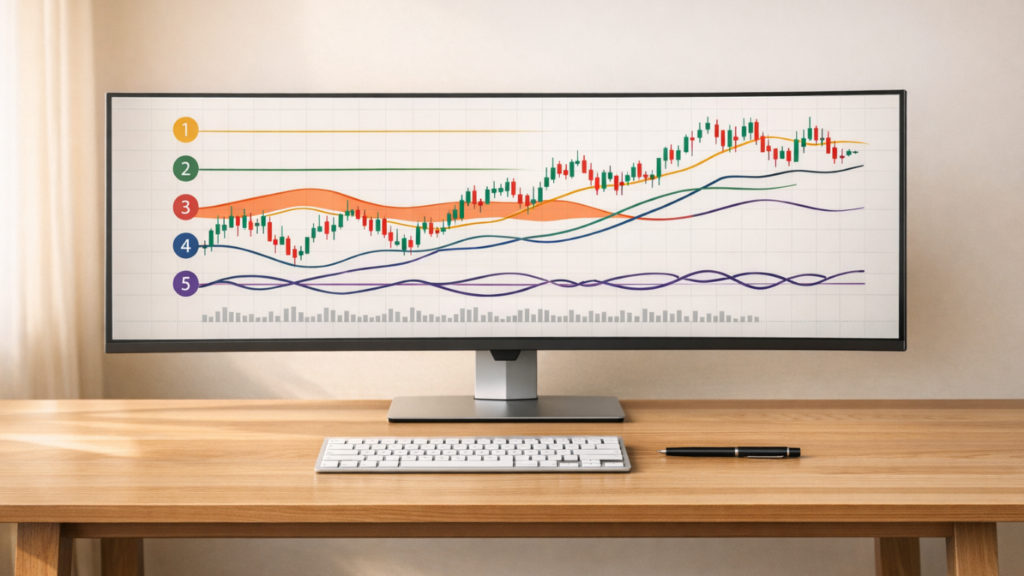
Want to make smarter stock trading decisions? Here’s a quick rundown of five essential technical indicators that can help you spot trends, assess momentum, and identify trading opportunities. These tools transform raw market data into actionable insights, helping you make informed decisions while reducing emotional bias.
Key Takeaways:
- Moving Averages: Smooth out price movements to reveal trends. Use tools like the 50-day or 200-day SMA for longer trends or shorter EMAs for quick momentum shifts.
- Relative Strength Index (RSI): Measures momentum and identifies overbought or oversold conditions. Look for readings above 70 (overbought) or below 30 (oversold).
- MACD (Moving Average Convergence Divergence): Tracks momentum and trend changes through crossovers and histograms.
- Bollinger Bands: Highlights volatility and potential breakouts using a 20-day SMA with bands set at two standard deviations.
- Accumulation/Distribution Line: Analyses volume flow to confirm trends and detect divergences between price and volume.
Why Use These Indicators?
- Combine trend, momentum, and volume-based tools.
- Filter stocks systematically for better trading opportunities.
- Reduce noise and improve consistency in your trading strategies.
For example, pairing moving averages with RSI can help spot “buy-the-dip” opportunities. Learn how to use indicators in trading effectively to make data-driven trades.
Master Systematic Trading with Collin Seow
Learn proven trading strategies, improve your market timing, and achieve financial success with our expert-led courses and resources.
How to Screen Stocks Using Technical and Fundamental Metrics
sbb-itb-466c9b0
1. Moving Averages
Moving averages are a tool that helps smooth out daily price movements, making it easier to spot the actual trend of a stock. By filtering out short-term noise, they allow traders to see the bigger picture of price direction.
There are two primary types: the Simple Moving Average (SMA), which calculates the average price over a specific period, and the Exponential Moving Average (EMA), which gives more weight to recent prices. As Oli Robertson, Market Analyst at IG, puts it:
“An EMA is a variation of the moving average that gives more weight to recent prices, making it more responsive to new information.”
Trend Identification
A stock’s position relative to its moving average can reveal its trend. If the price is above the moving average, the stock is often in an uptrend; if it’s below, a downtrend may be underway. The slope of the moving average also adds context – an upward slope supports bullish momentum, while a downward slope indicates bearish conditions.
For traders in Singapore analysing SGX stocks or global markets, the 50-day SMA is a common starting point to assess the overall trend. Long-term investors might prefer the 200-day moving average to identify broader structural trends. Meanwhile, day traders often rely on shorter EMAs, such as the 9-period or 21-period, to track quick momentum changes. These moving averages provide a clear framework for understanding market trends. This is a core component of systematic trading strategies.
Momentum Analysis
Moving averages are also valuable for assessing momentum. The gap between different moving averages, which forms the basis of indicators like the MACD, reflects the strength of momentum. Crossovers between short- and long-term moving averages can signal potential buy or sell opportunities. However, while shorter averages may provide early signals, they can sometimes lead to false alarms compared to the steadier signals from longer-period averages.
2. Relative Strength Index (RSI)
The Relative Strength Index (RSI), developed by J. Welles Wilder, is a momentum oscillator that ranges from 0 to 100. It evaluates price movements over a standard 14-day period by comparing recent gains to recent losses. This makes it a handy tool for identifying momentum shifts in the market.
Momentum Analysis
RSI is particularly effective in identifying extreme momentum conditions. When the RSI moves above 70, it generally signals that a stock might be overbought, hinting that prices could have risen too quickly. On the other hand, a reading below 30 suggests the stock might be oversold, indicating a potential rebound. However, in strong uptrends, RSI can remain above 70 without necessarily signalling an immediate reversal. Similarly, during downtrends, it often stays below 60. For traders in Singapore analysing SGX stocks or global equities, waiting for the RSI to climb back above 30 can help confirm a potential reversal.
Trend Identification
RSI isn’t just for spotting extremes – it’s also a good indicator of overall trend strength. The 50-level acts as a dividing line: values above 50 typically point to bullish momentum, while values below 50 suggest bearish pressure. Traders often use RSI as a filter when screening stocks. For instance, an RSI crossing above 50 may indicate a shift towards positive momentum, while readings between 0 and 30 can highlight possible deep-value opportunities.
Another useful signal is divergence. Bearish divergence happens when prices hit new highs, but the RSI forms lower highs, signalling weakening momentum. To improve accuracy, traders often combine RSI with other indicators like volume spikes or MACD crossovers. This approach helps filter out false signals, making it easier to identify trades with higher potential.
3. Moving Average Convergence Divergence (MACD)
The Moving Average Convergence Divergence (MACD) is a momentum indicator that follows trends, helping traders identify changes in market strength, direction, and momentum. It is made up of three key components: the MACD line (calculated by subtracting the 26-day EMA from the 12-day EMA), the signal line (a 9-day EMA of the MACD line), and the histogram, which represents the difference between the MACD and signal lines.
Trend Identification
The zero line plays a crucial role in spotting trend changes. When the MACD line crosses above the zero line, it indicates a bullish trend, while a move below signals bearish momentum. Crossovers that occur further away from the zero line are often seen as stronger signals. For traders analysing SGX stocks or global equities, this crossover is a popular tool to identify stocks entering new trends. Once a trend is identified, the histogram can provide further insights into momentum strength.
Momentum Analysis
The histogram is a visual representation of momentum. When the bars expand, it suggests momentum is picking up; when they contract, it indicates weakening momentum. Jasper Osita from ACY Securities explains:
“A steep MACD line means momentum is strong. A flattening MACD line means momentum is slowing – even if price is still moving.”
Traders often monitor the histogram for narrowing bars, as this can signal momentum exhaustion before a crossover occurs, giving them an early warning.
MACD is most effective in trending markets, as it can produce misleading signals in sideways or choppy conditions. To improve accuracy, traders commonly combine MACD with other indicators. For example, the Average Directional Index (ADX) is often used alongside MACD; an ADX reading above 25 confirms a trend, while a reading below 20 suggests the absence of one. Pairing MACD with volume indicators or oscillators like the RSI can also provide additional confirmation. These combinations make MACD a versatile tool for systematic stock screening across SGX and global markets.
For more tips on using MACD in your trading strategies, check out the free resources at Collin Seow Trading Academy (https://collinseow.com).
4. Bollinger Bands
Bollinger Bands add a layer of volatility analysis to trend and momentum indicators, making them a valuable tool for stock screening. They consist of a 20-day Simple Moving Average (SMA) flanked by two outer bands set at two standard deviations from the SMA. This setup helps traders assess market volatility, whether for stocks on the SGX or global markets.
Volatility Detection
The distance between the bands reflects a stock’s volatility. When the bands narrow significantly – a condition called a “squeeze” – it indicates low volatility, which often precedes a sharp price movement as volatility tends to normalise. Traders can use the Bollinger BandWidth indicator to spot stocks experiencing a squeeze (where the bands are at their narrowest over a six-month period), potentially identifying opportunities for significant price shifts. On average, Bollinger Bands encompass about 88–89% of price movements.
Trend Identification
The middle band, or the 20-day SMA, serves as a trend indicator. A rising middle band suggests an uptrend, while a falling one points to a downtrend. If a stock’s price frequently touches or stays near the upper band – known as “walking the bands” – it signals a strong, sustained trend. This behaviour is particularly useful for identifying momentum stocks on the SGX.
Momentum Analysis
Momentum shifts can also be analysed using Bollinger Bands. For instance, if a stock hits a new high but doesn’t reach the upper band after previously touching it, it may signal weakening momentum. Another pattern to watch for is the W-bottom, where a second low stays above the lower band despite a lower price. However, John Bollinger, the creator of the indicator, offers this caution:
“There is absolutely nothing about a tag of a band that in and of itself is a signal”.
This means traders should wait for confirmation through chart patterns or complementary indicators like the Relative Strength Index (RSI). Adding volume analysis can further refine the accuracy of these signals.
Volume Confirmation
While Bollinger Bands are price-focused, combining them with volume analysis can enhance decision-making. A breakout beyond the bands accompanied by high trading volume often signals the beginning of a strong trend. For short-term strategies, consider using a 10-day SMA with 1.5 standard deviations. For longer-term positions, a 50-day SMA with 2.5 standard deviations may be more suitable. When paired with volume insights, Bollinger Bands become a powerful tool for systematic stock screening.
5. Accumulation/Distribution Line
The Accumulation/Distribution Line (A/D Line) takes a different approach compared to other indicators that focus on price trends or volatility. By incorporating volume flow, it uncovers market pressure that might not be immediately obvious. Developed by Marc Chaikin, this tool measures whether money is moving into or out of a stock by analysing where the closing price falls within the day’s high-low range.
Volume Confirmation
Unlike the On-Balance Volume (OBV) indicator, which simply adds or subtracts volume based on price direction, the A/D Line uses a Money Flow Multiplier to capture more nuanced shifts in volume. This multiplier ranges from +1 to -1, depending on where the stock closes within its daily range. A close near the high corresponds to a multiplier close to +1, signalling accumulation, while a close near the low approaches -1, indicating distribution. A midpoint close results in a multiplier near 0.50. This method provides deeper insights into buying or selling pressure that might not be visible on basic charts.
Trend Identification
The A/D Line is particularly useful for confirming trends. When both the price and the A/D Line rise together, it signals strong buying pressure that supports the uptrend. For example, in August 2008, Kellogg Co. (K) showcased this relationship. Even after a slight price drop on 11 August 2008, the A/D Line continued to indicate strength, accurately predicting a price recovery. Similarly, Pfizer Inc. (PFE) demonstrated how the A/D Line can validate both upward and downward trends. During August 2008, it even led price action early in the month. For traders analysing SGX stocks, these confirmations can help assess trend reliability before making investment decisions and stock picks.
Momentum Analysis
Divergences between the A/D Line and price can act as early warning signs of weakening momentum. A classic example is Southwest Airlines (LUV). In this case, the A/D Line peaked in March and April, two months before the stock’s price reached its high. This divergence signalled underlying selling pressure, which was later confirmed when the stock broke its support level. For SGX traders, if a stock’s price hits new highs while the A/D Line declines, it suggests weak volume support and a potential bearish divergence.
However, the A/D Line works best when combined with other tools. Pairing it with momentum oscillators like the Relative Strength Index (RSI) or the Money Flow Index (MFI) can provide additional insights. For instance, an MFI reading above 80 indicates overbought conditions, while a reading below 20 suggests oversold levels. As Deepvue aptly puts it:
“Volume precedes price. If ADL is whispering before price starts shouting, pay attention”.
How to Use Technical Indicators in Stock Screening
After reviewing individual indicators, the next step is integrating them for effective stock screening.
A solid stock screening strategy often combines indicators from different categories. For example, pairing a trend-following tool like moving averages with a momentum oscillator such as the Relative Strength Index (RSI) can help cut through market noise and confirm trend directions.
Start by filtering for stocks trading above their 50-day or 200-day moving average. For stocks in an uptrend, look for an RSI below 40 or an RSI crossing above 30 – both can highlight potential “buy-the-dip” opportunities. Another option is screening for stocks above the 50-day moving average where the RSI crosses above 50, which could signal building bullish momentum. This method underscores the complementary nature of trend and momentum indicators.
A great example of this strategy in action occurred on 15 April 2026. Microsoft (MSFT) demonstrated a “Fast Bullish Crossover”, with its stock price climbing 4.6% to US$411.22. Notably, this was above both its 20-day and 50-day moving averages, even as those averages still signalled a bearish trend – an early sign of a potential reversal. Tesla (TSLA) also showed impressive bullish momentum that day, jumping 7.6% to US$391.95 and breaking resistance levels identified through standard deviation screening.
To strengthen signals from moving average and RSI crossovers, confirm breakouts with higher-than-average trading volume.
For a systematic approach, consider resources like Market Timing 101, a free e-course from Collin Seow Trading Academy (https://collinseow.com), which offers guidance on precise entry and exit timing.
“Successful traders typically combine two to four complementary indicators rather than relying on a single signal.” – Investopedia
This structured method lays the groundwork for refining your trading strategies further.
Conclusion
The five key indicators we’ve discussed play a crucial role in systematic stock screening, including sector-based stock screening, offering traders a disciplined way to make informed decisions.
Technical indicators simplify raw data into actionable signals, helping traders focus on significant market movements. Instead of manually analysing countless charts, screeners can filter stocks based on specific parameters – like identifying stocks where the 10-day moving average crosses above the 50-day moving average. This method provides a data-driven foundation for trading decisions, reducing emotional bias and promoting consistency.
For best results, combine two to four complementary indicators. For example, use trend tools like moving averages alongside momentum oscillators such as RSI, and confirm trends with volume filters. This combination creates a solid framework for market analysis and trading strategies. As Investopedia notes, technical indicators are invaluable for turning complex data into actionable insights.
For traders in Singapore, practical tools and courses are readily available. The Collin Seow Trading Academy (https://collinseow.com) offers resources like the free Market Timing 101 e-course, which teaches precise entry and exit strategies using technical indicators. The Systematic Trading Profits webclass provides a complete guide on what to buy, when to buy, and how much to buy. Additionally, the academy’s TradersGPS system integrates screeners and technical indicators to identify high-potential trades, particularly within the SGX market. These resources bridge the gap between theory and real-world application, equipping traders with actionable strategies.
As Collin Seow wisely puts it:
“Success in trading is not just about making decisions; it’s about making informed decisions”.
To get started, test these strategies on a demo account to understand how indicators behave in live markets. Start with a minimal set of indicators, confirm signals with volume, and stick to a systematic and disciplined trading approach.
FAQs
How do I choose the best timeframe for each indicator?
The timeframe you choose should align with your trading style and objectives. For instance, shorter timeframes like 1-minute or 5-minute charts are ideal for day traders who thrive on quick market movements. On the other hand, longer timeframes such as daily or weekly charts cater more to swing traders or long-term investors aiming to capitalise on broader trends.
It’s also worth noting that certain indicators are more effective on specific timeframes. For example, momentum indicators like the Relative Strength Index (RSI) tend to work well on shorter charts, offering insights into rapid price changes. Meanwhile, trend-following tools like the Moving Average Convergence Divergence (MACD) are better suited for longer timeframes, helping to identify sustained market trends.
Ultimately, testing different combinations of timeframes and indicators is key to finding what complements your strategy best.
Which 2–4 indicators work best together for stock screening?
When choosing indicators, it’s best to combine 2 to 4 complementary tools to keep your analysis efficient and avoid unnecessary overlap. For instance, pairing a trend-following indicator like the MACD with momentum indicators such as the RSI or Stochastic Oscillator can be highly effective. The MACD helps spot trends and shifts in momentum, while RSI or Stochastic focuses on identifying overbought or oversold levels.
To keep your strategy balanced, avoid using multiple indicators of the same type, as they often provide similar signals. Instead, mix tools from different categories – like trend, momentum, and volatility indicators – for a more comprehensive view. This approach ensures a well-rounded analysis without cluttering your charts.
How can I avoid false signals in sideways markets?
In sideways markets, it’s easy to get caught out by false signals. To navigate these conditions effectively, focus on strategies tailored for range-bound trading. For instance, concentrate on trading between support and resistance levels, where prices tend to bounce back and forth.
Avoid relying on trend-following strategies – they often struggle in this type of market. Instead, turn to indicators that help filter out misleading signals, ensuring your decisions are more informed.
Keep in mind that sideways markets usually involve smaller, more frequent price movements, so adjust your expectations accordingly. Lastly, disciplined risk management is key – this helps minimise potential losses and keeps your decision-making sharp in these challenging conditions.