
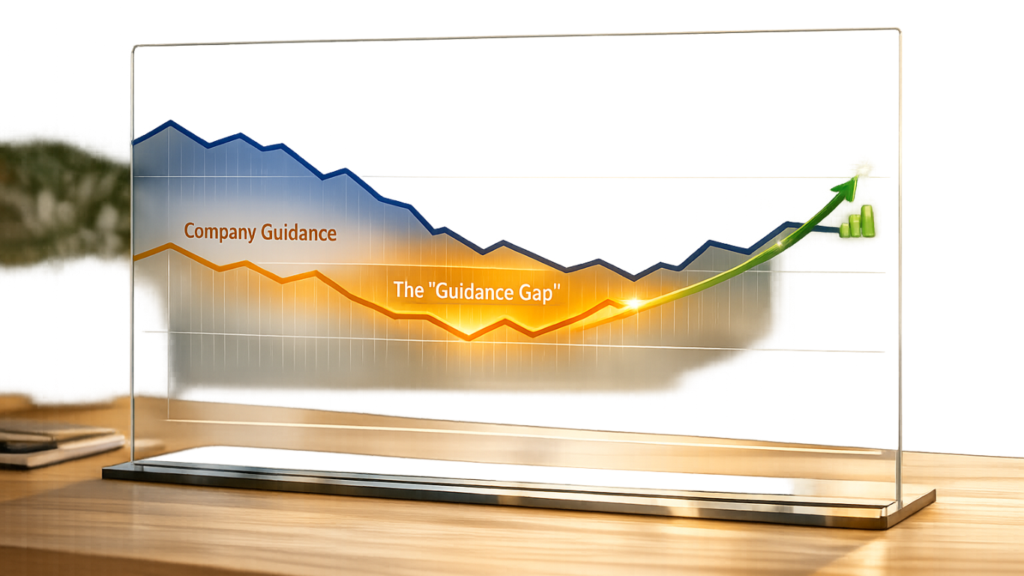
When companies release financial results, two numbers matter most: earnings guidance (what the company predicts for its future performance) and market expectations (what analysts forecast). These numbers often don’t align, creating opportunities and risks for traders. Here’s a quick breakdown:
- Earnings Guidance: Forecasts from company management based on internal data. Shared quarterly or during special updates.
- Market Expectations: Analyst predictions based on public information and trends. Constantly updated as new data emerges.
- Key Differences:
- Source: Guidance comes from the company; expectations come from external analysts.
- Frequency: Guidance is updated quarterly; expectations change continuously.
- Focus: Guidance is company-specific; expectations include broader market factors.
Stock prices often react more to future projections than past results. For example, even if a company beats current earnings, lower guidance can lead to a price drop. Traders can use this information to spot opportunities by tracking guidance, analyst revisions, and market sentiment.
Quick Tip: Look for patterns in guidance and analyst updates to anticipate stock movements during earnings season.
Master Systematic Trading with Collin Seow
Learn proven trading strategies, improve your market timing, and achieve financial success with our expert-led courses and resources.
Main Differences Between Earnings Guidance and Market Expectations
Sources and Data Access
The primary distinction lies in who provides the information and what data they use. Earnings guidance comes straight from a company’s leadership – typically the CEO and CFO – who rely on internal, non-public data. This might include real-time sales numbers, signed contracts, production schedules, or customer commitments. Essentially, it offers a direct window into the company’s current operations.
On the other hand, market expectations are shaped by securities analysts working for brokerage firms like JPMorgan or Morgan Stanley. These analysts use publicly available information, such as financial filings, industry reports, macroeconomic trends, and even channel checks, to form their forecasts.
Update Frequency and Scope
Timing is another key difference between the two. Companies generally release earnings guidance on a quarterly basis, often alongside their financial results or during special investor presentations [5,7]. Once issued, this guidance remains unchanged until the next update.
In contrast, analyst estimates are constantly evolving. As new information – like economic data, industry developments, or company announcements – becomes available, analysts adjust their models. These updates can happen within 24 to 72 hours of new guidance being released. This ongoing revision process, sometimes called “revision velocity”, makes market expectations much more fluid than company-issued guidance.
The scope of these forecasts also varies. Earnings guidance is narrowly focused on company-specific metrics, such as revenue targets, earnings per share, or capital expenditures. Market expectations, however, take a broader view. They consider factors like competitor performance, supply chain issues, and overarching economic conditions.
Comparison Table: Key Differences
| Aspect | Earnings Guidance | Market Expectations (Consensus) |
|---|---|---|
| Primary Source | Company Management (Internal) | Securities Analysts (External) |
| Data Access | Proprietary internal data | Public filings, macro data, channel checks |
| Update Frequency | Quarterly or ad hoc | Continuously revised |
| Scope | Specific company performance and targets | Broader industry and market trends |
| Format | Often presented as a range (e.g., S$2.50–S$2.70) | Average of individual analyst estimates |
| Legal Status | Protected by Safe Harbour (PSLRA) | Treated as professional opinions |
| Regulatory Framework | Governed by Regulation Fair Disclosure (Reg FD) | No formal regulatory requirements |
These differences highlight why stock prices can experience sharp movements when company-issued guidance and analyst-driven expectations don’t align.
sbb-itb-466c9b0
Impact on Stock Performance and Trading Strategies
How Stocks React to Earnings Guidance vs Market Expectations
When companies report earnings, stock prices hinge on two main factors. First, there’s the analyst consensus, which reflects market expectations for the current quarter. If a company misses these estimates, its stock price often takes a steep dive. On the other hand, beating expectations typically results in a price increase.
However, forward guidance – what the company projects for the future – can have an even bigger impact. Even if a company beats current estimates, lowering future projections can lead to a decline in stock price.
Take the “beat-and-raise” scenario: when a company exceeds expectations for revenue and earnings per share (EPS) while also raising future guidance, it usually sparks a strong rally in its stock price. Conversely, a “miss-and-lower” situation – falling short of expectations and cutting projections – signals deeper issues and often prompts a sharp market reaction. Interestingly, markets tend to penalise negative surprises more harshly than they reward positive ones of the same scale. A notable example occurred in July 2022 with Snap Inc. Despite meeting Q2 EPS estimates, the company significantly reduced its revenue guidance, causing its stock to plunge by about 25% in after-hours trading.
These dynamics highlight the importance of forward guidance in shaping stock performance and set the stage for understanding volatility and trading strategies.
Post-Earnings Volatility and Investor Confidence
When there’s a big gap between earnings guidance and market expectations, volatility often surges, and investor sentiment can shift dramatically. This reflects a broader market focus on future performance rather than past results. A lowered guidance doesn’t just revise numbers – it can also undermine confidence in management’s ability to predict the company’s future. This creates a form of information asymmetry, where insiders know more than the market, leading to sharp price swings as expectations realign.
Interestingly, analyst forecasts tend to align closely with actual earnings. Research on Post-Earnings Announcement Drift (PEAD) reveals that stocks with positive surprises often outperform for weeks after the announcement, while those with negative surprises underperform. However, not all earnings beats are created equal. For instance, a beat driven by cost-cutting rather than revenue growth sends a weaker signal, leaving investors wary about the long-term outlook.
This volatility creates opportunities for traders to deploy specific systematic trading strategies, which we’ll explore next.
Trading Strategies Around Earnings Announcements
Traders who understand the interplay between earnings guidance and market expectations can position themselves more effectively. One simple yet effective approach is to monitor the dispersion of analyst estimates. A wider spread often signals potential volatility.
Some seasoned traders prefer to wait a day or two after the earnings release before making any moves. This delay helps avoid the risk of overnight price gaps and allows the market to settle into a clearer trend, known as consolidation. Using the pre-earnings price as a stop-loss can also provide a safety net.
Another key strategy involves tracking how quickly analysts revise their estimates after new guidance is issued. Rapid downward revisions can signal an impending guidance cut, serving as an early warning. Meanwhile, companies that habitually set low guidance to ensure they beat expectations often see this behaviour already factored into their stock price, which can limit the upside of future positive surprises .
Options traders face a unique challenge with “volatility crush.” Implied volatility tends to rise sharply before earnings announcements but drops just as quickly afterward. This decline can erode the value of options even if the stock moves as expected. Being aware of this dynamic is critical for managing options strategies around earnings.
| Scenario | Current Quarter Result | Future Guidance | Typical Market Response |
|---|---|---|---|
| Beat and Raise | Above Consensus | Raised Above Consensus | Strongly Positive |
| Beat and Maintain | Above Consensus | Unchanged | Modestly Positive |
| Beat and Lower | Above Consensus | Lowered | Negative |
| Miss and Lower | Below Consensus | Lowered | Strongly Negative |
| Miss and Raise | Below Consensus | Raised | Mixed/Positive (Recovery) |
Using Differences Between Guidance and Expectations for a Trading Edge
Building on how earnings surprises influence stock performance, this section explores how traders can leverage divergences between internal guidance and external expectations to gain an edge.
Finding Opportunities from Divergences
The gap between a company’s internal earnings guidance and external analyst expectations can highlight trading opportunities. For example:
- When guidance exceeds consensus estimates, it could indicate that the market hasn’t fully adjusted its sentiment, creating a potential buying opportunity.
- When guidance falls short of expectations, it may signal caution or even present a short-selling opportunity.
Another useful signal is revision velocity, which refers to how quickly analysts revise their estimates in the weeks leading up to an earnings announcement. Sharp changes can serve as early warning signs. Additionally, professional investors often rely on the unofficial “whisper number”, which is typically higher than published consensus estimates. If a company beats the consensus but misses the whisper number, its stock may still decline as a result.
Dispersion, or the range between the highest and lowest analyst estimates, is another key factor. Most analyst forecasts fall within ±S$0.04 of actual earnings, but a wider range suggests genuine uncertainty about the company’s prospects. Such divergence signals can be systematically tracked to refine trading models.
Adding This to Systematic Trading Strategies
Traders can incorporate divergence insights into systematic strategies by tracking patterns in quarterly guidance, consensus estimates, and historical beat/miss data. For instance, identifying companies with a history of consistently conservative guidance can help anticipate earnings beats, even if the upside potential diminishes over time.
Monitoring official filings like Form 8-K (specifically Item 2.02) can also provide an edge. These documents often include regulated management outlooks, and analysts typically update their models within 24 to 72 hours after new guidance is released. This makes these filings a valuable early signal of changing expectations.
To strengthen these strategies, traders can pair divergence insights with quality metrics such as free cash flow and return on invested capital. This ensures that earnings growth is supported by sustainable business performance rather than temporary cost-cutting measures. By combining these elements, traders can position themselves more effectively ahead of earnings announcements.
Practical Example: Pre-Earnings Positioning
Take the example of Wells Fargo in April 2026. The bank reported Q1 earnings of S$5.3 billion, up 7% year-on-year, alongside revenue of S$21.4 billion, a 6% increase from the previous year. This growth followed the removal of regulatory asset caps. Management reaffirmed its full-year 2026 guidance for net interest income at approximately S$50 billion. In response, Phillip Securities Research upgraded the stock to a “BUY” with a target price of S$98, citing strong operational performance supporting the guidance.
This example illustrates how steady guidance, underpinned by solid fundamentals, can provide a lower-risk entry point. Traders can apply systematic checks to better time their entries and exits around earnings announcements. To manage risk, it’s often wise to wait a day or two after the earnings release to let initial volatility settle. Additionally, focus on earnings beats driven by sustainable revenue growth rather than one-off measures like cost cuts, as revenue-driven beats are more likely to sustain momentum.
Conclusion and Key Takeaways
Summary of Earnings Guidance vs Market Expectations
Earnings guidance represents a company’s internal forecast, typically shared quarterly by its management team. On the other hand, market expectations are dynamic estimates, frequently updated by analysts based on publicly available data. While guidance reflects the company’s internal insights, consensus estimates offer a broader, external perspective.
This dynamic between the two shapes the “earnings game”, a key driver of stock movements. As the StockTitan Research Team explains:
The two numbers that move stocks most aren’t what happened last quarter – they’re what everyone expects will happen next quarter.
This forward-looking approach helps explain why a stock might drop even after exceeding past earnings if its future guidance disappoints.
Actionable Tips for Traders
Here are some practical strategies for traders to navigate earnings reports effectively:
- Track Guidance and Estimates: Keep a detailed record of quarterly guidance ranges, consensus estimates, and historical beat/miss trends. This can help identify stock picks from companies that often issue conservative forecasts, a practice sometimes called “sandbagging.”
- Watch Analyst Revisions: Pay attention to how analyst estimates change in the weeks before earnings announcements. A pattern of downward revisions may hint at management’s cautious outlook, even if not explicitly stated.
- Analyse Estimate Dispersion: Look at the gap between the highest and lowest analyst forecasts. For instance, about 88% of analyst projections fall within ±S$0.04 of actual earnings. Wider gaps could signal uncertainty and potential for significant post-earnings volatility.
- Go Beyond EPS: Don’t just focus on Earnings Per Share (EPS). Include other quality metrics like Free Cash Flow and Return on Invested Capital to ensure growth is sustainable and not simply the result of temporary cost cuts.
Learn More with Collin Seow Trading Academy

Mastering the relationship between earnings guidance and market expectations is only one piece of a well-rounded trading strategy. For those looking to deepen their understanding, Collin Seow Trading Academy provides a wealth of resources. From free e-courses like Market Timing 101 and Systematic Trading Profits to live webinars and the book The Systematic Trader v.2, there’s plenty to help traders build disciplined, emotion-free systems. Visit https://collinseow.com to gain the tools you need to trade with confidence and consistency.
FAQs
Why can a stock drop even after beating earnings?
A stock can still fall even after posting strong earnings. Why? Several reasons could be at play:
- Positive results already priced in: If investors had already anticipated the good news, the stock price might not move much – or could even drop – after the announcement.
- Disappointing guidance: Even with great earnings, if the company provides a weaker-than-expected outlook for future performance, it can dampen investor confidence.
- Revenue shortfall: Strong earnings don’t always mean strong revenue. If revenue misses expectations, it could signal underlying issues.
- Sector rotation: Sometimes, investors shift their focus to other industries or sectors, pulling money out of the stock even if the company performed well.
- High valuation: If the stock is already trading at a premium, there may not be much room for further growth, leading to a sell-off.
These factors highlight how market expectations and future outlooks play a big role in stock price movements.
How can I track analyst revisions before earnings?
To stay ahead of analyst revisions before earnings, keep an eye on changes in analyst estimates and company guidance. Pay close attention to updates in analyst consensus and management guidance – these offer valuable insights into market expectations and potential surprises. Watching how forecasts evolve over time can help you spot shifts in sentiment and emerging market trends. Some platforms even offer tools that highlight these revisions, making it easier for traders to predict possible market reactions after earnings announcements.
How are options affected by a post-earnings volatility crush?
After a company announces its earnings, options often experience what’s called a post-earnings volatility crush. This happens when implied volatility – the expected future price swings of the stock – drops significantly, sometimes by as much as 30-50% overnight. As a result, option premiums decrease sharply. This can lead to losses for traders, even if the stock moves in the predicted direction, because the drop in implied volatility can offset any gains from the stock’s movement.