On Thursday, 5 November, the Nasdaq Composite fell 5.52%, its worst day since April 2025, and closed more than 10% below its record high. The S&P 500 lost 4.36% on the same day.
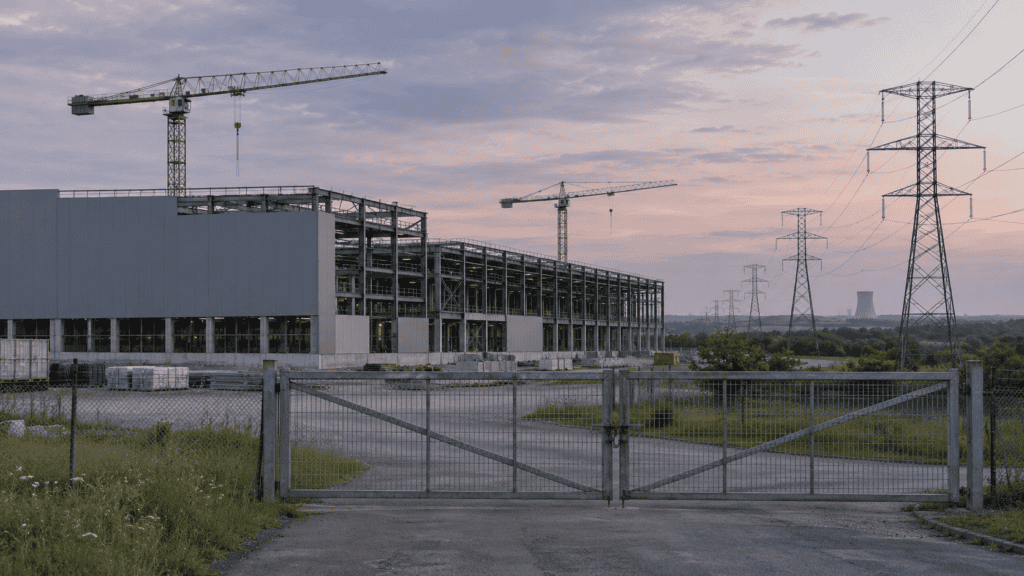
That drop came two days after Democrats won control of both houses of Congress in the US midterm elections, along with governorships in states where many of America’s AI data centres are being built. The link between those two events runs through one thing, which is how much of the Nasdaq now depends on that construction continuing.
What the election changed
The midterms were held on Tuesday, 3 November. Democrats won the House and the Senate, and took governorships in states with heavy data centre development, including Texas and Ohio.
Several of the winners campaigned directly against new data centres. In Texas, Gina Hinojosa defeated Governor Greg Abbott after promising a statewide pause on new data centre approvals, and in Ohio, governor-elect Amy Acton supports what she calls a conditional moratorium, under which data centres would have to cover all of their utility costs.
Voters also weighed in directly. Ballotpedia counted 41 local measures on data centres across 10 states, and voters sided with restrictions in nearly all of them, with the town of Harwood in North Dakota the one exception.
At the national level, Senator Bernie Sanders, who caucuses with the Democrats, has called for a national data centre moratorium, and a bill to pause new AI data centre construction was introduced earlier this year. With Democrats controlling Congress from January, investors had to consider whether proposals like that now had a better chance.
How the selloff unfolded

The first reaction was mixed. On Wednesday, the broader market rose, while the companies most tied to building new data centres fell. Power producer Vistra closed about 14% lower, and data centre operators such as CoreWeave also dropped.
The hyperscalers went the other way that day. These are the largest cloud companies, such as Amazon, Microsoft and Alphabet, which already own most of the data centres in operation, and Amazon and Microsoft were each up about 6% by midday. Some investors reasoned that fewer new data centres would make the existing ones more valuable and could slow Big Tech’s heavy AI spending.
By Thursday, the selling had spread to the chipmakers whose products fill those data centres. The Philadelphia Semiconductor Index fell 12.3%, its worst day since March 2020, Nvidia dropped 9.3%, and the hyperscalers turned lower as well. On the Nasdaq, almost five stocks fell for every one that rose.
The election was not the only pressure on these stocks, though. Chip and memory stocks were already well below their 2026 highs going into the week, and recent results from Alphabet and Amazon had already cooled some of the enthusiasm for Big Tech’s spending on AI data centres.
Why the Nasdaq is so exposed to this
The Nasdaq is weighted by company size, and many of its largest companies are now tied to AI in one way or another. That is why a question about building permits in Texas and Ohio can move the whole index.
Most of these companies are valued on years of expected spending. Chipmakers are priced on future orders for AI servers, data centre operators on facilities they have not finished building, and power companies on contracts for electricity that new data centres will need. If construction slows, each of those future revenue streams could arrive later or come in smaller.
Analysts put rough numbers on that risk after the vote. Goldman Sachs pointed to the high concentration of data centres in states that Democrats flipped, such as Texas and Ohio, and UBS estimated that around 30% of the US data centre capacity expected to come online in 2028 could be at risk from construction pauses.
No law has changed yet, and the reporting at the time described investors repricing the chance that the buildout runs slower than share prices had assumed.
What Washington has actually done so far
It helps to separate what the election signalled from what has happened since. The new Congress does not convene until January, and any national moratorium bill would face a possible presidential veto.
Since the election, Congress has held only one vote involving data centres. On Monday, 9 November, the Senate voted 73 to 25 to open debate on a bipartisan permitting bill, which would speed approvals for power plants and transmission lines while making large data centres pay more of the grid upgrades they need. That bill has backing from both parties, and its final passage is still uncertain.
The market has also partly recovered. The Nasdaq Composite rose 2.7% on Monday, 9 November, then slipped 0.74% on Tuesday after October’s inflation report came in hotter than expected and raised the odds of another Fed rate hike in December.
Two mistakes to avoid
Don’t trade the election result
Whether a moratorium passes, how far Texas goes in January, and whether the permitting bill reaches the President’s desk are all open questions. Building a position around your view of the answers means betting on politics, which is not what our system is designed to trade.
Don’t sell everything because of one bad Thursday
A day when almost five stocks fall for every one that rises pulls good charts down along with weak ones. One session can damage a weekly trend, but it does not decide it on its own, and the exit should come from your stop and your rules.
Sort your AI stocks by how much they depend on new construction
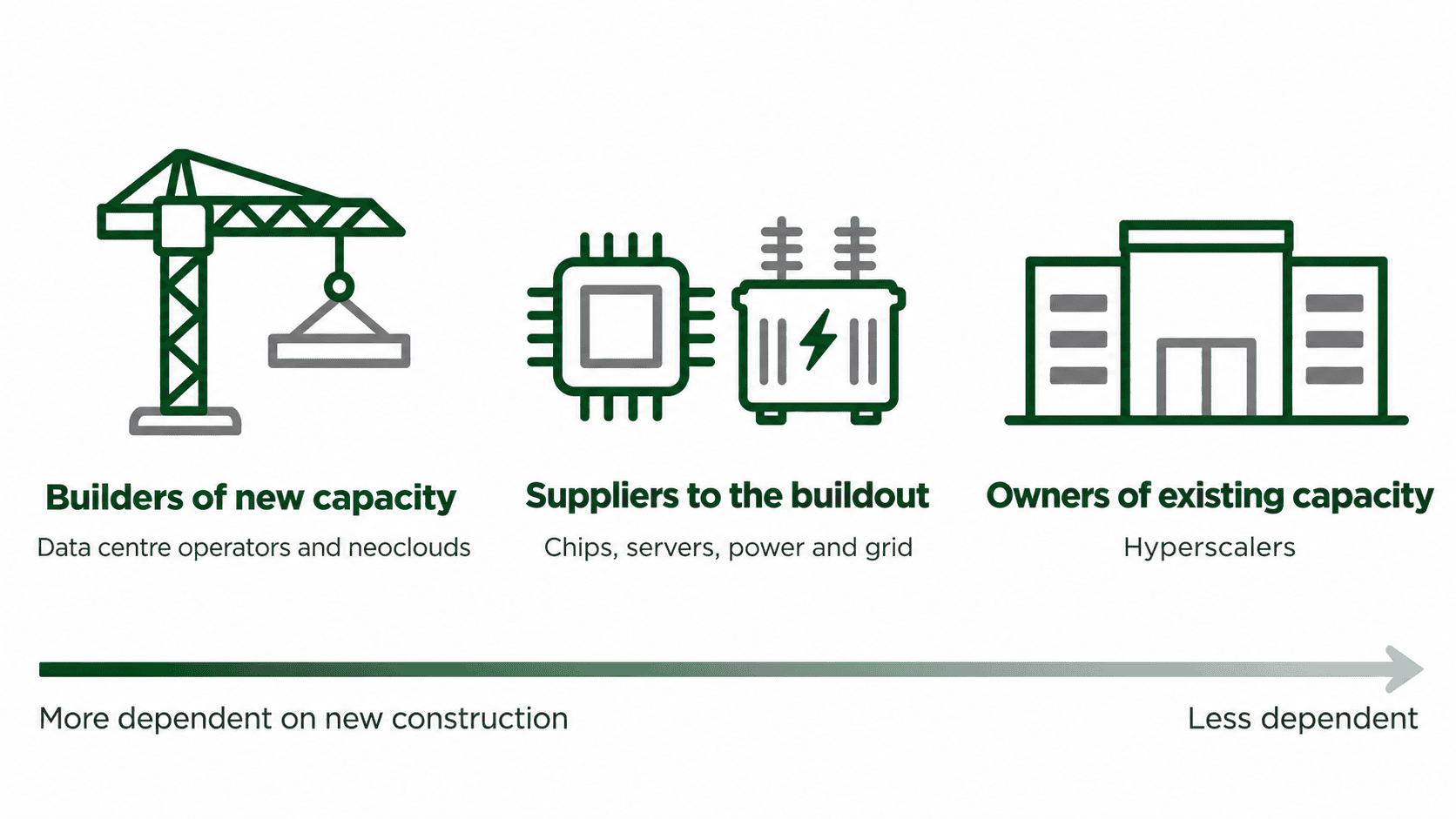
The election hit different parts of the AI trade in different ways, so sort your list before reading anything into a headline.
Builders of new capacity
These are the data centre operators and neoclouds, companies that rent out AI computing power from facilities they are still building, such as CoreWeave, Nebius and IREN. Their growth depends most directly on new sites being approved and finished, and they were among the biggest fallers on both days.
Suppliers to the buildout
This group includes chipmakers, server makers, and the companies supplying power and grid equipment, such as Nvidia, Dell, Vistra and GE Vernova. They get paid when new data centres place orders or sign power contracts, so a slower buildout would reach them a step later than the builders.
Owners of existing capacity
These are the hyperscalers, which already run large data centre fleets and generate cash from other businesses. They were the only one of these three groups that rose on Wednesday, and their exposure is mixed, since a slower buildout could lower their spending as well as limit their growth.
For each stock, check its relative strength in your screener, then compare it with its own sector and with the Nasdaq. A stock that held up better than its group through this selloff is showing you something different from one that fell further.
Let the chart make the decision
You don’t need a view on Congress or Texas to manage these stocks, because the weekly chart answers the trading question for you.
Has the weekly trend broken? If it has, the political argument no longer matters for the trade, so exit by your rules or check that your stop is where it should be.
Is the weekly trend still up after a week like this? Then the market has not yet treated the election as serious enough to change it, and momentum still has to confirm on your rules before there is a new entry.
A signal is a point where the rules say a defined risk is worth taking. Some signals work and some don’t, and the rules stay the same either way.
Nasdaq-100 (Position Weekly)
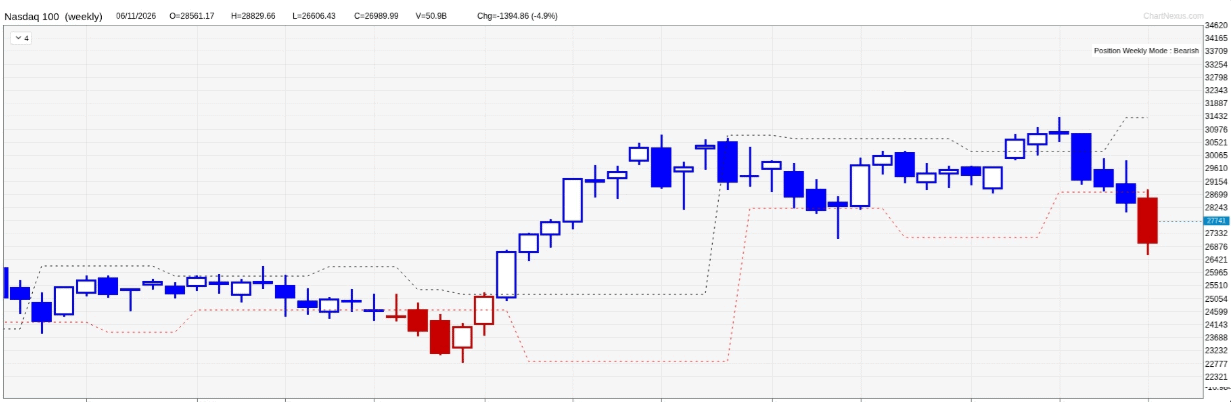
The Position Weekly candle turned from blue to red in the week ending 6 November 2026, which was the week of the midterm election. The week before had closed blue at about 28,385. The red week then opened at 28,560, slid to a low of about 26,610, which was 6.8% below the open, and closed at about 26,990, down 4.9% on the week.
Since Position Weekly is long-only, the red candle is a sell signal for anyone holding, not a signal to go short. Under our rules, that change from blue to red ends the uptrend that began in April, so a holder exits or checks that the stop is still where the system set it.
Nasdaq-100 (Position Daily)
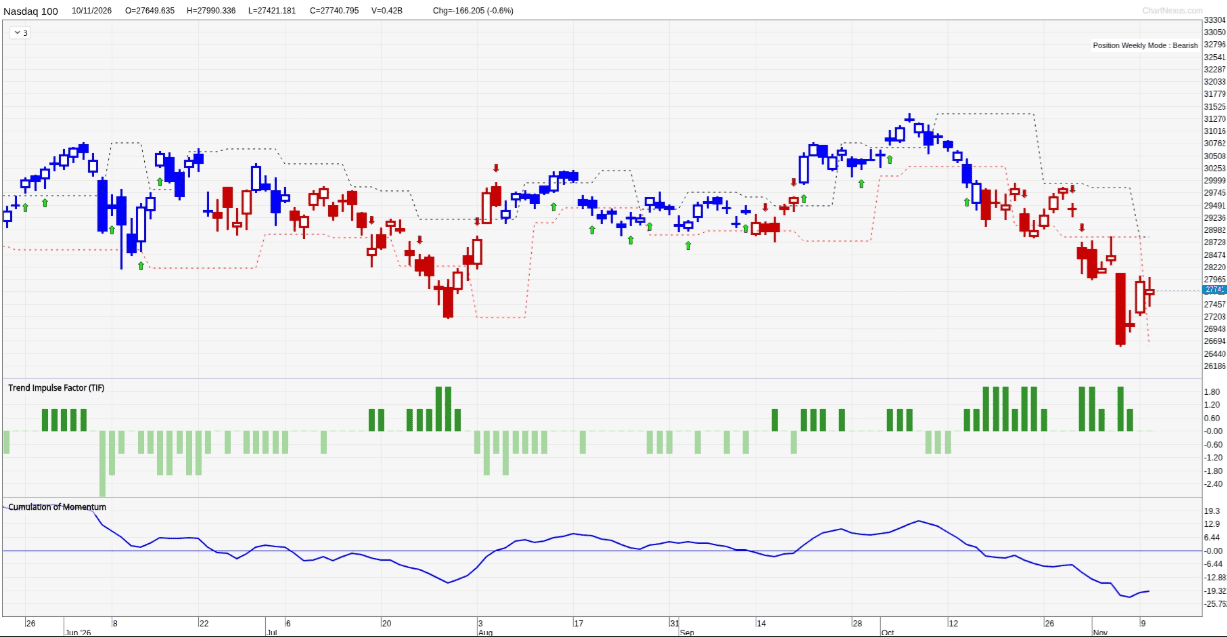
The daily chart gave its signal a few days earlier. A Position Daily sell arrow printed on Friday, 30 October, the last session before the vote, with the index closing at about 28,385. That put the sell-stop slightly below that day’s low of about 28,095, roughly 1.0% under the close.
On Monday, 2 November, the index dipped to about 27,970 and triggered the sell-stop before closing near 27,990, another 0.4% below the stop level. Because Position Daily trades both long and short, that triggered sell-stop opened a short at about 28,095, and by 10 November, with the index near 27,740, the short was about 1.3% in profit.
Not every daily signal works, and not every arrow becomes a trade. When one fails, we take the small loss at the stop, and nothing about the rules changes.
Nvidia Corp (Position Daily)
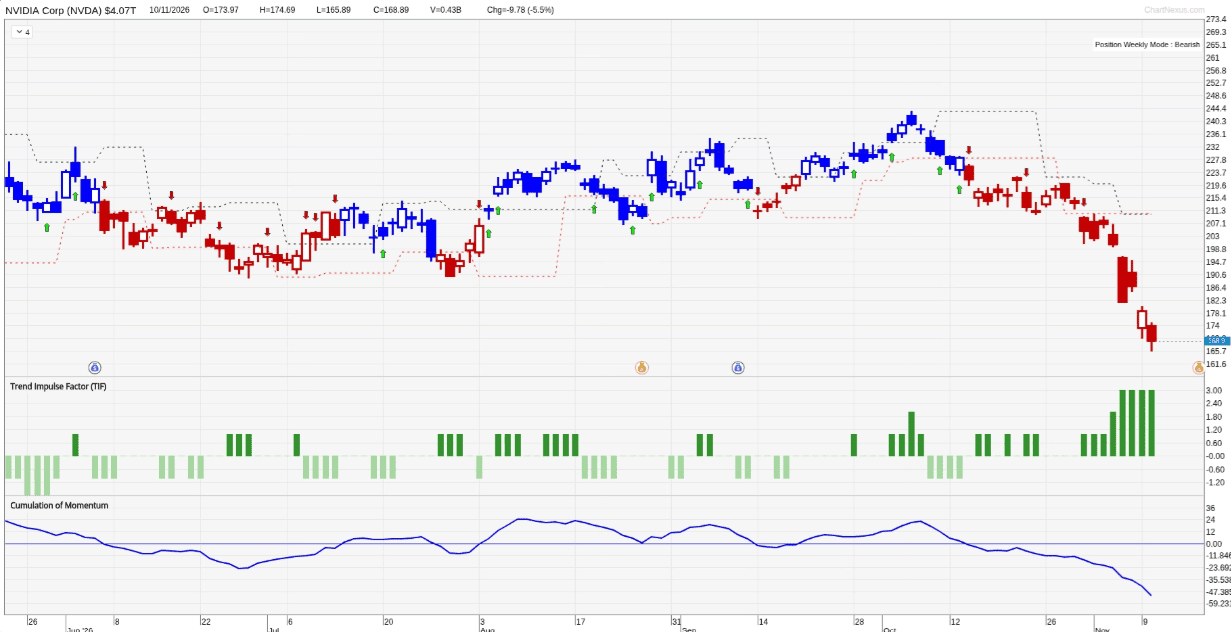
Nvidia printed its own Position Daily sell arrow on the same Friday, 30 October, closing at about 205 with a low of about 200.9. On Monday, 2 November, it fell only as far as about 201.7, which stayed above the sell-stop, and on Tuesday it held higher still, so by the rules the sell-stop moved up to just under each new day’s low while the signal remained valid.
On Wednesday, 4 November, Nvidia opened at about 203.5, already below the raised sell-stop, so the short filled at the open. The selling carried on through the week, with Nvidia falling as low as about 181.6 on Thursday, and its weekly candle turned red, closing at about 187. By 10 November, Nvidia had closed at about 168.9, leaving the short about 17% in profit.
What to watch in December
The Senate permitting bill
The Senate has voted to open debate, but the bill still needs a final Senate vote and a path through the House before Congress adjourns. If it passes, data centres would carry more of their own grid costs, and if it stalls, the question moves to the new Congress in January.
PJM’s December capacity auction
PJM, the largest power grid in the US, holds its next capacity auction from 9 to 15 December, with results due on 22 December. A result at the price cap would suggest power for data centres is still scarce, while a result below the cap could suggest expected demand is easing.
The Fed meeting on 8 and 9 December
The decision is due at 3:00 a.m. Singapore time on Thursday, 10 December. Another hike could add pressure on growth stocks that are valued on future earnings, while a hold could ease some of it.
Each of these matters only if it changes the weekly trend, and the chart will show you when it does.
You don’t need to predict what Congress does with data centres when your trading rules already tell you what to do.
–
If this article helped you understand the market, the next step is seeing how to put that knowledge to work.
Watch my 3-step trading process LIVE: find promising stocks, plan when to buy and sell, and decide how much to risk before placing a trade.
It’s the same approach I’ve used to trade systematically and generate monthly returns over the past five years. Click the banner below to learn more.