
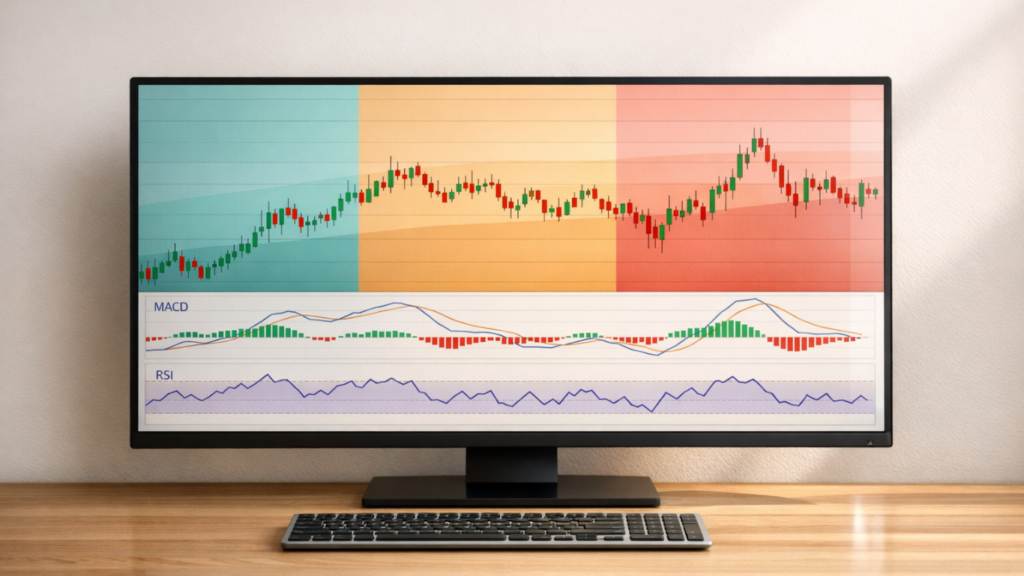
When trading, MACD and RSI are two of the most commonly used indicators in trading to analyse price movement. Here’s the key difference:
- MACD is better for spotting trends and momentum in trending markets.
- RSI works best in range-bound markets to identify overbought or oversold conditions.
Both indicators serve different purposes, but combining them can create stronger trading signals. For example, RSI can signal a potential reversal, while MACD confirms the trend.
Quick Comparison
| Feature | MACD | RSI |
|---|---|---|
| Best For | Trending markets | Range-bound markets |
| Key Strength | Confirms trend direction and momentum | Identifies overbought/oversold zones |
| Limitation | Lags in volatile markets | May generate false signals in trends |
| Market Use Case | Momentum tracking | Timing reversals |
Pro Tip: Use MACD for trend confirmation and RSI for entry/exit timing to avoid misleading signals.
MACD in Trending Markets
How MACD Identifies Trends
The MACD is a tool that measures trend momentum by analysing key EMA (Exponential Moving Average) crossovers. When the MACD line crosses above the 9-period EMA, it signals bullish momentum. Conversely, a crossover below it points to bearish momentum, helping traders spot potential trend changes.
The zero line serves as a dividing line for trend direction. Positive MACD values suggest bullish momentum, while negative values indicate bearish momentum. The distance between the EMAs reflects the trend’s strength – a larger gap signals stronger momentum.
Divergence is another critical signal, often hinting at a potential trend reversal. This occurs when prices continue to hit new highs or lows, but the MACD fails to follow the same pattern. In trending markets, the MACD histogram’s expansion or contraction provides additional clues about whether momentum is picking up or slowing down.
These signals set the stage for applying systematic trading strategies to improve reliability when trading in trending markets.
Best Practices for Using MACD in Trends
To make MACD signals more effective, pairing them with the Average Directional Index (ADX) can help filter out noise. For instance, MACD signals are more trustworthy when the ADX reads above 25, as this confirms a strong trend. On the other hand, readings below 20 typically suggest a sideways market.
“In strong trends, MACD helps confirm continuation. In sideways markets, MACD can produce frequent false signals.” – Erwanto Khusuma, Gotrade Team
Pay attention to the MACD histogram. Widening bars often indicate accelerating price momentum. Adding a 200-day Simple Moving Average to your analysis can also ensure your trades align with the broader market trend. Additionally, MACD crossovers are generally more reliable when they align with the dominant trend rather than opposing it.
Limitations of MACD in Trending Markets
Despite its usefulness, MACD has its drawbacks. Since it relies on past price data, it’s a lagging indicator. This means signals often appear after a significant price move has already occurred. For example, zero-line crossovers tend to be slow, with prices potentially moving substantially before the signal confirms the trend.
In consolidation phases, MACD can drift toward the zero line, leading to misleading divergence signals. It also doesn’t provide specific price levels for setting stop-loss or take-profit orders, making it necessary to use additional risk management tools.
“A slowdown in the momentum – sideways movement or slow trending movement – of the price will cause MACD to pull away from its prior extremes and gravitate towards the zero lines even in the absence of a true reversal.” – Investopedia
While MACD is effective for validating trends, its lagging nature means traders should pair it with other strategies for better risk management.
sbb-itb-466c9b0
RSI in Ranging Markets
How RSI Detects Overbought and Oversold Levels
The Relative Strength Index (RSI) is a tool that measures average price gains and losses over a 14-period cycle, plotting its values on a scale from 0 to 100. In range-bound markets, this indicator focuses on recent highs and lows, helping traders spot potential reversals or signs of momentum slowing down. Because of its fixed scale, RSI often signals shifts in momentum before a trend fully changes direction.
“The RSI aims to indicate whether a market is considered to be overbought or oversold in relation to recent price levels.” – Investopedia
RSI typically oscillates between its defined thresholds, making it a favourite for mean reversion strategies. Traders often buy near the lower threshold and sell near the upper one. Additionally, the 50-level serves as a key midpoint: when RSI moves above 50, it may indicate growing buying interest, while dropping below 50 suggests increasing selling pressure.
This versatility makes RSI a handy tool for adapting to different market conditions.
Adjusting RSI for Ranging Conditions
Traders can tweak RSI settings to better fit the market’s behaviour. For tighter ranges or low-volatility environments, using a shorter RSI period (7–9) allows traders to capture smaller price movements. In more volatile ranges, adjusting thresholds to 80/20 or 75/25 helps filter out false signals.
“In ranging markets, this is where RSI shines like a diamond. Clear overbought/oversold levels work beautifully when price is bouncing between support and resistance.” – ePlanetBrokers
Different trading styles call for varied RSI settings:
- Scalpers: Often use a 5–7 period RSI with 80/20 thresholds on short-term charts.
- Swing traders: Prefer the standard 14-period setting for balanced signals.
- Position traders: May extend RSI to 21–25 periods for smoother, longer-term insights.
However, relying solely on RSI signals can be risky. Combining RSI with price action – like candlestick patterns at range boundaries – or volume analysis can confirm reversals. Additionally, traders should watch for “failure swings”, where RSI hits an extreme, retreats to form a higher low (bullish) or lower high (bearish), and then breaks the previous peak or trough to signal a potential momentum shift.
Common Pitfalls of RSI in Ranging Markets
While RSI is a flexible tool, misreading its signals can lead to mistakes.
One common error is assuming a reversal will occur as soon as RSI hits overbought or oversold levels. In reality, momentum can stay in these zones for extended periods, even within a range.
“Selling just because RSI touched 70 is like asking a fast-moving train to stop just because it reached top speed.” – Dipjyoti Sharma
In low-volatility markets, small RSI fluctuations often fail to indicate meaningful reversals. Instead of acting immediately when RSI reaches an extreme, traders should wait for it to move back toward neutral levels – like crossing above 30 – or look for confirming candlestick patterns near key support or resistance zones. Traders can also apply these techniques when evaluating curated stock picks to identify high-probability entries. Since RSI is a lagging indicator, it may signal a reversal after the price has already begun to change direction. To improve accuracy, combining RSI with other indicators like MACD can provide a more complete technical analysis.
Master Systematic Trading with Collin Seow
Learn proven trading strategies, improve your market timing, and achieve financial success with our expert-led courses and resources.
Both Indicators in Volatile Markets
Challenges of Volatile Markets
Volatile markets are notorious for their rapid price swings, often leading to “whipsaws” – false signals that can mislead traders into taking positions just before a market reverses. Both the MACD and RSI struggle in these conditions, though their challenges differ. The RSI, being a quicker indicator, can hit overbought or oversold levels too soon and stay there, even as prices continue to fluctuate unpredictably. On the other hand, the MACD, which relies on moving averages, tends to lag, making it slower to react to sudden market movements.
Neither tool is inherently designed to handle such chaotic environments. The RSI’s strength lies in identifying extremes, but in volatile markets, these extremes can shift rapidly. Similarly, the MACD’s crossover signals may either come too late or generate multiple false entries and exits. To address these issues, traders often need to adjust the parameters of both indicators to better suit the conditions.
Adapting MACD for Volatility
To enhance the MACD’s responsiveness in volatile markets, traders can tweak its default settings (12, 26, 9). Shorter configurations like (6, 13, 5) make it quicker to react, while longer settings such as (20, 50, 10) are better for filtering out noise and focusing on broader trends.
The MACD histogram is particularly helpful in these scenarios. Shrinking histogram bars indicate a loss of momentum, signaling traders to avoid entering as volatility decreases. Another strategy is to focus on zero-line crossovers instead of traditional signal line crossovers. For example, bullish MACD crossovers near or below the zero line offer a stronger indication of a potential trend shift, giving the market more room to develop.
“In sideways or choppy markets where there’s no clear trend, the MACD can whipsaw back and forth, giving lots of false crossovers.” – The Editors, Wealthsimple
This approach helps strike a balance between filtering out noise and providing timely signals.
Using RSI Effectively in Volatile Markets
In volatile environments, fine-tuning the RSI’s settings can improve its accuracy. Since the RSI reacts quickly, it’s effective for spotting rapid overextensions. To minimise false signals, traders can widen the usual 70/30 thresholds to 80/20, especially for highly volatile assets.
RSI divergence is another powerful tool. For instance, if prices reach a new high but the RSI does not, it may suggest weakening momentum and hint at a possible reversal. This divergence can act as an early signal to exit a position.
For intraday traders dealing with sharp volatility, using a shorter RSI period (2–7) helps capture quick momentum shifts. Conversely, position traders might prefer a longer period, such as 21 or more, to smooth out short-term fluctuations and focus on identifying longer-term trends. It’s also crucial to wait for a candle to close before acting on an RSI signal, as values can change significantly during its formation.
| Feature | RSI in Volatile Markets | MACD in Volatile Markets |
|---|---|---|
| Response Speed | Faster; reacts quickly to sudden price spikes | Slower; affected by moving average lag |
| Primary Risk | May generate false signals by lingering in extremes | Lagging signals can result in late entries or exits |
| Best Use Case | Identifying price exhaustion and overextension | Confirming trend direction and momentum strength |
| Volatility Adjustment | Widen thresholds to 80/20; consider shorter periods (2–7) | Adjust settings to (6, 13, 5) for speed or (20, 50, 10) for smoothing |
For more tips on adjusting technical indicators for different market conditions, check out the educational resources at Collin Seow Trading Academy.
MACD vs RSI: Strengths and Weaknesses Across Market Phases
Selecting the right tool – MACD or RSI – can improve your systematic trading outcomes, especially when matched to the market’s behaviour. Each indicator has its own strengths depending on whether the market is trending, ranging, or experiencing high volatility.
When markets are trending, MACD shines by confirming both the trend’s direction and its momentum. On the other hand, RSI, with its fixed scale, might signal reversals too early, which can mislead traders. As Alex Rodionov, a tech analyst and trader at LiteFinance, explains:
“In trending markets, use MACD. In sideways or ranging markets, rely more on RSI to identify overbought and oversold levels”.
In range-bound markets, RSI becomes a more reliable tool, effectively pinpointing reversal points at the edges of the range. Meanwhile, MACD tends to struggle in these conditions, often producing false crossovers – commonly called “whipsaws” – that can result in unnecessary losses.
In volatile markets, both indicators face challenges. RSI is quick to respond to sudden price spikes, which helps identify rapid overextensions. However, this sensitivity also increases the likelihood of false signals. MACD, with its lagging nature, is slower to react but can confirm genuine trend shifts when the dust settles.
Here’s a quick comparison of how each performs across different market conditions:
| Market Phase | MACD Performance | RSI Performance |
|---|---|---|
| Trending | Strong: Detects trend direction and momentum strength | Weak: Often stuck in overbought/oversold zones |
| Ranging | Weak: Frequently generates false signals or “whipsaws” | Strong: Accurately identifies reversals at range boundaries |
| Volatile | Lagging: Slower to react to rapid price changes | Leading: Quick to respond but prone to false signals |
Understanding these strengths and weaknesses provides a solid foundation for combining MACD and RSI to create more reliable trading signals.
Combining MACD and RSI for Better Signals
How MACD and RSI Complement Each Other
Looking at these two indicators individually, it’s clear they each have their strengths. But when you put them together, they create a system that helps filter out unreliable signals in different market conditions. The RSI works as an early warning system, spotting potential overbought or oversold levels, while the MACD steps in to confirm if the momentum shift is real or just noise.
“The Relative Strength Index (RSI) and the Moving Average Convergence Divergence (MACD) are powerful on their own. But when combined, they can filter out false signals and give you more confidence in your trades.” – Finzebra
Here’s how they work together: one indicator identifies a possible trade, and the other confirms it. For instance, if the RSI shows a bullish divergence (where the price makes a lower low, but the RSI forms a higher low), you’d wait for the MACD to cross above its signal line before entering. This extra layer of confirmation helps cut down on false entries.
A popular approach is to use MACD on a higher timeframe – like a daily chart – to determine the overall trend, while the RSI on a lower timeframe (e.g., a 4-hour chart) pinpoints the entry. Backtesting has shown that combining these two can deliver win rates as high as 73%.
This pairing of indicators provides a practical framework for trading decisions.
Practical Example of Combining MACD and RSI
Let’s break it down with an example. Imagine a scenario where the RSI shows divergence, and the MACD confirms it with a signal line crossover. When these two align, the accuracy of your trade setup improves significantly.
For a long trade, wait for the RSI to recover from oversold levels (below 30) and confirm with a MACD crossover above the signal line. For a short trade, look for the RSI to drop from overbought levels (above 70) and confirm with a MACD crossover below the signal line.
However, stay cautious during certain conditions. Avoid trading when the MACD hovers near the zero line or when the RSI fluctuates between 40 and 60. These patterns often indicate a directionless or choppy market, where both indicators may struggle to provide reliable signals.
This combined strategy addresses the limitations of using either indicator alone, offering a more precise approach to market timing. For more trading strategies and market insights, visit Collin Seow Trading Academy.
Conclusion
MACD and RSI serve different purposes based on market conditions. While MACD is adept at spotting trend changes, it tends to lag behind actual price movements. On the other hand, RSI shines in sideways markets, accurately highlighting overbought levels (above 70) and oversold zones (below 30). However, during strong trends, RSI can remain in extreme ranges, offering limited guidance as prices continue moving.
In volatile markets, RSI’s heightened sensitivity helps catch quick reversals, whereas MACD’s histogram provides insights into subtle momentum shifts. This difference in functionality makes them a great pair for a complementary approach. The key lies in understanding when and how to use each indicator effectively.
For instance, MACD can help identify the overall trend, while RSI fine-tunes entry and exit points. In a bullish trend confirmed by MACD, you might wait for RSI to dip into the 30–40 range before considering an entry.
“RSI works best for short-term setups, helping traders identify overbought or oversold levels, while MACD performs better in markets with a strong trend, showing corrections and confirming the dominant direction” – Alex Rodionov, Tech Analyst and Trader at LiteFinance
While neither indicator is flawless on its own, combining them offers a broader perspective on market conditions. To dive deeper into trading strategies and learn more, check out Collin Seow Trading Academy.
FAQs
How do I tell if the market is trending or ranging?
To spot a trending market, keep an eye on momentum divergence. This happens when the price moves in one direction, but indicators like the RSI (Relative Strength Index) or MACD (Moving Average Convergence Divergence) show a different pattern. Such divergence can hint at possible reversals or the continuation of a trend.
Another helpful tool is the Average Directional Index (ADX). If the ADX value is below 25, it usually points to a ranging or sideways market. On the other hand, higher ADX values suggest a strong trend is in play. By combining these tools, traders can make better use of MACD and RSI during different market conditions.
What MACD and RSI settings should I use for my timeframe?
When it comes to optimising MACD and RSI settings, the “best” choice often depends on your trading style and the specific market conditions you’re dealing with. For traders focusing on shorter timeframes, such as 1- to 5-minute charts, quicker MACD settings like 8-17-9 or 5-35-5 are frequently used. As for RSI, the default period of 14 is generally a reliable starting point.
However, these settings aren’t set in stone. It’s crucial to tweak them based on your unique strategy. Make sure to test any adjustments through backtesting or demo trading. This way, you can confirm that the settings work well with your trading goals and risk tolerance.
How do I use MACD and RSI together to avoid whipsaws?
To cut down on false signals, try combining RSI and MACD with an understanding of market conditions. Start by using the RSI to identify overbought levels (above 70) or oversold levels (below 30). Once you spot these, look for confirmation through a MACD crossover. This layered method helps filter out misleading signals, especially in markets with strong trends.
For even better accuracy, keep an eye on the trend in a higher timeframe and steer clear of low-momentum markets. This extra step can significantly reduce the chances of entering at the wrong time.