On Tuesday, 20 October, during SpaceX’s quarterly results call, Elon Musk said that both SpaceX and Tesla had formed special committees to discuss combining the two companies. SpaceX shares closed 7.8% higher at $159.31 the next day, and Tesla closed 3.4% higher at $386.47.
What is easy to miss in the excitement is that nothing has been agreed. There is no price, no exchange ratio, and no timetable, so both stocks are now moving on a deal that may or may not happen, and that changes how you should think about holding either of them.
What’s happening?
A special committee is a small group of independent directors that a board sets up when its own leader has a conflict of interest. Musk runs both companies, so he sits on both sides of any deal, and he said he is excluded from the committees’ discussions. He described the process as “an odd kabuki dance”.
He was also careful about where things stand. Musk said it would be “overstating it” to assume a merger will happen and that the committees have not reached agreement on any terms, although he added that he sees “a lot of merit” in combining the companies.
Neither company has published terms, so the most detailed picture comes from analysts. In a note dated 14 October, Barclays analyst Dan Levy said he expects an all-stock deal in which SpaceX is the buyer, with Tesla shareholders receiving roughly 0.7 SpaceX shares for each Tesla share at current market values, before any takeover premium, which Barclays expects Tesla holders to receive.
On size, SpaceX was worth about $2.0 trillion and Tesla about $1.5 trillion at the 20 October close, so Tesla shareholders would own less than half of a combined company.
Tesla also reported its own third-quarter results on Wednesday, 21 October. Revenue came in at $28.05 billion, slightly above analyst estimates of $27.9 billion but a little below the same quarter last year, while net income fell to $787 million from $1.4 billion a year earlier.
So one company is growing quickly but valued richly, the other is profitable but with shrinking earnings, and the market is trying to price a deal between them that has no terms yet.
How a share-for-share merger works

Picture two shops on the same street deciding to merge. Instead of one owner paying the other in cash, the owner of the smaller shop swaps their shop for a share of the combined business, and the exchange ratio is simply how big that share is.
An all-stock deal between SpaceX and Tesla would work the same way. Tesla shareholders would hand over their Tesla shares and receive SpaceX shares in return, so the value of what they get depends on the ratio agreed and on where SpaceX shares are trading when the deal closes.
That is why the two prices are now tied together more tightly than before. Any hint about the ratio, the timing or the chance of a deal happening at all can move both stocks at once, sometimes in opposite directions.
A deal still has hurdles to clear
The first hurdle is the vote. Approval needs a majority of all Tesla shares outstanding, not just the shares that are voted, so any retail holder who doesn’t vote effectively counts as a no. Musk himself called this “quite a high hurdle”.
Timing is the second. Tesla’s annual meeting is set for Thursday 3 December, and none of the proposals on the agenda is a merger vote. Barclays has said that if an announcement slips into late October or early November, approval at that meeting becomes harder, and a deal could instead come in the next six to 12 months.
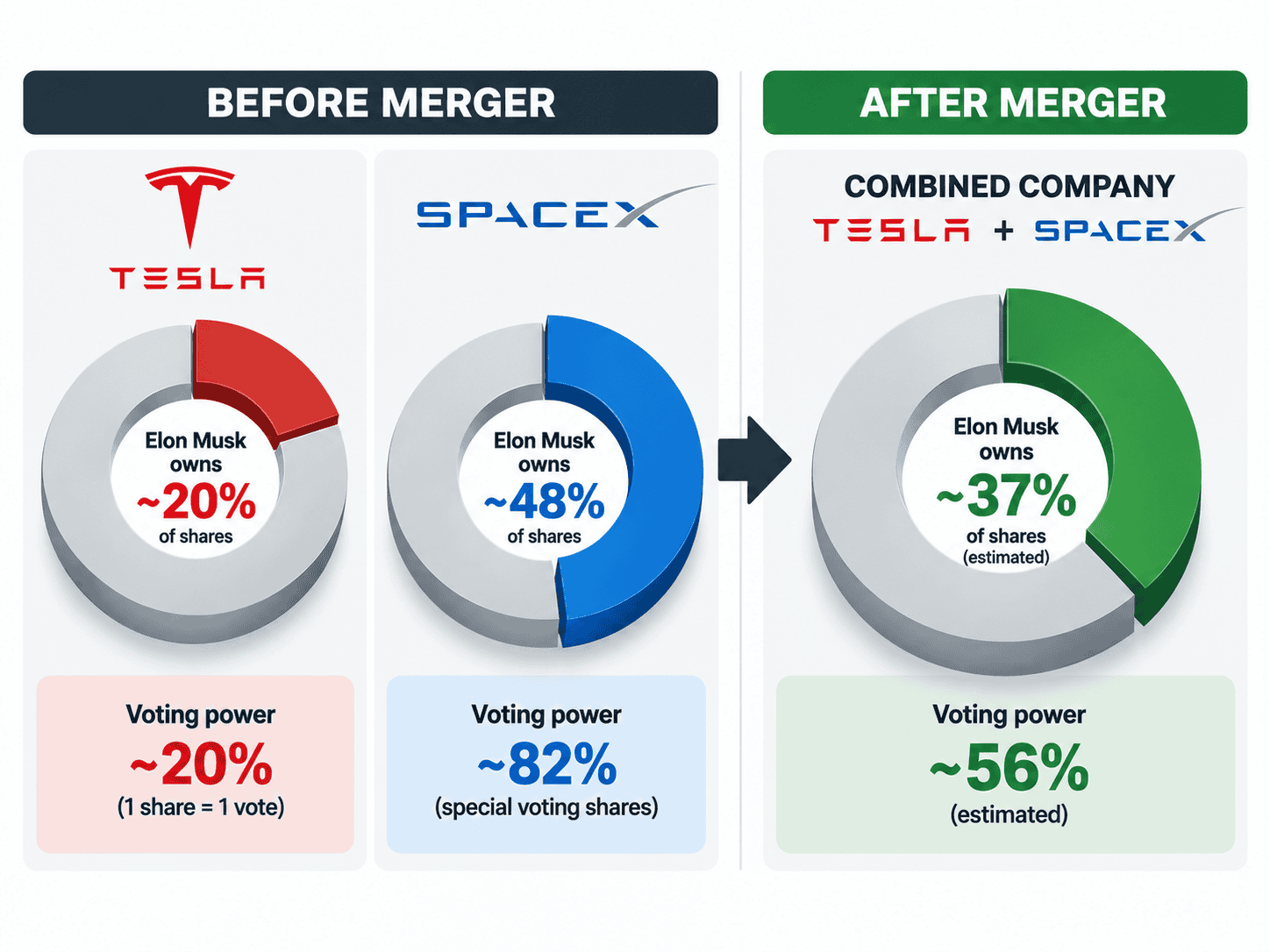
Then there is control. Musk owns about 20% of Tesla and about 48% of SpaceX, and his special voting shares give him about 82% of SpaceX’s votes. Barclays estimates that after an all-stock deal he would own about 37% of the combined company and control about 56% of the vote, which is the kind of outcome independent committees exist to scrutinise.
The two companies are also already linked. Tesla agreed to invest about $2 billion in xAI in January, xAI became part of SpaceX in February, and one Tesla director, Ira Ehrenpreis, now also sits on SpaceX’s board.
None of this means a deal can’t happen. It means the path from “committees are talking” to “shares are exchanged” has several steps, and any of them could change the price along the way.
Two mistakes to avoid
Don’t trade the merger before it exists
It’s tempting to buy one stock to get the other “cheaply” through the ratio, or to sell ahead of a deal you think will disappoint. Both approaches depend on terms nobody has seen, and the 0.7 figure is an analyst’s estimate, not an offer.
If the committees agree on a different ratio, or walk away, a trade built on that estimate loses its reason to exist, and a position sized on how certain the deal feels can get very large very quickly. In my own first good year of trading, I sized a position on how confident I felt rather than on a rule, and it was liquidated, so sizing in our system always comes from the stop distance and a fixed risk rule.
Don’t let one headline override the weekly trend
Merger talk produces plenty of headlines, and each one can move both stocks for a day or two. A single session’s jump, like 21 October, doesn’t change the weekly trend by itself, and momentum still has to confirm on your rules before there is an entry.
The same goes in the other direction. If talks stall and both stocks drop on the news, that drop matters for your position only if it breaks the weekly trend.
Sort your positions into three groups
These are examples to help you sort, not recommendations. Each group faces the merger differently, and TGPS handles each one with a different step.
Group 1: You hold Tesla
If a deal happens on the terms Barclays describes, your Tesla shares would turn into SpaceX shares, so you would end up holding a different, faster-growing and more richly valued business than the one you bought.
Check Tesla’s relative strength in your screener against the S&P 500 and against the Nasdaq-100. If Tesla is only keeping up because of merger headlines while the weekly chart was weak beforehand, TGPS would treat the weekly trend as the deciding factor, not the headline.
Group 2: You hold SpaceX
For SpaceX holders, a deal would mean issuing a large number of new shares to Tesla shareholders, on top of the lock-up releases already scheduled. About 1.3 billion more SpaceX shares became sellable on Thursday 22 October; another 328 million are released on Saturday 24 October and can trade from Monday 26 October; and the remaining 180-day lock-up runs out on Tuesday 8 December.
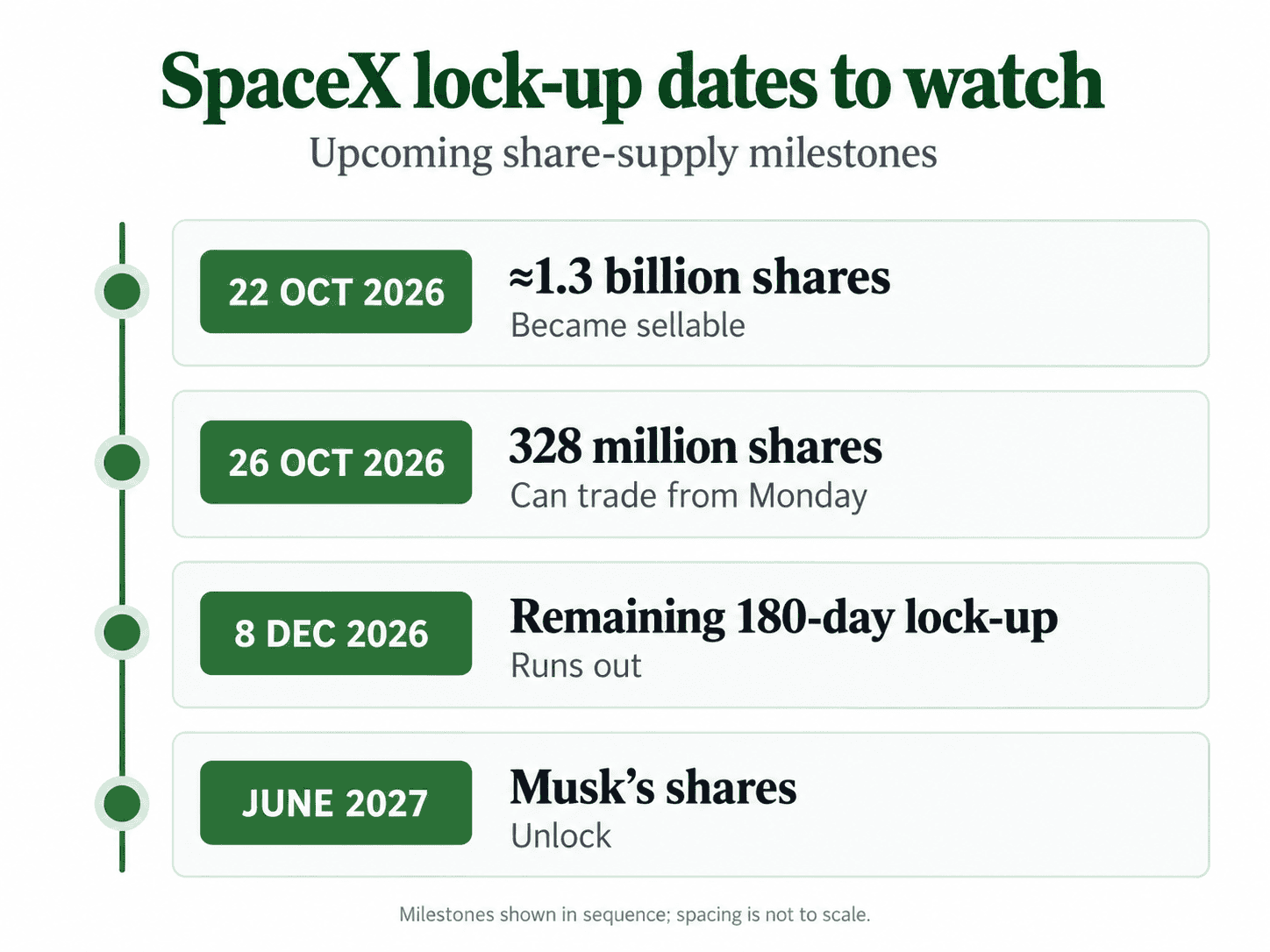
Write those dates next to SpaceX on your list, then compare its relative strength with the Nasdaq-100, which it joined in July. A stock that weakens against its own index while new supply arrives is one that TGPS screening would flag first.
Group 3: You hold related stocks
Several space stocks moved in sympathy with SpaceX on 21 October. If you hold any of these, check whether they are moving on their own weekly trend or simply following SpaceX headlines, because a sympathy move can unwind as quickly as it arrived.
Plenty of traders hold stocks across all three groups without realising how closely they are tied to the same headline, and that is often where the confusion begins.
Let the chart make the decision
You don’t need a view on the ratio, the vote, or Musk’s control to manage these positions, because the weekly chart answers the trading question for you.
Is the weekly trend up on Tesla or SpaceX? Then the market hasn’t yet decided the merger risk is serious enough to change it, and momentum still has to confirm on the TGPS rules before there is an entry.
Has the weekly trend broken? Then the reason no longer matters, whether it was a stalled deal, a disappointing ratio or something unrelated, and you exit by the rules or check that your stop is where the system placed it.
A signal is simply a point where the rules say a defined risk is worth taking. Some signals work and some don’t, and the TGPS rules stay the same either way.
Here is how the SMT setup reads each chart.
Tesla Inc (Position Weekly)
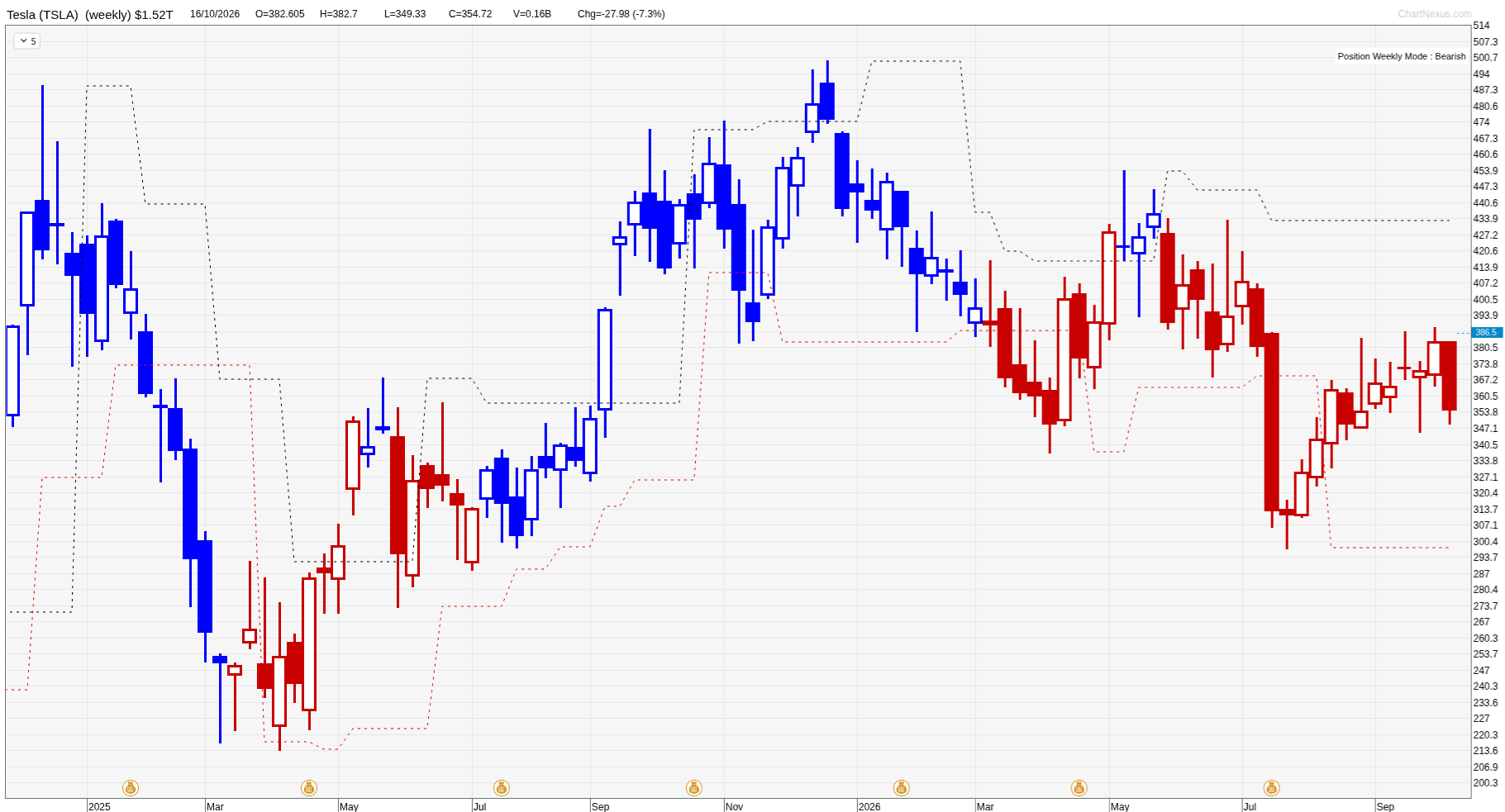
The Position Weekly candle changed from blue to red in the week ending 13 March 2026. Under the rules that turned the system bearish, the trigger sat slightly below that week’s low of 381, at about 381.
It triggered the following week, ending 20 March, when the price fell to 364 and closed at 368. The system has stayed in Bearish mode since. The latest week, ending 16 October, closed at 355, down about 7%.
No long was taken, because there has been no red-to-blue change since March. The system is still waiting for the next one before a buy-stop goes in.
None of this needed a view on deliveries, robotaxis, or the SpaceX listing. The rules set when to stand aside, and so far they’ve kept you out while the chart stayed in Bearish mode.
Space Exploration Technologies Corp (Position Daily)
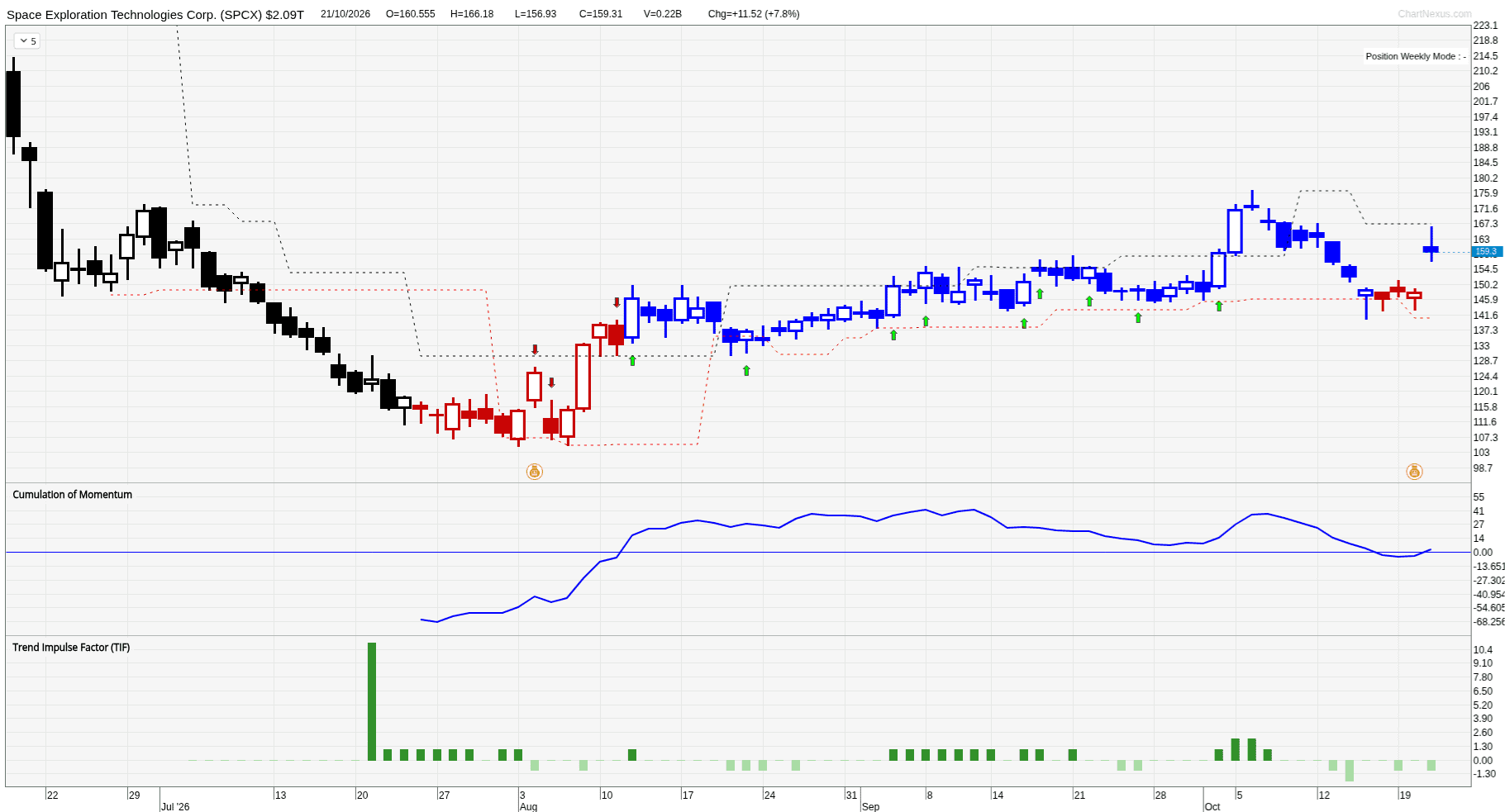
On the daily chart, the first ATM setup came on 14 August 2026, and by the rules, traders would have entered at about 145. Since then, the price has closed as high as 172, and it closed at 159 on 21 October, so by the rules, that position would still be open.
A fresh buy arrow printed in early October, and it triggered above 160 on 5 October. By the rules, that arrow sits inside an existing trade rather than marking a fresh entry.
Not every daily signal works, and not every arrow is a trade. The rules stay the same either way.
What to watch between now and Tesla’s annual meeting on 3 December
Any filing that names committee members, advisers, or terms
This would be the first sign of how far talks have progressed. A filing with terms could move both stocks sharply, while news that talks have stalled could do the same in the other direction.
SpaceX’s remaining lock-up releases
The 1.3 billion shares released on 22 October, the tranche that can trade from 26 October, and the 8 December backstop all add SpaceX shares that can be sold. Smooth absorption could leave the trend intact, while heavy selling could put pressure on the price.
Tesla’s annual meeting on 3 December
The meeting starts at 5 am Singapore time on Friday 4 December. There is no merger proposal on the current agenda, so watch whether that changes before then.
Each of these matters only if it changes the weekly trend, and TGPS will show you when that happens.
Sort your positions, know which group each one belongs to, and let the weekly chart tell you when something has genuinely changed.
You don’t need an opinion on the Tesla–SpaceX merger when your TGPS rules already tell you what to do.
–
If this article helped you understand the market, the next step is seeing how to put that knowledge to work.
Watch my 3-step trading process LIVE: find promising stocks, plan when to buy and sell, and decide how much to risk before placing a trade.
It’s the same approach I’ve used to trade systematically and generate monthly returns over the past five years. Click the banner below to learn more.