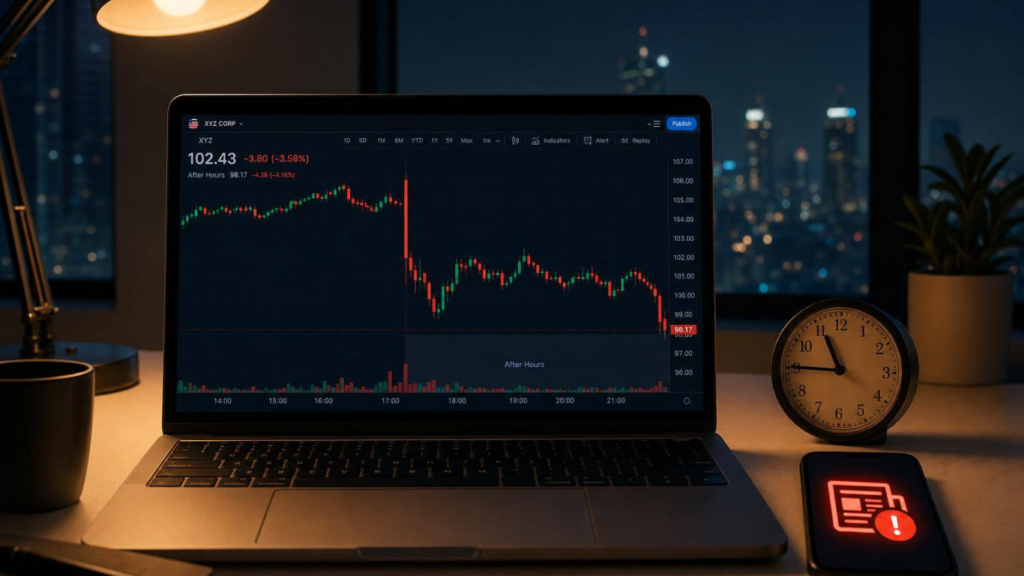
Bad news often hits volatility harder than good news calms it. If you trade stocks in Singapore, that matters because a headline from the US or Europe at night can affect your positions by the next market open.
Here’s the short version:
- Negative news is linked to higher stock volatility
- The effect is stronger during crisis periods, such as 2008–2009 and COVID-19
- Firm-specific bad news can move a stock faster than broad market news
- Overnight headlines matter, especially for next-day risk
- Sentiment works best as a risk warning tool, not by itself as a buy-or-sell signal
If I had to boil the research down to one line, it would be this: when negative headlines pile up, volatility often stays high for longer, and that can hurt position sizing, stop-loss planning, and hedging costs.
For Singapore-based traders, the practical takeaway is simple. If global sentiment turns sour after local market hours, you may want to check your exposure before the next session starts. That matters even more in stressed markets.
My read: this research is less about predicting every price move and more about helping you avoid being caught on the wrong side of a volatility jump.
How Researchers Measure Negative News Sentiment and Volatility
News and Sentiment Data Sources
Most studies rely on RavenPack, a news analytics platform that pulls from more than 200,000 sources and gives each item a sentiment score. Its Event Sentiment Score (ESS) ranges from 0 to 100, with 50 treated as neutral.
Some papers also bring in StockTwits and Google Trends. In practice, structured news feeds tend to be cleaner. Social data is more often used as a stand-in for retail attention and market noise.
After researchers capture sentiment, they plug it into systematic trading volatility models to see whether it helps explain or predict market moves.
To avoid counting the same story more than once, researchers use relevance and novelty filters. For example, they may keep only highly relevant articles and record only the first mention within a 24-hour window. They then match news items to price moves using exact publication timestamps from news wires.
Models Commonly Used in the Studies
Older studies leaned on dictionary-based NLP, often using finance lexicons such as Loughran and McDonald. Newer work uses machine-learning classifiers. The latest move is toward transformer-based large language models (LLMs).
Recent research shows that GPT-4 does a better job than RavenPack at classifying news sentiment for volatility analysis.
The main volatility models are:
| Model | Primary Use | Key Strength |
|---|---|---|
| GJR-GARCH | Capturing asymmetric news effects | Models asymmetry, where negative news has a stronger effect than positive news |
| FIGARCH | Long-memory volatility modelling | Captures the slow-decaying persistence of volatility shocks |
| HAR | Realised volatility forecasting | Uses daily, weekly, and monthly components in a simple structure |
| RS-GARCH | Regime-switching analysis | Distinguishes between “calm” and “turbulent” market states |
Researchers also use 5-minute intraday data to build realised volatility measures such as the Realised Kernel, often taken from the Oxford-Man Institute of Quantitative Finance. That high-frequency setup helps them see exactly when a news item landed and how prices moved in the minutes after.
“The sentiment of macroeconomic news is a significant determinant of long-term risk on the stock market, while the presence of novel firm-specific news released outside the official trading hours determines changes in volatility in the short run.” – Simon Tranberg Bodilsen, Aarhus University
One useful takeaway stands out: adding macroeconomic news sentiment can improve monthly volatility forecasts for the S&P 500 by as much as 30% based on mean squared error. That helps explain why sentiment measurement keeps showing up in volatility research.
These choices in data and modelling shape the market-level findings discussed next.
Master Systematic Trading with Collin Seow
Learn proven trading strategies, improve your market timing, and achieve financial success with our expert-led courses and resources.
sbb-itb-466c9b0
What Studies Find at the Market Level
At the market level, the effect shows up fast and then carries into later sessions. Volatility can jump in the same trading session, often within 15 to 30 minutes of a news release. On top of that, negative sentiment today can point to higher volatility in later sessions too. The main takeaway is simple: the shock can land within minutes, then stick around.
The effect is also asymmetric. Research by Lee A. Smales on S&P 500 data from 2000 to 2010 found that the VIX climbs more sharply after negative news than it drops after positive news.
“A significant negative contemporaneous relationship between changes in VIX and news sentiment is discovered. The relationship is asymmetric whereby changes in VIX are larger following the release of negative news items.” – Lee A. Smales
Studies on the GFC and COVID-19 show the strongest effects during stress periods. Research by Aktham Maghyereh and Hussein Abdoh found that sentiment has much more power to predict realised volatility during system-wide stress, and that sentiment moved faster during COVID-19 than during the GFC. Negative news also slows volatility mean reversion, which means markets can stay unsettled for longer.
Research Summary Table: Major Market Studies
| Study | Sample Period | Sentiment Source | Volatility Measure | Main Finding |
|---|---|---|---|---|
| Hsu, Lu & Yang | 2008–2009 (focus) | Aggregate News Sentiment Index (ANSI) | GARCH / GJR-GARCH | Both immediate and lagged negative news drive volatility; effect peaks during the GFC |
| Smales | 2000–2010 | RavenPack (Dow Jones / WSJ) | VIX (implied volatility) | Strong negative contemporaneous link; VIX rises more for negative news than it falls for positive news |
| Maghyereh & Abdoh | GFC vs. COVID-19 | News-based economic sentiment | Realised volatility | Sentiment predictive power increases during crises; sentiment moved faster during COVID-19 than during the GFC |
| G20 Panel Study | 2020–2021 | Google Search Volume Index (GSVI) | Realised volatility | Negative sentiment (“coronavirus” searches) increases volatility; positive sentiment (“vaccine” searches) reduces it |
| Barunik et al. | 2012–2017 | NASDAQ News Platform | Stochastic volatility | Negative sentiment raises the mean reversion point for volatility, sustaining elevated volatility for longer |
At the market level, negative sentiment works like a broad risk signal. At the firm level, the timing and size of the move get more specific. These market-level results set the baseline for firm-specific and intraday reactions in the next section.
Firm-Level, Intraday, and One-Sided Volatility Effects
Firm-Specific News and Short-Term Volatility Reactions
Firm-level moves are sharper than market-level moves. Research on Dow Jones Composite Average constituents found that negative firm-specific news has a much larger effect on intraday volatility than positive news. The same study also found that firm-specific sentiment explains more volatility persistence than macro news. Put simply, when bad news hits a single stock, the reaction tends to be faster and more one-sided.
The overnight window matters just as much. Research shows that the raw count of firm-specific news arriving between trading sessions, not only the sentiment score, helps improve next-day volatility forecasts. So if one stock has a heavy overnight news flow, that alone can be a warning sign. This effect gets stronger when markets are already volatile.
When Negative Sentiment Has a Stronger or Weaker Effect
The impact of a headline changes with the market backdrop. Research on Dow Jones Composite Average constituents using RS-GARCH models found that news sentiment explains a much larger share of volatility persistence during turbulent, high-volatility regimes than during calm periods.
This link also changes over time. Research on global equity markets found that sentiment transmits volatility unevenly, with sharper shocks during major events and smaller spillovers during routine periods. In other words, the pattern is event-driven, not steady.
Research Summary Table: Firm-Level and Intraday Studies
| Study Focus | Data Frequency | Sentiment Source | Volatility Measure | Key Finding |
|---|---|---|---|---|
| Dow Jones Composite Average Constituents (Ho et al.) | Hourly (Intraday) | RavenPack News Analytics | FIGARCH / RS-GARCH | Negative news has a larger effect, especially in turbulent regimes |
| S&P 500 & Individual Stocks (Bodilsen & Lunde) | Daily / Overnight | News Analytics | Realised Volatility | Overnight news count significantly improves next-day volatility forecasts |
| Japanese TOPIX Core 30 (Feng et al.) | Intraday | RavenPack News Analytics | Regime-switching GARCH | News sentiment is a key driver of transitions between volatility states |
| Global Market Connectedness (Abdollahi et al.) | High-Frequency | Textual Analysis | Directional Connectedness | Sentiment induces event-driven volatility shocks during major events |
These firm-level findings turn the broader market pattern into tradeable stock picks. They suggest that who the news is about, when it hits, and what kind of market you’re in can all shape the size of the volatility response.
Conclusion: What Traders Should Take from the Research
The research points in the same direction: negative news sentiment is linked to higher volatility. You see this at both the market and firm level, and across both short and longer time frames. So the main issue isn’t whether sentiment matters. It’s when it matters most.
That link gets stronger when markets are under pressure, especially during crisis periods. The size of the effect changes based on the data source, the model used, and the market regime. Social sentiment tends to be faster and more reactive. Macroeconomic news, on the other hand, is often more useful when you’re looking at volatility over a longer horizon.
Key Points to Close
From a trading point of view, sentiment should sit in your risk controls first. It’s more useful as a risk filter for monitoring conditions and spotting volatility regimes than as a standalone trading signal. If negative news suddenly spikes, especially in a stressed market, that’s a clear cue to review position sizing or add hedges to portfolio risk.
The big takeaway is simple: volatility tends to jump harder on bad news than it eases on good news. That makes negative sentiment a handy warning sign for exposure, hedging, and regime shifts.
FAQs
How can I track negative news before the Singapore market opens?
Convert international GMT timestamps to Singapore Standard Time (SGT) and track overnight news for each firm. That gives you a cleaner view of what hit the market while Singapore was asleep, which can help with short-term volatility forecasts. News rarely gets priced in all at once, so timing matters.
It also helps to group weekend or public holiday sentiment and map it to the next trading day’s open. A stock can look calm on Friday, then face a wave of chatter before Monday morning. If you only check headlines at the open, you may miss the build-up.
Tools with NLP features, such as StockGeist.ai or Sentia, can help you watch message-volume spikes and live sentiment scores. If you want a more structured way to apply this, Collin Seow Trading Academy offers resources on using these methods in a repeatable process.
Does bad news affect all stocks equally?
No. Bad news doesn’t always move volatility in the same way.
The effect depends on the type of news, the state of the market, and whether the news is tied to one company or the whole economy.
Research suggests that firm-specific news often has a bigger effect on the volatility of an individual stock than broad macroeconomic news. And those effects tend to hit harder during periods of market stress than during calmer stretches.
Should I use news sentiment as a trading signal?
Yes, news sentiment can be a useful trading signal if you use it in a systematic framework.
Research shows that sentiment can improve volatility forecasting and help you fine-tune risk management alongside price history.
For the best results, use sentiment with technical indicators and price data rather than on its own. It also helps to split macroeconomic news and firm-specific news into separate buckets.
- Macroeconomic news tends to be more useful for longer-term signals
- Firm-specific news is often better for shorter-term forecasts