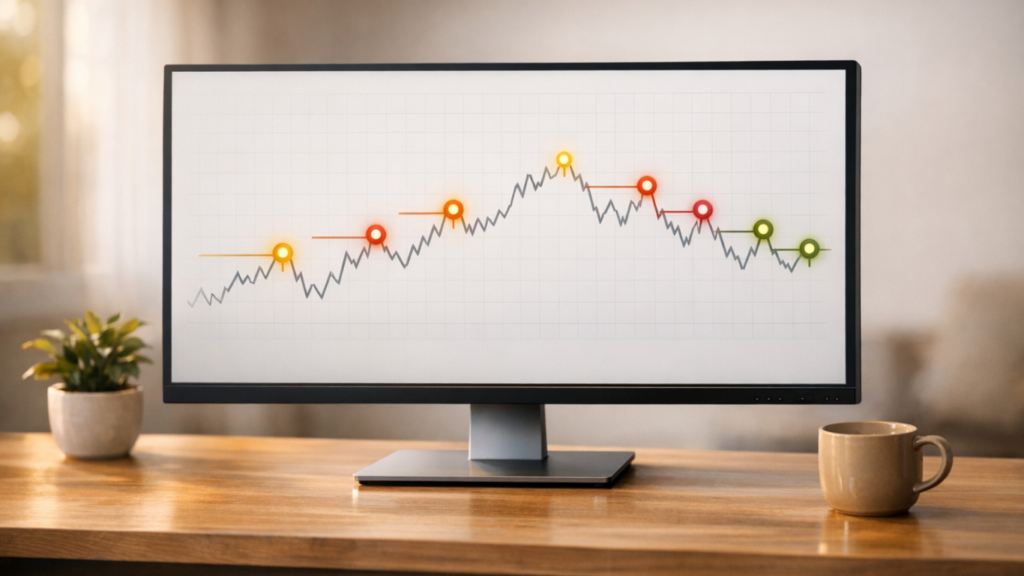
Stop orders are a powerful tool for managing risk in trading. They automatically trigger buy or sell actions when a specific price is reached, helping you stick to your trading plan and avoid emotional decisions. Here’s a quick overview of seven key stop order strategies:
- Basic Stop-Loss Order: Sets a fixed price to minimise losses. Ideal for hands-off risk management but can be affected by slippage or market gaps.
- Trailing Stop Order: Adjusts dynamically with price movements, locking in profits during trends. Works well in steady markets but may trigger prematurely in volatile conditions.
- Stop-Limit Order: Combines a trigger price with a limit price to control execution. Great for precise entries/exits, but risks no execution in fast-moving markets.
- Stop-Profit Order: Locks in gains at a pre-set price. Useful for disciplined profit-taking but may miss out on further price increases.
- Bracketed Stop Order: Combines stop-loss and take-profit orders for automated exits. Helps manage risk and reward but may fail in extreme market conditions.
- Time-Based Stop Order: Exits trades after a set time. Useful for avoiding overnight risks but may close positions too early.
- Volatility-Adjusted Stop Order: Uses market volatility (e.g., ATR) to set dynamic stops. Reduces noise-triggered exits but requires careful calibration.
These strategies cater to different trading styles and market conditions. For example, trailing stops are excellent for trend-following, while bracketed orders suit swing traders. The key is choosing the right strategy to match your goals and risk tolerance.
1. Basic Stop-Loss Order
Trigger Mechanism
A basic stop-loss order stays active until the market price hits your pre-set stop level. At that point, it turns into a market order and executes at the next available price. For instance, if you own shares at S$10.00 and set a stop-loss at S$9.50, the order kicks in once the price touches or drops below S$9.50.
Execution Guarantee
While execution is almost always ensured once the stop-loss is triggered, the exact price at which it gets filled isn’t guaranteed. In volatile or less liquid markets, you might experience slippage, where the actual execution price is lower than your stop price. Overnight price gaps can also cause unexpected outcomes.
Best Use Case
This strategy works well for traders who can’t actively monitor the market and need an systematic trading approach to manage risk. It’s particularly effective in markets with steady trends and typical levels of volatility and liquidity. A common tactic is to position stop-loss orders just below key support levels for long trades or above resistance levels for short trades.
Advantages
One of the biggest perks is that it helps traders stick to their plans without letting emotions take over. As Investopedia highlights, stop-loss orders counteract the “disposition effect”, where traders hold onto losing positions for too long and sell winning ones too quickly. Another plus? Most brokers don’t charge for setting up these orders – fees only come into play when the order is executed. Additionally, because the order is stored in the broker’s system until it’s triggered, it stays hidden from the market, reducing the risk of tipping off algorithmic traders.
Risks
There are some downsides to be aware of. Slippage and market gapping can lead to less-than-ideal execution prices. Then there’s the “whipsaw” effect – short-term price swings might trigger your stop-loss just before the market rebounds. To avoid this, it’s wise not to place your stop-loss too close to the current price, as this increases the chances of being stopped out by routine market noise. However, setting it too far away could lead to larger losses. Many experienced traders recommend risking only 1% to 2% of your total account equity on a single trade to balance risk and reward.
Next, we’ll look at other stop order strategies.
sbb-itb-466c9b0
2. Trailing Stop Order
Trigger Mechanism
A trailing stop order takes the concept of a basic stop-loss and adds a dynamic twist. Instead of locking in a fixed price, you set a “trailing amount” – this could be in points, pips, or percentages. For long positions, the stop adjusts upwards as the price climbs to new highs. For short positions, it moves downwards as the price hits new lows. The trigger price is calculated as the New High Bid minus the trailing amount for long positions. If the market reverses, the stop remains fixed at the last high (or low) it reached, without moving backwards. This approach allows your systematic trading strategy to adapt to market trends. Some brokers even offer a “step” feature, where the stop adjusts only after the price moves a set increment, such as 10 pips, to avoid constant adjustments.
Execution Guarantee
When the market price hits or crosses the trigger level, the trailing stop converts into a market order. This means it will execute at the next available price, which may differ from the trigger level due to slippage, especially in volatile markets or during gaps. It’s also worth noting that most trailing stops are active only during standard market hours (9:30 a.m. to 4:00 p.m. ET, or 9:30 p.m. to 4:00 a.m. SGT) and won’t trigger during pre-market or after-hours trading.
Best Use Case
Trailing stops are most effective in markets with strong trends and minimal corrections. They are particularly useful for traders who can’t monitor their positions constantly but want an exit strategy that adjusts automatically with price movements. For long-term positions, they help lock in profits without the need for daily manual updates. However, they are less suited for rangebound or choppy markets, where frequent price swings could prematurely close your position. In trending markets, they can protect profits while keeping your trade aligned with the broader trend.
Advantages
The standout benefit of a trailing stop order is its ability to protect profits automatically. As Kevin Horner, Senior Specialist at Charles Schwab, explains:
“Trailing stops can provide efficient ways to manage risk. Traders most often use them as part of an exit strategy.”
Trailing stops allow your position to follow the trend, securing gains as the price moves in your favour. They also offer unlimited upside potential while capping downside risk. Additionally, GTC (Good-Till-Cancelled) trailing stop orders can remain active for as long as 180 days.
Risks
One common risk with trailing stops is the potential for whipsawing in volatile markets. Sudden price reversals can trigger an exit before the trend resumes, especially if the trailing distance is set too tight. Patrick Foot, a former senior financial writer at Forex.com, warns:
“Trailing stops can encourage a ‘set and forget’ mindset, which is rarely recommended when trading active markets.”
To mitigate this, many traders use tools like the Average True Range (ATR) indicator to determine an appropriate trailing distance. A common approach is to set the trailing stop at 3 to 3.5 times the ATR, giving the trade enough room to handle normal market fluctuations.
3. Stop-Limit Order
Trigger Mechanism
A stop-limit order operates using two key price levels: the stop price and the limit price. The stop price acts as the trigger, while the limit price sets the worst acceptable execution price. When the market hits the stop price, the order converts into a limit order, which will only execute at the limit price or better. For buy stop-limit orders, the trigger is based on the Ask price, while for sell stop-limit orders, it’s based on the Bid price. Traders often set a buffer between these two prices, commonly using 2–3 times the spread or 0.05–0.10 times the ATR (Average True Range) to account for market fluctuations.
Execution Guarantee
There’s no assurance that your stop-limit order will be executed. The order will only fill if the market price matches or improves upon your limit price. If the price gaps past your limit due to sudden news or significant market movements, your order won’t execute, potentially leaving you exposed to greater losses. In markets with low liquidity, partial fills are also possible, meaning only part of your order is completed while the rest remains pending. As the Singapore Forex Club explains, “The trade-off is obvious: you may not get filled in fast markets, and that is by design”. This makes stop-limit orders more suitable for planned entries or exits rather than urgent scenarios.
Best Use Case
Stop-limit orders are ideal for momentum breakouts, where you want confirmation of a price move but don’t want to risk overpaying or selling too low during a spike. They’re also effective for controlled exits during sudden market gaps or periods of low liquidity, ensuring you don’t accept prices below your set threshold. However, these orders are not recommended for critical “must-exit” situations. In such cases, a standard stop-loss (market) order is better as it guarantees your position will close, regardless of price. The ability to set precise conditions makes stop-limit orders distinct from basic stop-loss orders.
Advantages
The main advantage of stop-limit orders is price control. You can ensure you won’t buy above or sell below your specified limit, which helps minimise slippage in volatile markets by predicting volatility. This level of precision supports disciplined risk management. For intraday traders, setting these orders as “Day” orders ensures they don’t carry over into different market conditions or get triggered by widened spreads during market rollovers. A practical tip: avoid setting stop prices at round numbers like S$50 or S$100, as these levels are often targeted by algorithmic “stop hunting”. Instead, use slightly offbeat numbers like S$49.75 to give yourself some breathing room.
Risks
The biggest drawback is the risk of no execution. In fast-moving markets or during price gaps, the market might skip over your limit price entirely, leaving your order unfilled. This is particularly risky if you’re trying to exit a losing position, as the market could continue moving against you while your order remains inactive. The Singapore Forex Club highlights that precision is key to balancing disciplined risk-taking with avoiding unnecessary losses. Additionally, setting up these orders requires a deeper understanding of price interactions and more effort compared to simple stop-loss orders, as you need to input multiple price levels and account for market behaviour.
4. Stop-Profit Order
Trigger Mechanism
A stop-profit order, also known as a take-profit order, is designed to lock in gains by closing your trade when the price hits a more favourable level than your entry point. For long positions, you set the trigger price above your entry, while for short positions, it’s set below. The order stays inactive until the market reaches your specified price, at which point it executes as a limit order at that price or better. It’s important to note the difference here: unlike a stop-loss order, which protects against losses by executing at a less favourable price, a stop-profit order ensures your gains are secured before the market potentially reverses. Essentially, it’s a proactive way to protect profits.
Execution Guarantee
Stop-profit orders are executed as limit orders, meaning they depend on market liquidity. If the market hits your target price but lacks enough liquidity, the order may not be filled. This differs from stop-loss orders, which convert to market orders upon triggering and ensure execution regardless of the price. With a stop-profit order, you’re guaranteed your specified price, but not the execution itself.
Best Use Case
Stop-profit orders are particularly useful for short-term traders who rely on technical analysis to define profit targets. They work best when clear resistance levels (for long positions) or support levels (for short positions) are identified. Many traders combine stop-profit orders with stop-loss orders to maintain a clear risk-to-reward ratio, often aiming for ratios like 1:2 or 1:3 before entering a trade. As FOREX.com highlights:
“Take profits can help you to be disciplined with your trading strategy and not chase profits unnecessarily”.
For instance, with a 1:3 risk-to-reward ratio, a trader can still achieve overall profitability even if only 30% of their trades succeed.
Advantages
One of the biggest benefits of using stop-profit orders is how they encourage emotional discipline. By automating your exit at a pre-set profit level, you avoid the urge to hold on for “just a bit more” or overreact to small pullbacks. This automation also reduces the need for constant market monitoring, which is especially helpful when managing multiple trades simultaneously. As Charles Archer from IG points out:
“The automated nature of take-profit orders makes it easier to manage risk”.
Risks
The main drawback of stop-profit orders is the potential for missed opportunities. If the asset continues to move in your favour after the order is executed, you might miss out on additional gains. For example, if you set your take-profit at S$55.00 and the stock later rallies to S$62.00, you’d miss out on an extra S$7.00 per share. Additionally, relying too much on automated orders can lead to complacency, where traders fail to stay aware of fundamental market changes.
Master Systematic Trading with Collin Seow
Learn proven trading strategies, improve your market timing, and achieve financial success with our expert-led courses and resources.
5. Bracketed Stop Order
Trigger Mechanism
A bracketed stop order combines three components: an entry order, a take-profit limit, and a stop-loss order. It uses One-Cancels-the-Other (OCO) logic, meaning once one order is triggered, the other is automatically cancelled.
Execution Guarantee
The take-profit leg works as a limit order, ensuring execution at the specified price – or better – but only if the market reaches that level. On the other hand, the stop-loss leg converts into a market order when triggered. While this guarantees execution, it may occur at a less favourable price during periods of high volatility. Some platforms address this risk by offering Guaranteed Stop-Loss Orders (GSLOs), which ensure execution at the exact price, even during market gaps.
Best Use Case
Bracketed stop orders are especially handy for intraday traders who need to close all positions before the market session ends, as these orders typically do not carry over to the next trading day. They are also practical during high-volatility periods, such as earnings releases or major economic announcements, when prices can change rapidly. Additionally, for traders unable to monitor the market constantly, bracketed stop orders provide a complete exit strategy from the moment a position is opened. This approach automates risk management, aligning with the principles of disciplined trading.
Advantages
The main advantage of a bracketed stop order lies in its ability to manage both risk and reward simultaneously. It protects against losses while locking in potential gains from the outset. As Charles Schwab explains:
“A bracket order immediately places an OCO ‘take profit’ and a stop order after a position is opened”.
By enforcing disciplined exits, these orders eliminate emotional decision-making, such as chasing gains or holding onto losing trades. They can also be paired with a trailing stop-loss, which adjusts upward as prices move in your favour.
Risks
Despite its benefits, bracketed stop orders have some limitations. They are often restricted to intraday trading, expiring at market close and leaving positions unprotected if carried overnight. During volatile conditions, slippage can lead to worse-than-expected execution on the stop-loss leg. Additionally, in extreme market volatility, prices may gap past the stop-loss level, resulting in larger losses unless a guaranteed stop-loss is used. The take-profit order might also fail to execute in low-liquidity situations.
6. Time-Based Stop Order
Trigger Mechanism
A time-based stop order is designed to exit a position after a predetermined time period rather than at a specific price. This could mean closing a trade at a certain hour, the end of a trading session, or after a set number of days or weeks. For instance, a Day Order automatically expires at the end of the current trading session, while a Good-Till-Date (GTD) order stays active until a specified calendar date. On the Singapore Exchange (SGX), GTD orders can be set for up to 30 calendar days. Unlike price-based strategies, this method focuses solely on timing, giving positions a clear expiration point.
Execution Guarantee
While time stops ensure that trades exit at a specific time, they don’t guarantee the execution price. For example, a Market-On-Close (MOC) order will execute at the best price available just before the market closes, but fast-moving markets can result in slippage. On the other hand, a time-based limit order might not execute at all if the market price moves beyond the set limit.
Best Use Case
Time-based stops work well for cutting losses on underperforming trades. As Babypips.com aptly states:
“Set a time limit and cut off that dead weight so that money can do what it is meant to do… Make more money!”
This method also helps manage gap risk by closing positions before events like weekend or overnight price jumps. Traders often opt to exit before weekends to avoid unpredictable price gaps.
Advantages
One major benefit of time-based stops is that they improve capital efficiency. By keeping track of your average holding period, you can identify and exit trades that aren’t performing, freeing up capital for better opportunities. These orders also save time by eliminating the need to manually re-enter orders daily.
Risks
The biggest downside is the risk of exiting too early, potentially missing out on favourable market movements that happen later. If a time-based order is set to execute at the next market open, the price could vary significantly from the previous close due to overnight news or economic developments. Additionally, GTD orders can pose risks if left active in changing market conditions, possibly leading to unintended executions.
7. Volatility-Adjusted Stop Order
Trigger Mechanism
Volatility-adjusted stops take the idea of fixed and trailing stops further by incorporating market dynamics into the equation. These stops use measures like the Average True Range (ATR) or Standard Deviation, multiplied by a safety factor (commonly 2 or 3), to set an exit point. The reference price could be the current closing price or the highest high for long positions. What makes this approach stand out is its flexibility – the stop adjusts automatically, expanding during high volatility and contracting when the market is calmer.
Best Use Case
This method works best in trending markets, where the aim is to stay in profitable trades while avoiding exits triggered by routine market noise. Let’s say you’re trading Singapore stocks, and the 14-day ATR shows an average daily movement of S$0.50. By setting your stop at three times the ATR – around S$1.50 below your entry – you allow the position to ride out ordinary fluctuations without being prematurely stopped out.
Advantages
The main perk here is the ability to cut through market noise. By placing stops outside normal price swings, you lower the chances of exiting too early compared to fixed-dollar stops. This approach can also help reduce emotional decision-making during market downturns. Plus, its adaptability means tighter stops in calm markets and wider stops in volatile ones, giving your trades room to breathe while still locking in profits. However, this flexibility isn’t without its downsides.
Risks
One of the biggest challenges is getting the parameters right. For example, deciding between a 2× or 3× ATR multiplier could either lead to premature exits or expose you to more risk. Another issue is that these stops rely on historical data, usually from the past 14 days, which might not hold up during sudden market events like major economic announcements. As Investopedia notes:
“Highly volatile or directionless markets are the worst conditions under which to trade using a volatility stop. Under these conditions, stops are likely to get hit frequently.”
Additionally, when these stops are triggered, they execute as market orders, meaning there’s no guarantee of a specific execution price. Slippage can become an issue, especially in fast-moving markets or during overnight gaps. To counter this, consider widening the calculated stop by an extra 0.5%–1% during periods of extreme volatility.
Strategy Comparison Table
Each trading strategy comes with its strengths and is suited to different scenarios. Below is a table that summarises key aspects of various stop order strategies, focusing on their triggers, execution methods, ideal market conditions, and potential risks.
Trailing stops are particularly effective in trending markets, as they automatically adjust to secure profits as prices move in your favour. Stop-limit orders, on the other hand, offer precise price control but carry the risk of not being executed if the market gaps past your limit price. Bracketed (OCO) orders are perfect for swing traders who aim to set both profit targets and stop-losses at once, allowing for a “set-and-forget” approach. Time-based stops are useful for day traders, ensuring positions don’t extend overnight into new market conditions. Meanwhile, volatility-adjusted stops leverage ATR to adapt to market noise, widening during volatile periods and tightening when the market is calm. The table below highlights these strategies in detail:
| Strategy | Trigger Mechanism | Execution Type | Best For | Market Condition | Primary Risk |
|---|---|---|---|---|---|
| Basic Stop-Loss | Price hits stop level | Market Order | General risk management; emergency exits | All conditions | Slippage in gaps |
| Trailing Stop | Price reverses by set % or $ | Market Order | Trend following; locking in profits | Trending markets | Premature exit in choppy markets |
| Stop-Limit | Price hits stop level | Limit Order | Breakout entries; avoiding panic fills | Low volatility; high liquidity | No fill if price gaps |
| Stop-Profit | Price hits target level | Limit Order | Disciplined profit-taking | When target is reached | Missing further gains |
| Bracketed (OCO) | Either stop-loss or take-profit hit | Market or Limit | Swing trading; automated exits | Range-bound or volatile | Both orders may fail in extreme gaps |
| Time-Based | Time duration expires | Cancellation | Avoiding overnight/weekend risk | Day trading | Order expires before target is hit |
| Volatility-Adjusted | ATR-based level hit | Market or Limit | High-volatility assets (e.g., crypto/forex) | Volatile markets | Wider stops increase potential loss |
For professional traders, it’s common to set stop-to-limit gaps at 0.05–0.10 times the daily ATR to account for intraday volatility. Additionally, spread buffers of 2–3 times the spread during liquid trading sessions can help ensure smoother execution.
Conclusion
Stop orders play a crucial role in maintaining disciplined trading by sticking to pre-set strategies. The seven strategies discussed here – ranging from basic stop-losses to volatility-adjusted stops – offer options that cater to different trading styles, risk levels, and market conditions. The trick is aligning the right strategy with your goals: trailing stops for trend-followers, bracketed orders for swing traders, or time-based stops for day traders looking to avoid overnight risks.
“Position sizing is the glue that holds together a sound trading system.” – Brijesh Bhatia, Equity Capital Market Analyst, Definedge
Discipline is non-negotiable in trading. A staggering 90% of traders lose money due to lack of discipline. Setting a stop-loss before entering a trade is essential. As a starting point, many traders follow the 1–2% rule: risk only 1% to 2% of your account value on a single trade using fixed ratio or fixed fractional sizing. For markets prone to high volatility, consider using ATR-based stops set at 1.5 to 2 times the Average True Range to avoid getting caught in routine market fluctuations.
Refinement is key to improving your trading plan. Regularly backtest your stop strategies, review your performance weekly, and maintain a decision journal to track your progress.
For traders looking to sharpen their risk management skills, Collin Seow Trading Academy offers valuable resources. The free Market Timing 101 e-course teaches precise entry and exit strategies, while the book The Systematic Trader v.2 provides structured frameworks to optimise your approach to risk management. These tools can help you build the discipline needed to apply stop strategies effectively and consistently.
FAQs
How can I select the best stop order strategy for my trading style?
Choosing the right stop order strategy boils down to your risk tolerance, trading objectives, and the prevailing market conditions. If you’re a conservative trader, fixed stop-loss orders might be your go-to, as they limit potential losses. On the other hand, active traders may lean towards trailing stops to lock in profits as prices shift in their favour.
Familiarising yourself with various stop order types – like hard stops, ATR-based stops, or trailing stops – can help you customise your strategy. For instance, short-term traders often prefer tighter stops to limit exposure, while long-term investors might opt for wider stops to avoid being prematurely stopped out. Regularly revisiting your trading plan ensures your stop orders stay in sync with your goals and serve as effective tools for managing risk.
What challenges can arise when using stop orders in highly volatile markets?
In fast-moving markets, stop orders can come with their own set of challenges. One major issue is slippage – this happens when your order gets executed at a price far away from your intended stop level because of rapid price changes. This could mean your losses are bigger than you planned, or your profits end up smaller.
Another concern is that, in extremely volatile conditions, your stop order might not get filled at all. This leaves you vulnerable to even more unpredictable price swings. To handle these risks, it’s crucial to use stop orders wisely and keep a close eye on how the market is behaving.
How can I reduce slippage when using stop-loss orders?
To avoid slippage with stop-loss orders, it’s crucial to place your stop price thoughtfully. Set it at a level that accounts for typical market movements, rather than too close to the current price. If it’s too tight, sudden market swings could trigger the order at an unfavourable price.
You can also reduce slippage by trading during periods of lower volatility and ensuring the market has enough liquidity. Regularly assess market conditions and fine-tune your approach to achieve better trading results.