
GDP growth is a key economic indicator that impacts markets like stocks, currencies, and bonds. For traders, understanding GDP trends helps predict market movements and refine strategies. Singapore, as a trade-heavy economy, relies on external demand, with GDP growth often tied to sectors like manufacturing and trade. In Q3 2025, Singapore’s GDP grew 2.4% quarter-on-quarter, reflecting a strong annual growth forecast of 4.0%.
Why does GDP matter for traders?
- Stocks: Strong GDP growth boosts cyclical sectors (e.g., manufacturing, financials).
- Currencies: Higher GDP growth strengthens the SGD due to trade confidence.
- Bonds: Positive GDP surprises can raise yields as markets anticipate tighter monetary policies.
Key tools for traders: GDP data, combined with other indicators like inflation, employment, and PMI, provides a clearer picture of economic health. For example, Singapore’s July–August 2025 CPI eased to 0.4%, supporting growth forecasts, while strong export PMIs drove gains in trade-sensitive stocks.
Actionable strategies:
- Use GDP surprises to trade short-term market reactions.
- Follow multi-quarter GDP trends to adjust long-term portfolio exposure.
- Combine GDP data with macroeconomic indicators for systematic trading models.
GDP is not just a number – it’s a critical piece of the puzzle for informed trading decisions. Start tracking GDP releases and align them with your trading strategy to stay ahead.
How GDP Data Releases Affect Financial Markets
GDP reports often trigger quick and notable changes in equities, currencies, and bonds. The key driver behind these movements is the “surprise” factor – the difference between the actual GDP growth and what the market was expecting. When actual growth surpasses expectations, risk assets like stocks tend to gain, while a disappointing figure can lead to a pullback as investors reassess earnings prospects, interest rates, and the broader economic outlook. These reactions set the stage for how specific asset classes behave, as outlined below.
Market Reactions to GDP Surprises
When GDP figures exceed expectations, equity markets usually respond positively. Investors anticipate stronger corporate earnings and reduced recession risks, which often leads to rallies, especially in cyclical sectors like financials and industrials. In Singapore, where trade-related industries play a major role, stronger GDP data has historically boosted performance on the SGX. For instance, upward revisions in GDP forecasts often lead to gains in trade-sensitive and cyclical stocks.
In currency markets, a better-than-expected GDP report tends to strengthen the domestic currency. This happens as higher growth fuels expectations of tighter monetary policy and increased foreign capital inflows. In Singapore, strong GDP numbers could lead to a more assertive stance by the Monetary Authority of Singapore on the SGD Nominal Effective Exchange Rate, lending support to the Singapore dollar. On the flip side, weak GDP data can result in currency depreciation, reflecting looser monetary policy and weaker external demand.
Government bonds typically move in the opposite direction. A positive GDP surprise pushes yields higher due to expectations of stronger growth and potentially higher interest rates. Conversely, disappointing GDP figures can lead to bond buying, driving yields lower. In trade-reliant economies like Singapore, where the trade-to-GDP ratio exceeds 300%, weak GDP data can amplify concerns about export demand and corporate earnings, pressuring benchmarks like the Straits Times Index and trade-linked sectors. Beyond these immediate reactions, traders also examine long-term GDP trends to refine their investment strategies.
Reading GDP Trends for Trading Decisions
While short-term market moves are often driven by unexpected GDP surprises, sustained GDP trends play a larger role in shaping trading strategies. Unexpected GDP figures can create sharp but brief volatility across stocks, currencies, and bonds. However, traders focused on longer-term strategies often look at multi-quarter GDP patterns. These trends help them adjust their exposure to cyclical and high-risk assets over time.
Analysing the underlying drivers of GDP growth is equally important. For instance, understanding which sectors are contributing to growth – or facing headwinds – can guide sector-specific decisions. Revisions to GDP data also carry weight: an upward revision to past data can soften the blow of a slight miss in the current quarter, while a downward revision can intensify selling pressure. These insights are critical for traders aiming to balance short-term opportunities with longer-term positioning.
Key Economic Indicators Related to GDP Growth
While GDP is a critical measure of economic performance, relying solely on quarterly GDP figures can leave traders blind to crucial shifts that occur between releases. Indicators like inflation, employment data, and the Purchasing Managers’ Index (PMI) provide more frequent and immediate insights into economic trends. For Singapore, a trade-reliant nation with a trade-to-GDP ratio exceeding 320%, these indicators are particularly valuable in tracking movements in key sectors such as semiconductors.
Let’s break down how these indicators complement GDP to refine trading strategies.
Inflation, Employment, and PMI Data
Inflation, often tracked through the Consumer Price Index (CPI), helps gauge whether economic growth is balanced or at risk of overheating. For example, a high CPI might reflect strong demand, which can temporarily boost GDP but also raise the likelihood of monetary tightening by the Monetary Authority of Singapore (MAS). In July–August 2025, MAS core CPI eased to 0.4% year-on-year from 0.6%, supporting GDP forecasts as AI-driven export growth gained momentum. On the flip side, low inflation could signal weak consumer demand, potentially dragging down GDP. For traders, monthly CPI data offers a more immediate read on economic conditions than quarterly GDP figures, allowing timely adjustments in positions, whether in the Singapore dollar or the Straits Times Index.
Employment statistics provide another layer of insight. Singapore’s unemployment rate, which hovered around 2% in 2025, reflects a robust labour market. Strong employment is a key driver of consumer spending, which in turn fuels GDP growth. Recent job gains in finance and insurance sectors have supported overall economic momentum, while resilient services employment offset stagnation in manufacturing. Conversely, weak employment data can signal a downturn. Traders often scrutinise quarterly reports from the Ministry of Trade and Industry to assess whether manufacturing slowdowns are spilling over into other sectors.
The Purchasing Managers’ Index (PMI), which surveys activity in manufacturing and services, offers another early signal. A PMI reading above 50 indicates expansion, while a reading below 50 suggests contraction. In 2025, strong export PMIs contributed to GDP growth, while weakening Eurozone PMIs raised concerns about tariff risks affecting Singapore’s exports. Monthly PMI data also highlights sector-specific trends, such as the electronics sector, which posted a remarkable 11.3% quarter-on-quarter growth in Q3 2025, helping to achieve a first-half GDP average of 4.3%.
Market Impact of Economic Indicators
Each of these indicators influences markets differently, depending on how often they are released and their implications for monetary policy. Here’s a snapshot of how Singapore traders typically respond:
| Indicator | Frequency | Market Impact | Reactions (Singapore Context) |
|---|---|---|---|
| CPI (Inflation) | Monthly | High | SGD strengthens on high CPI due to MAS tightening expectations; equities may dip on rate hike fears (e.g., 0.4% easing in 2025) |
| Employment | Quarterly | High | STI rises on job gains (e.g., Q3 services boost); bonds fall as growth expectations improve |
| PMI | Monthly | Medium-High | Export stocks rally when PMI exceeds 50 (e.g., AI semiconductors in 2025); USD/SGD volatility increases |
| GDP | Quarterly | Very High | Broad equity rally on GDP beats (e.g., 2.4% in Q3); risk-off sentiment on misses |
When these indicators diverge, they often signal turning points in the economy. For instance, rising inflation paired with declining PMI could suggest that cost pressures are capping growth – a scenario traders are monitoring closely for 2026 amid tariff concerns. On the other hand, alignment across low inflation, strong employment, and robust PMI, as seen in Q3 2025, helped drive a 4.3% first-half GDP average and led to upgraded full-year forecasts of around 4%, up from an earlier range of 1.5–2.5%.
Incorporating these indicators into systematic trading models provides a more nuanced macroeconomic perspective, offering traders a broader toolkit than relying on GDP alone. The market reactions tied to these indicators also play a key role in shaping the trading strategies discussed in later sections.
sbb-itb-466c9b0
Systematic Trading Strategies Using GDP Data
This section dives into how traders can use systematic strategies to turn GDP data into actionable trades. By employing rule-based frameworks, traders can establish clear entry points and manage risks effectively, avoiding impulsive decisions or chasing trends. These strategies apply across equities, forex, and bonds.
Directional Trading on GDP Surprises
GDP surprises offer a valuable opportunity for traders. A GDP surprise is calculated using the formula:
(Actual GDP Growth – Consensus Forecast) / Consensus Forecast.
Trades are initiated only when GDP surprises exceed ±0.5%. For instance, when Singapore’s Q3 2025 GDP outperformed forecasts, systematic rules triggered long positions in trade-sensitive assets like STI Index Futures. This led to gains of 3–5%, as the wholesale trade sector showed a 3.9% year-on-year increase.
Here’s how different asset classes react to GDP surprises:
- Equity indices: Positive surprises trigger long positions, such as with the STI Index.
- Forex pairs: Stronger US GDP tends to strengthen the USD against the SGD.
- Bond yields: Positive GDP surprises often push yields higher, creating opportunities for short positions on 10-year Singapore Government Securities.
To manage risk, position sizes should be limited to 1–2% of the portfolio. Stop-losses can be set at 1.5–2% below entry points (or 2x the Average True Range), with an exit strategy if momentum reverses within 30 minutes.
Adding GDP Trends to Macro Models
Instead of focusing solely on GDP surprises, traders can incorporate GDP growth trends into broader macroeconomic models. A useful approach is to calculate a 4-quarter moving average of annual GDP growth and its z-score relative to Singapore’s long-term average of 1.51%. For example, in 2025, when the z-score exceeded +1 standard deviation and forecasts hit 4%, the model indicated overweighting cyclical assets like manufacturing ETFs or semiconductor exporters.
For best results, GDP trends should be combined with other indicators, such as:
- PMI and inflation data: These can be weighted at 20–30% in the overall model.
- Forex signals: SGD/USD is particularly sensitive due to Singapore’s high trade-to-GDP ratio (320%).
- Equities: Manufacturing sectors, which surged 11.3% quarter-on-quarter in Q3 2025, often respond strongly to GDP trends.
- Commodities: Oil exports, tied to regional growth, also react to GDP changes.
However, bond signals tend to be less reliable, as the Monetary Authority of Singapore’s policies often overshadow GDP effects.
Example GDP-Driven Trades
Below is a table showcasing examples of GDP-driven trades, detailing entry points, expected returns, and risk metrics based on recent scenarios in Singapore:
| Scenario | Asset Class | GDP Surprise | Entry (Long/Short) | Expected Return (1-week) | Risk Metrics (Stop-Loss, R:R) |
|---|---|---|---|---|---|
| Singapore Q3 2025 (+0.4% surprise, 2.4% QoQ) | STI Index Futures | +20% vs forecast | Long | 3–5% | 1.5% stop, 1:2 R:R |
| US GDP beat (hypothetical +0.5%) | USD/SGD Forex | Positive | Long USD | 1–2% | 0.5% stop, 1:3 R:R |
| Eurozone GDP miss (-0.3%) | 10Y SGS Bond Yields | Negative | Short Bonds | 2–4% yield rise | 1% stop, 1:2.5 R:R |
Traders should risk no more than 1% per trade and exit positions if stop-losses or targets are hit. Before deploying these strategies live, backtesting is crucial to ensure a Sharpe ratio above 1.0.
Using GDP Data in Collin Seow Trading Academy‘s Systematic Trading
Collin Seow Trading Academy combines macroeconomic insights, like GDP trends, with systematic trading strategies to refine market exposure. For Singapore-based traders, keeping an eye on domestic GDP and key trading partners – such as the US, Eurozone, China, and other Asian markets – is essential. These economies directly impact export-driven stocks on the SGX and global markets. GDP data helps define the broader market environment, while technical analysis and risk management shape the specific trading decisions. Let’s explore how the academy integrates GDP insights into its trading courses.
Using GDP Trends in the Market Timing 101 E-Course
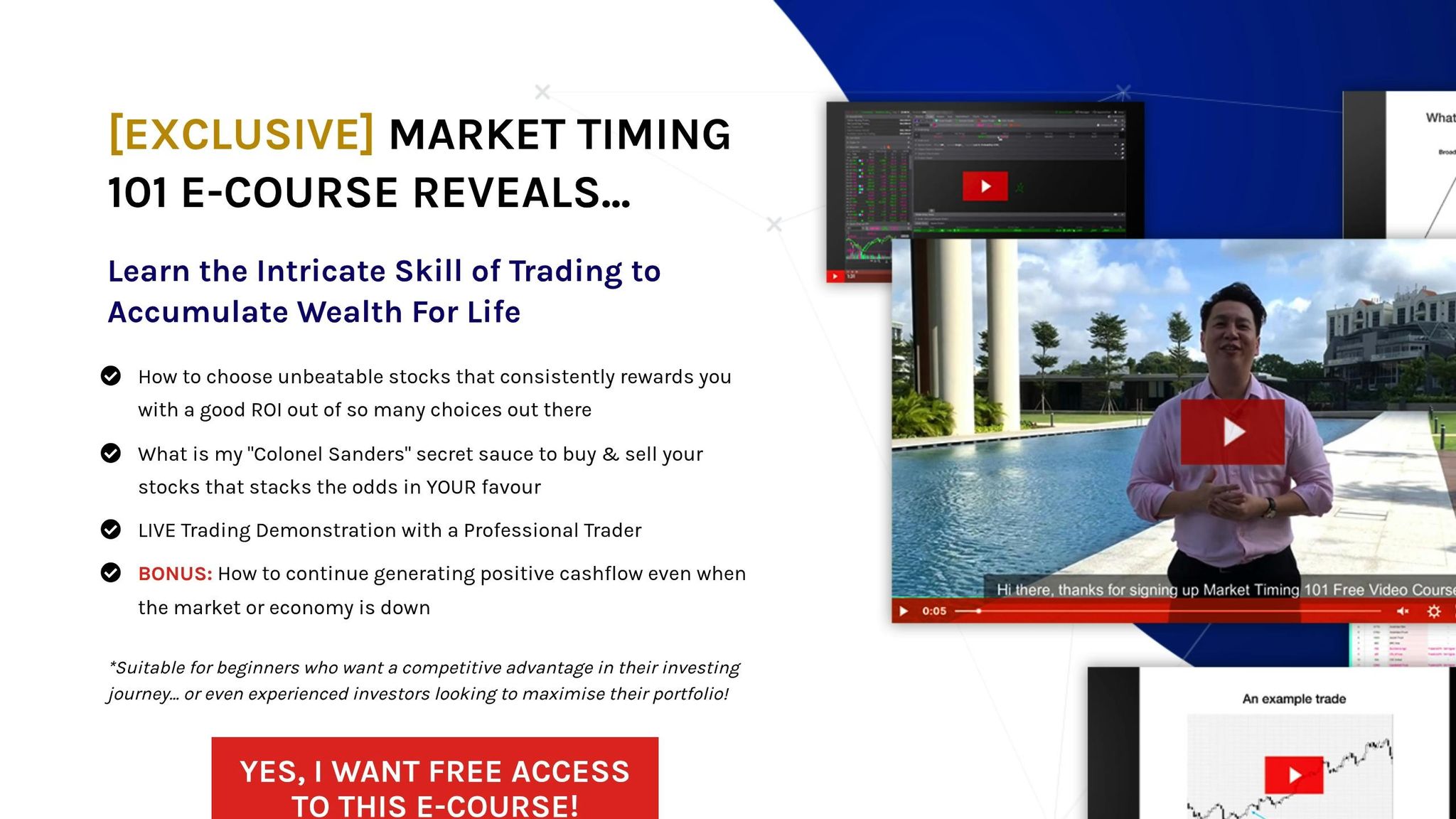
The Market Timing 101 E-Course, which is free, uses GDP trends as a contextual tool rather than a frequent trading signal. When Singapore’s year-on-year GDP growth is solid and exceeds its long-term average, and key trading partners are showing upward revisions in their growth forecasts, traders are encouraged to focus on long setups in cyclical and trade-related sectors. This is especially true when technical indicators – like moving averages, trend filters, or price action – turn bullish. On the flip side, during periods of declining GDP forecasts, the course emphasises preserving capital, tightening stop-loss levels, and being more selective with entries.
A straightforward checklist helps traders align GDP surprises with macroeconomic regimes that guide trade setups and risk management. For example:
- Expansion Regime: Allow higher equity exposure and favour trend-following strategies.
- Cautious Regime: Reduce portfolio exposure and focus on defensive sectors.
Traders are advised to act only when macroeconomic signals align with technical indicators. If there’s a mismatch – like weak GDP but a strong price trend – the system prioritises price action, treating GDP as a secondary risk-management layer rather than a decisive veto.
Master Systematic Trading with Collin Seow
Learn proven trading strategies, improve your market timing, and achieve financial success with our expert-led courses and resources.
Systematic Trading with GDP Data in the Systematic Trader Program
The Systematic Trader Program takes a more advanced approach by integrating GDP trends into portfolio management. This programme mechanically adjusts portfolio exposure and strategy allocation based on whether domestic and global GDP growth are above or below their long-term averages and whether growth forecasts are being revised up or down.
In Singapore, where economic growth and market performance are closely tied to global trade, GDP-driven rules play a critical role in managing risk. For instance:
- If Singapore or its major trading partners show slowing GDP growth and downgraded forecasts, the system can automatically reduce the maximum position size per trade (e.g., from 2% to 0.5–1% of capital).
- It can also lower overall portfolio exposure and impose stricter limits on trade-related sectors like manufacturing and wholesale trade, especially when reports from the Ministry of Trade and Industry (MTI) or Monetary Authority of Singapore (MAS) signal potential slowdowns due to tariffs or weaker external demand.
Historical examples of sharp GDP contractions or external shocks are used to test the system’s rules. These simulations demonstrate how the framework would have reduced exposure and protected capital during past economic stress, helping traders build confidence in the system’s ability to weather similar challenges in the future.
Conclusion
GDP growth plays a key role in shaping corporate earnings, interest rates, and investor sentiment. For traders in Singapore’s small, open economy, staying on top of both local GDP trends and those of major trading partners like the US, China, and the Eurozone can provide a clear advantage. This is particularly important for navigating export-driven sectors such as electronics, financials, and trade-related stocks listed on the SGX. Historically, stronger-than-expected GDP figures have boosted equity sentiment and cyclical sectors, while slower growth often favours defensive plays and safe-haven assets.
GDP data becomes even more impactful when paired with related indicators like inflation, employment figures, and PMI. When integrated into systematic, rules-based trading strategies, these insights can help traders make more informed decisions. For instance, GDP trends can guide event-driven trading rules, shape macro-regime models for equity and sector allocations, and inform risk management strategies that adjust position sizing during periods of slowing growth. This structured approach equips traders to handle market volatility while aiming for steadier, long-term performance.
Discipline and strict risk management are critical when trading around GDP releases. As Collin Seow puts it, “Success in trading is not just about making decisions; it’s about making informed decisions.” Traders who rely on predefined rules, maintain realistic expectations about win rates, and stick to consistent risk limits are better positioned to avoid overtrading and emotional reactions to news.
To put these principles into action, consider leveraging the resources offered by Collin Seow Trading Academy. The Academy provides tools and courses, such as the Market Timing 101 E-Course and the Systematic Trader Program, to help traders turn macroeconomic insights like GDP growth into actionable strategies. These programmes teach traders how to combine GDP data with technical signals, apply disciplined risk management, and build a personalised, rules-based trading plan. For Singapore traders, this means creating a framework that respects market volatility, avoids common behavioural pitfalls, and aims for consistent results.
Start by tracking GDP release calendars and observing market reactions. Experiment with simple, rules-based strategies and explore the Collin Seow Trading Academy’s courses, free e-courses, and webinars to enhance your trading approach. Systematic trading is a skill that can be developed over time, offering a structured path to navigate the complexities of the market.
FAQs
How does GDP data help traders anticipate market trends?
Traders rely on GDP data as a key indicator of an economy’s overall health and to gauge potential market movements. When GDP shows strong growth, it typically signals a robust economy, which can uplift investor confidence and push stock prices upward. Conversely, weak or shrinking GDP often points to an economic slowdown, prompting more cautious market behaviour or a pivot towards safer investment options.
By studying quarterly GDP reports alongside technical indicators and market sentiment, traders can fine-tune their strategies. This combination allows them to pinpoint more precise entry and exit points, enhancing timing and managing risks more effectively in systematic trading.
How do unexpected GDP results affect Singapore’s currency and bond markets?
Unexpected GDP results can cause noticeable ripples in Singapore’s currency and bond markets. When GDP growth exceeds expectations, it tends to uplift confidence in the economy. This usually strengthens the Singapore dollar (SGD) while pushing bond yields lower, as investors feel more optimistic about stable growth and reduced risks.
Conversely, weaker-than-expected GDP figures often have the opposite effect. The SGD may weaken, and bond yields might rise, signalling cautious investor sentiment and unease about potential economic hurdles. These reactions are typically tied to shifts in risk appetite and predictions about future changes in monetary policy.
How do indicators like PMI and inflation work alongside GDP in trading strategies?
Indicators like the Purchasing Managers’ Index (PMI) and inflation provide timely insights that complement GDP when analysing economic trends. While GDP gives a broad picture of overall economic performance, PMI focuses on business activity and economic momentum. Inflation, on the other hand, sheds light on changes in purchasing power and price levels.
Looking at these indicators together allows traders to fine-tune their timing, evaluate market risks, and craft strategies tailored to specific sectors. This integrated approach is especially useful for navigating dynamic markets such as Singapore’s, enabling more informed and strategic trading decisions.