
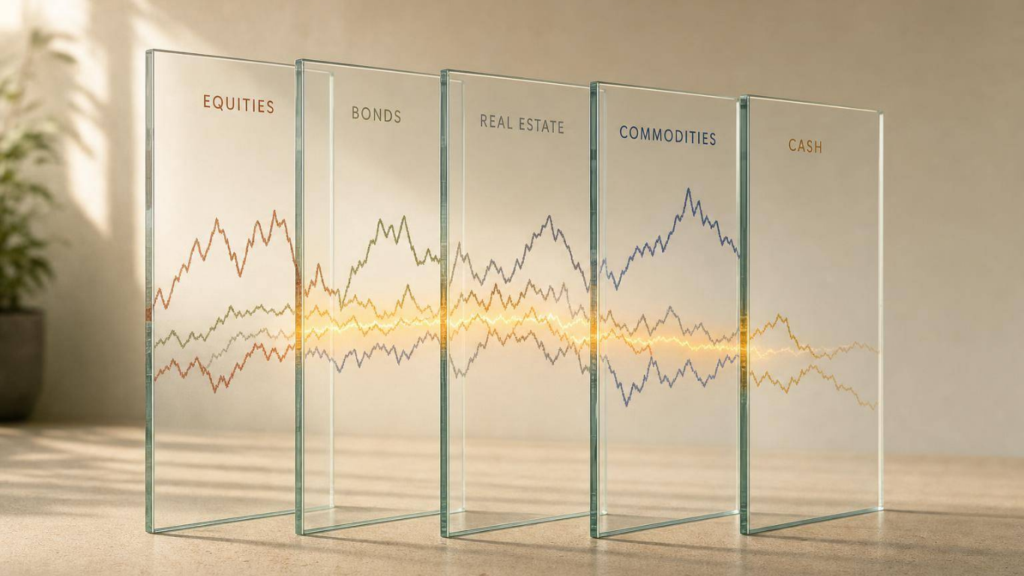
More holdings do not always mean less risk. If your assets move together, your portfolio can still fall together.
Here’s my simple takeaway: I should check what drives each holding, not just count how many funds or asset classes I own. A portfolio with equities, REITs, bonds, gold, and overseas ETFs can still be packed with overlap. In Singapore, that often shows up through bank-heavy STI exposure, S-REIT sensitivity to interest rates, and repeated US mega-cap names inside “global” funds.
What I’d keep in mind straight away:
- Correlation matters more than labels
- Diversification gets weaker when markets are under stress
- The old 60/40 mix did not hold up in 2022
- US and developed ex-US equities have high correlation at about 0.84
- When inflation and volatility climb, assets that usually offset each other may start moving the same way
- A 24-month baseline plus a 60-day rolling check can help me spot changes early
- Position sizing, overlap checks, and rebalancing rules matter more than adding extra funds
A few numbers stand out:
- The top 3 local banks make up more than 40% of the STI
- Financials are about 53–54% of the SPDR Straits Times Index ETF sector weight
- In 2022, 9 out of 10 major asset classes posted major losses together
- When US CPI goes above 4.13%, bonds have often moved in the same direction as equities
- When the VIX goes above 28.99, risky assets tend to become more correlated
If I want a portfolio that holds up better, I’d focus on three things: check rolling correlation, reduce hidden overlap, and size positions by shared risk. That is the core idea behind the whole article.
| What to check | What it can show | What I may do |
|---|---|---|
| Local equity + REIT exposure | Shared Singapore rate and liquidity risk | Cut overlap or trim one side |
| Multiple global ETFs | Same top US tech names repeated | Review top 10 holdings across funds |
| Equity + high-yield bond mix | Equity-like behaviour in sell-offs | Treat as one risk bucket |
| Bond allocation | May not offset equities in inflation shocks | Review bond role, duration, and cash buffer |
| Rolling correlation | Drift toward holdings moving in sync | Rebalance when limits are breached |
That’s the short version: I should measure overlap, not assume diversification from fund names or asset labels.
sbb-itb-466c9b0
Problem 1: Diversification Can Break Down When Correlations Rise
A portfolio can hold equities, REITs, bonds, and global funds – and still drop together during a market shock. The core issue is shared exposure, not the number of assets you own, a challenge often addressed through systematic trading strategies. And that gets much harder to spot when each holding is viewed on its own.
How Correlations Spike During Market Stress
In calm markets, assets may move in different directions. But when markets get hit, correlations often climb fast, and losses start moving in sync.
The 2022 interest rate shock is a clear case. Central banks hiked rates hard to fight inflation, and that triggered a broad sell-off across almost every major asset class. Government bonds, property, and equities all fell sharply at the same time. In fact, 9 out of 10 major asset classes posted major losses together that year. The old 60/40 equity-bond portfolio – long seen as a steady setup – did not protect investors.
Columbia Threadneedle fund managers said 60:40 diversification “went into reverse” in 2022.
That kind of stress test shows why portfolio-level correlation matters more than surface-level labels. Historical correlations often fail you when markets are under pressure – exactly when you want protection most.
Hidden Concentration in Equities, REITs, and Regional Exposure
This issue does not start only in a crisis. Many portfolios already carry shared risk drivers before markets turn.
In Singapore, a common case is holding local bank stocks together with S-REITs. On paper, they seem separate. In practice, both depend on Singapore interest rates and banking liquidity, so they can move in the same direction.
Then there are multiple “global” ETFs. That may sound well spread out, but the overlap can still be heavy. Many “global” funds hold the same large US tech names – such as Apple and Microsoft – across different products. The label says global diversification. The underlying holdings tell a different story.
Perceived Diversification vs Actual Correlation Risk
The table below shows how common portfolio mixes can hide shared risk drivers, especially for Singapore-based investors.
| Portfolio Characteristic | Why It Looks Diversified | Hidden Correlation Issue | Likely Outcome During a Market Sell-Off |
|---|---|---|---|
| Heavy STI + S-REITs | Holds dozens of stocks and multiple property types | Both share Singapore’s interest rate environment and banking liquidity as risk drivers | Sharp, synchronised decline as both sectors react to local liquidity tightening |
| Multiple “Global” ETFs | Spreads money across different fund managers and regions | Same US mega-cap tech names (e.g. Apple, Microsoft) appear across different “global” products | Portfolio falls together if the US tech sector corrects, regardless of the “global” label |
| 60/40 Equity-Bond Split | Bonds are usually seen as the cushion against equity swings | In high-inflation, rising-rate periods, both face the same downward pressure | Large drawdowns as the defensive buffer disappears |
| Equities + High-Yield Bonds | Mixes growth with income | High-yield bonds behave more like equities in a crisis than like government bonds | Both asset classes fall at the same time as credit spreads widen |
Across all four cases, owning more holdings without adding different risk drivers is not diversification. It is diworsification: more complexity, more fees, and no extra resilience.
The next problem is that many investors track each asset on its own and miss the overlap at the portfolio level.
Master Systematic Trading with Collin Seow
Learn proven trading strategies, improve your market timing, and achieve financial success with our expert-led courses and resources.
Problem 2: Most Investors Track Assets Separately, Not as a Portfolio
Hidden overlap is easy to miss when you look at holdings one by one. That’s how most investors do it. But portfolio risk doesn’t come from each asset in isolation. It comes from how those assets move together.
How to Read a Correlation Matrix
A correlation matrix shows how each pair of assets moves together on a scale from -1.0 to +1.0. If a pair starts drifting toward +1.0, that’s a warning sign. It means your diversification is getting weaker.
A good example is US and developed ex-US equities, which correlate at around 0.84. On paper, holding both may look diversified. In practice, the protection is smaller than many investors expect.
A simple way to track this:
- Use a 24-month baseline for a steadier view
- Add a 60-day rolling check to catch market regime shifts earlier
Why Rolling Correlation and Regime Changes Matter
One static reading won’t tell you enough. Correlations change when the macro backdrop changes.
UBS Asset Management notes that correlations are not static.
US Treasuries and equities show this clearly. From 1950 to 2000, they were positively correlated. Then that link flipped negative for about 20 years. More recently, it has turned positive again. That means bonds may no longer cushion equity losses the way many investors assume.
Two macro triggers stand out.
When US CPI inflation rises above 4.13% – the top 10% of historical environments – government bonds have tended to move in the same direction as equities, not the opposite.
And when the VIX crosses 28.99, the correlation between most risky asset classes and equities climbs fast. In those periods, only cash and certain macro strategies have tended to resist the sell-off.
FTSE Russell says historical correlations can be a poor guide to future correlations.
That’s why rolling correlation matters. A 60-day rolling check or a 24-month baseline can help you spot these shifts before they hit your portfolio too hard.
Comparing Correlation Measurement Methods
Different methods pick up different parts of correlation risk. Here’s a quick side-by-side view.
| Method | Strengths | Limitations |
|---|---|---|
| Simple Historical Correlation | Easy starting point, but backward-looking. | Misses sudden regime shifts. |
| Rolling Correlation | Shows changing relationships, though shorter windows can be noisy. | Sensitive to lookback window choice. |
| Factor-Based Analysis | Finds shared drivers such as rate sensitivity, but needs specialised tools. | Requires specialised software to break assets into underlying risk factors. |
| Regime-Switching Models | Picks up non-linear shifts, but is harder to use. | Requires large amounts of historical data and macro analysis. |
For most investors, rolling correlation is the easiest first screen before making allocation or position-sizing decisions. Start there, then turn what you see into allocation and sizing rules.
Solutions: Practical Ways to Reduce Correlation and Improve Risk-Adjusted Returns
The fix is to manage shared risk drivers, not just pile on more positions.
Diversify Across Different Risk Drivers, Not Just More Holdings
Adding more funds or positions doesn’t cut risk by itself. If those holdings lean on the same drivers – growth, inflation, or interest rate expectations – they’ll often fall together when markets turn. You end up with more line items, not more diversification.
A better way is to map each position to the main thing that moves it: monetary policy expectations, global risk sentiment, commodity supply dynamics, or currency differentials. Assets that react to different drivers are less likely to move in lockstep during a sell-off.
Focus on the source of risk, not just the label on the fund. Gold and the USD index are a good example. Gold is priced in USD, so the two tend to have a structural negative correlation. That tends to make the pairing more dependable as a diversifier than short-term correlations that show up for a while and then fade.
In Singapore, many portfolios bunch up around the same local equity, income, and currency drivers. That’s a bigger issue than it looks, especially when STI, REIT, and SGD exposure start overlapping.
Once you know the main drivers, the next step is simple: control how much risk each one adds.
Risk-Based Allocation, Position Sizing, and Currency Awareness
Risk-based allocation spreads risk more evenly. Instead of putting the same dollar amount into each asset, you size holdings so each asset class contributes roughly the same amount of risk to the portfolio. That helps stop high-volatility assets, such as equities, from dominating everything else.
Position sizing matters too, especially when two holdings are tightly linked. If two positions have a correlation of 0.8, treating them as separate risks can make your diversification look better than it is. A cleaner approach is to treat highly correlated positions as one risk bucket, then size that bucket against your total risk limit.
Currency matters as well. Singapore’s policy is exchange-rate based, so currency exposure affects both import costs and local asset values. For short-term goals of up to 3 years, keeping exposure in SGD can make sense if you want more predictable outcomes. For longer-term growth capital, some foreign currency exposure can help offset local economic risk. And if you hold international assets, rebalance when any asset class drifts 5–10 percentage points from target instead of waiting for a set calendar date.
Correlation becomes useful only when it changes how you size positions and when you rebalance.
Use the checklist below to pick the simplest lever first.
Correlation Management Strategies at a Glance
| Strategy | Primary Objective | Correlation Impact | Implementation Challenge |
|---|---|---|---|
| Adding High-Quality Bonds | Provide stability and ballast | Typically low or negative correlation to equities during growth shocks | Sensitivity to rapid interest rate hikes |
| Gold Allocation | Inflation hedge and safe haven | Low or negative correlation to USD and equities | No yield; price influenced by USD strength |
| Risk-Based Sizing | Equalise risk contribution across assets | Reduces the impact of high-volatility asset clusters | Requires ongoing volatility monitoring |
| Currency Hedging | Manage SGD versus foreign currency exposure | Reduces the impact of SGD/USD movements | Hedging costs can erode long-term returns |
| Reducing Equity Overlap | Eliminate hidden concentration | Remove hidden overlap by checking underlying holdings, not fund names | Requires a look-through of fund holdings |
Applying Correlation Insights in Systematic Trading and Singapore Portfolios
How to Build Correlation Checks into a Trading Process
Once you know correlation can weaken diversification, the next step is simple: make it part of your regular portfolio review. Don’t wait for a shock in the market. Check it on a set schedule, such as every month or quarter.
A practical rule helps. If rolling correlation goes above your limit, trim the total exposure. When two positions start moving in lockstep, reduce the combined position size.
This matters even more in Singapore, where index and sector overlap can hide your actual risk. For example, if you hold the STI ETF together with bank stocks or financial sector funds, you may be doubling up on Singapore financial exposure. On paper, the portfolio can look spread out. In practice, it may be leaning heavily on the same part of the market.
Once a year, list the top 10 holdings across all your funds and accounts. That simple overlap check often shows that a portfolio is clustered in the same names.
How Collin Seow Trading Academy Supports a Systematic Approach

A systematic trading approach makes these checks easier to repeat. Collin Seow Trading Academy offers systematic trading resources, including The Systematic Trader v.2, free e-courses, live webinars, and video content, for investors building a rule-based risk process.
Conclusion: The Key Lesson on Correlation and Diversification
The main lesson is straightforward: measure overlap, not labels. Size positions based on shared risk, and rebalance when correlations climb. That’s what keeps diversification real, instead of something that just looks good on paper.
FAQs
How do I spot hidden overlap in my portfolio?
Look past your list of holdings and pay attention to the forces underneath that make prices move together, especially when markets get shaky.
A correlation matrix can help you spot pairwise coefficients between assets. If those correlations are above 0.7, your portfolio may be too concentrated. On paper, two positions can look different. In practice, they might still react to the same pressure.
It also helps to run stress tests or scenario analysis on a regular basis. That gives you a clearer view of how your holdings might behave in a crisis, when assets that seem unrelated can suddenly start moving in sync.
How often should I check rolling correlation?
Check rolling correlation often. Market relationships can change within days after major economic announcements, so an old reading can go stale fast. A simple way to stay on top of it is to recompute your correlation matrix every month.
Correlations also tend to spike during periods of market stress or financial crises. That’s why active monitoring works better than relying on a fixed snapshot from the past. Collin Seow Trading Academy offers educational resources to help traders spot these shifts and use systematic strategies.
What should I do when correlations rise?
When correlations rise, diversification often loses some of its punch. In stressed markets, assets that usually move differently can start moving in the same direction at the same time.
That’s why risk control matters even more in these periods. A few practical moves can help:
- Cut position sizes so one sharp market swing doesn’t hit your portfolio too hard.
- Stress-test your portfolio for high-correlation scenarios to see what might happen if multiple holdings fall together.
- Use dynamic or regime-switching models that adjust when market conditions change.
- Look at structural hedges such as cash or long-dated put options for extra protection.
If you want more guidance, Collin Seow Trading Academy also offers resources on systematic strategies for volatile markets.