
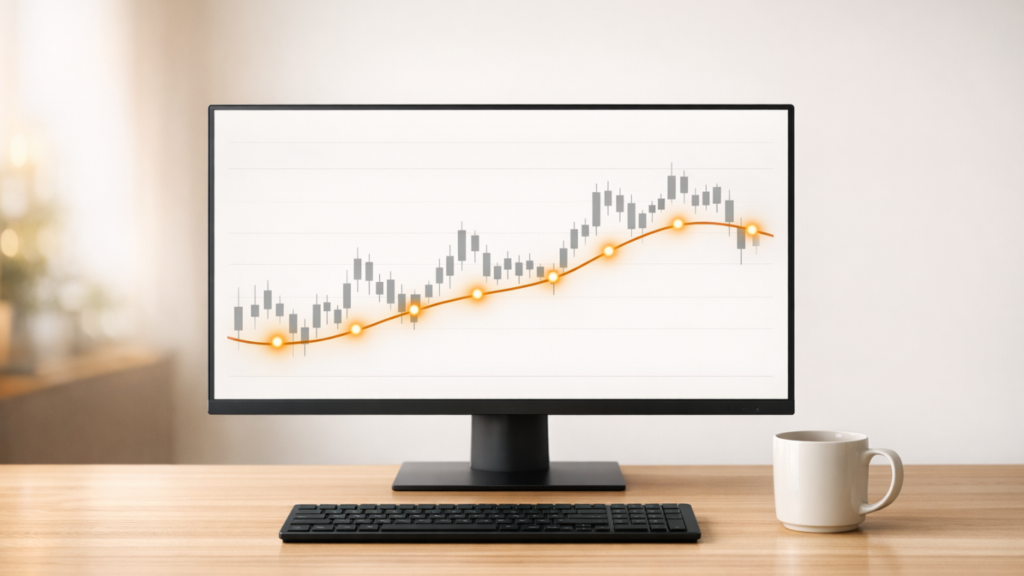
Moving averages are a popular tool for spotting trends, but many traders misuse them, leading to costly errors. Here are the 7 most common mistakes:
- Using Only One Moving Average: Relying on a single moving average can give incomplete signals. Combining multiple averages (e.g., 20-day, 50-day, 200-day) provides better confirmation of trends.
- Picking the Wrong Timeframe: Using mismatched timeframes can create conflicting signals. Tailor the timeframe to your trading style – short-term for scalping, medium-term for swing trading, and long-term for investing.
- Overloading Charts with Too Many Moving Averages: Adding too many averages clutters your chart and creates confusion. Knowing how to read stock charts properly helps you maintain clarity. Stick to two or three key periods for clarity.
- Ignoring Price Action and Market Context: Moving averages reflect past data and don’t account for real-time market conditions. Combine them with candlestick patterns or volume analysis for better insights.
- Not Adjusting for Market Volatility: Fixed moving averages fail in volatile markets, causing false signals. Use exponential moving averages (EMAs) for quicker reactions or adapt settings to current conditions.
- Selecting the Wrong Type of Moving Average: Choose the right type – SMA for long-term trends, EMA for short-term moves, or WMA for a balance. Match the type to your trading goals.
- Trading Without Confirmation: Acting on moving averages alone is risky. Validate signals with indicators like RSI, MACD, or volume trends to avoid false entries.
Key takeaway: Moving averages are useful but must be paired with other tools and strategies to avoid misleading signals. Simplify your approach, pick the right settings, and always consider the broader market picture.
Do You Make These Moving Average Mistakes?
sbb-itb-466c9b0
1. Using Only One Moving Average
Relying on a single moving average is like trying to navigate Singapore with just half a map – sure, you might get a sense of direction, but you’ll likely miss key turns along the way. For example, while a 50-day moving average might suggest an uptrend, a 200-day moving average could paint a completely different picture, pointing to a long-term downtrend instead. This mismatch across timeframes can lead to decisions that don’t align with the bigger picture.
The problem with using just one moving average is that it doesn’t provide confirmation. It’s tough to tell whether you’re seeing a real trend reversal or just market noise. By combining multiple moving averages, traders can identify crossovers – like when a short-term moving average crosses below a long-term one, signalling a bearish shift (often called a “death cross”). Without this extra layer of confirmation, signals can be misleading.
“Relying too heavily on a single technical indicator without considering other factors can be misleading.” – Pepperstone Trading Guides
Take this example: a swing trading strategy for AAPL used both a 10-day and a 50-day simple moving average (SMA). A buy signal appeared when the 10-day SMA crossed above the 50-day SMA at $150, and a sell signal was triggered when it crossed back below at $190. This simple strategy resulted in a $40 profit per share.
Using multiple timeframes – such as combining 20-day, 50-day, and 200-day moving averages – can help traders understand both short-term momentum and the broader market trend. This approach is particularly useful for filtering out weak signals and avoiding false breakouts, especially in sideways markets.
Recognising that a single moving average isn’t enough is the first step toward sidestepping other common trading mistakes.
2. Picking the Wrong Timeframe
Selecting the wrong timeframe is like relying on tomorrow’s weather forecast to plan today – it can lead to misjudging market conditions. For instance, a 50-day moving average might suggest an uptrend, but stepping back to a 200-day moving average could reveal that the apparent rally is just a temporary bounce within a broader downtrend. This kind of mismatch can create conflicting signals, resulting in poorly timed entries and exits.
There’s no universal timeframe that fits all situations. Each asset has its own unique characteristics – volatility, price history, and trading patterns. A timeframe that works well for the Straits Times Index might give misleading signals when applied to a highly volatile cryptocurrency. In fact, moving averages often struggle to provide clarity in volatile or range-bound markets. This highlights the importance of customising your timeframe to suit the asset you’re trading.
As Nayab Bhutta, a trader and ML builder, aptly puts it:
“Moving averages are not signals. They are frameworks.”
To avoid this common pitfall, align your moving averages with your trading goals. For scalpers operating on 1-minute to 15-minute charts, fast and adaptive moving averages like the 9-period or 21-period EMA are crucial to minimise lag. Swing traders using hourly or daily charts might prefer trend-following averages such as the 50-day or 100-day EMA to capture medium-term trends without overtrading. Meanwhile, long-term position traders focusing on daily or weekly charts can rely on the 200-day SMA as a structural guide to manage portfolio-level risk.
Always keep an eye on higher timeframes, like daily or weekly charts. This helps you avoid trading against a larger structural trend and mistaking short-term counter moves for genuine reversals.
3. Adding Too Many Moving Averages to Charts
Overloading your chart with too many moving averages can make things unnecessarily complicated. Imagine trying to navigate with five different maps at once – you’d likely feel more lost than when you started. Similarly, stacking multiple moving averages, like 20-day, 50-day, 100-day, 150-day, and 200-day, layers overlapping lagging data. This often leads to conflicting signals that blur the trend direction rather than clarifying it.
This kind of clutter can cause what’s commonly referred to as analysis paralysis. Instead of gaining insights, you’re left staring at a maze of lines that obscure the actual price action. Shaun Murison, Senior Market Analyst at IG, puts it well:
“Some traders use too many MAs, creating confusion rather than clarity. Stick to two or three key periods for clearer signals.”
Keeping your chart simple is crucial for avoiding misinterpretations and false signals. In volatile or range-bound markets, too many moving averages can lead to frequent crossovers that add little to no actionable value.
The fix is straightforward: limit yourself to two or three moving averages. A commonly used and effective combination is the 20-day, 50-day, and 200-day moving averages. Together, these provide a balanced view of short-, medium-, and long-term trends. This “rule of three” keeps your chart uncluttered, making it easier to focus on price action and the most relevant indicators. Always remember, moving averages are there to support your analysis, not dominate it. They should work alongside other tools like momentum oscillators or candlestick patterns to give you a clearer picture.
4. Ignoring Price Action and Market Context
Once you’ve fine-tuned your choice of indicators, it’s crucial to include real-time price action and market context to validate the signals you’re seeing. Relying solely on moving averages won’t give you the full picture. These indicators are based on historical data, meaning they reflect past trends rather than predict future movements. Depending entirely on a moving average crossover or a price touching the 50-day line is like navigating traffic by looking only at the rear-view mirror. Incorporating price action helps you determine whether these signals align with current market trends.
Overlooking price action can increase your risk significantly. For instance, while a moving average might suggest a level of dynamic support, without confirmation from candlestick patterns – like a bullish Hammer or a bearish Marubozu – you can’t be certain that the support will hold. Kelvin Wong, Senior Market Analyst at OANDA, emphasises this point:
“Moving averages should not be used in isolation. Combining them with other tools, such as momentum oscillators, or Japanese candlestick patterns can increase their effectiveness and help manage risk.”
Beyond price action, you need to consider the broader market context. Moving averages don’t account for fundamental changes, such as shifts in company leadership, new competitors entering the market, or changes in industry demand. For example, a bullish crossover might show up on your chart, but the company could simultaneously be facing challenges that the moving averages can’t detect. These fundamental factors can significantly influence market behaviour and make technical signals less reliable.
This issue becomes even more pronounced in sideways or choppy markets. When a stock isn’t trending clearly, moving averages can produce frequent false signals as prices fluctuate without a definitive direction. Acting on these signals can lead to poor reward-to-risk ratios, especially if you enter a trade after a significant price move has already occurred. To use moving average strategies effectively, ensure the market is trending clearly, as these indicators perform best in directional environments.
Master Systematic Trading with Collin Seow
Learn proven trading strategies, improve your market timing, and achieve financial success with our expert-led courses and resources.
5. Not Adjusting for Market Volatility
Market conditions are constantly shifting, and relying on a fixed moving average across all scenarios can lead to trouble during periods of high volatility. Think of it this way: using a fixed moving average in every situation is like driving at the same speed in clear weather and dense fog – it just doesn’t work. During volatile times, prices can repeatedly cross the moving average without establishing a clear trend. This phenomenon, known as whipsawing, can trigger false signals and lead to larger drawdowns.
The core issue lies in the nature of moving averages – they’re lagging indicators built on historical price data. When the market experiences rapid price swings, the lag becomes more noticeable, and signals may come too late to reflect the current trend. As Investopedia explains:
“If a market is bouncing up and down a lot, moving averages are not likely to capture any meaningful trends.”
Moving averages tend to perform well during clear, sustained trends, whether upward or downward. However, they often falter in sideways or choppy markets.
To handle volatility, consider adapting your approach. For example, during turbulent market conditions, switching from simple moving averages (SMAs) to exponential moving averages (EMAs) can help. EMAs place greater emphasis on recent price data, making them more responsive to rapid changes. Another option is to use moving average ribbons – multiple moving averages with varying periods. These ribbons can help identify consolidation zones. When the lines cluster tightly, it signals low market conviction; when they spread out, it often confirms a developing trend.
Clemence Benjamin, a technical analyst, highlights the importance of adjusting to market dynamics:
“Markets are dynamic by nature. Levels that once appeared reliable can lose effectiveness as volatility increases and price structure becomes irregular.”
Instead of treating a moving average as a rigid line, think of it as a probability zone – a range where prices are likely to interact, accounting for natural market noise and occasional overshoots.
Timeframe adjustments are another key strategy. Scalpers, for instance, may use very short periods (1–5) to react quickly to reversals, while swing traders often prefer medium-term periods (10–50) to filter out daily fluctuations. Ultimately, every asset’s volatility requires tailored settings. Base your parameters on the current market behaviour, rather than sticking to a one-size-fits-all approach.
6. Selecting the Wrong Type of Moving Average
Picking the wrong moving average can throw off your trading strategy. The three main types – Simple Moving Average (SMA), Exponential Moving Average (EMA), and Weighted Moving Average (WMA) – react differently to price movements. Knowing how each works is key to spotting trends effectively. This choice is just as important as selecting the right timeframes or asset-specific settings mentioned earlier.
The SMA calculates the average price over a set period, giving equal weight to all data points. It’s slower to react to price changes, making it ideal for identifying long-term trends or key support and resistance levels. But in fast-moving markets, this lag can be a drawback. As Financial Tech Wiz puts it:
“The SMA responds slowly to recent price changes. In fast-moving markets this lag can produce late entries and exits.”
The EMA, however, applies more weight to recent prices, making it far more responsive. This is why short-term traders often prefer it. Shaun Murison, an analyst at IG, explains:
“While both serve similar purposes, EMAs give more weight to recent prices, making them more responsive to current market conditions.”
That said, EMAs can be overly sensitive in volatile or sideways markets, leading to false signals from temporary price spikes.
The WMA strikes a middle ground, assigning weights linearly, with the most recent price carrying the highest weight. For example, in a 5-day WMA, today’s price is multiplied by 5, yesterday’s by 4, and so on. It’s more reactive than the SMA but less jittery than the EMA. Despite this balance, WMAs are less commonly used by traders.
Using the wrong moving average type can create a mismatch between your tools and trading objectives. For instance, applying a slow SMA in day trading might mean entering trends too late, while an overly sensitive EMA in long-term trading could lead to premature exits due to minor fluctuations. The right choice depends on your trading timeframe and market conditions. As Investopedia notes:
“Traders will use EMAs or WMAs over the SMA when concerned that lags in the data might lower the responsiveness of the moving average indicator.”
Choosing the right moving average type ensures your strategy aligns with your trading goals and complements earlier lessons on timeframes and volatility adjustments.
7. Trading Moving Averages Without Confirmation
Relying solely on moving averages for trading decisions is a risky move. These indicators are based on historical data, which means they often miss sudden market shifts like changes in industry demand or the entry of new competitors. As Investopedia points out:
“Like any type of technical analysis tool, chart indicators don’t take into account changes in fundamental factors that may affect a security’s future performance.”
The risk becomes even more pronounced in sideways or range-bound markets, where prices lack a clear trend. In such cases, moving averages can produce misleading signals. For instance, a bullish crossover on a 50-day moving average might suggest an uptrend, while the 200-day moving average still indicates a downtrend. These conflicting signals can easily trap traders. To steer clear of such pitfalls, it’s essential to validate moving average signals with other indicators.
To manage this risk, combine moving averages with tools like the RSI, MACD, and volume analysis. The Relative Strength Index (RSI) identifies overbought or oversold conditions. For example, if a moving average crossover aligns with an RSI reading over 70, it may indicate an overextended trend. The Moving Average Convergence Divergence (MACD) helps confirm momentum shifts, making crossovers more reliable when its signal line crosses or the histogram expands. Volume analysis also plays a key role – rising volume tends to support a trend, while declining volume can signal weakness. Watch for divergence: if prices hit new highs but the RSI or MACD shows lower highs, it might indicate weakening momentum, even if the moving averages suggest otherwise. In markets without a clear trend, oscillators like the RSI are often more effective.
Collin Seow, Founder of The Systematic Trader, sums it up well:
“Relying on a single indicator is a recipe for disaster; momentum analysis requires a ‘weight of evidence’ approach where multiple tools confirm the same story.”
Comparison Table
Different types of moving averages cater to varying trading styles. The Simple Moving Average (SMA) is calculated by taking the arithmetic mean of prices over a specific period, giving equal importance to all data points. In contrast, the Exponential Moving Average (EMA) applies a smoothing factor – commonly calculated as [2 / (selected period + 1)] – which places greater emphasis on recent price movements, allowing it to react faster to price changes. Another option, the Weighted Moving Average (WMA), assigns linear weights, with the most recent prices holding the highest weight. Choosing the right moving average type and timeframe is essential for aligning with your trading goals.
| MA Type | Calculation Method | Characteristics | Best Application |
|---|---|---|---|
| Simple (SMA) | Arithmetic mean of past prices | Stable, smooth, higher lag | Identifying long-term trends and major support/resistance |
| Exponential (EMA) | Weighted towards recent prices | Responsive, less lag | Short-term momentum and day trading |
| Weighted (WMA) | Linearly weighted towards recent prices | Highly responsive, follows price closely | Capturing quick momentum changes |
In addition to choosing the type of moving average, selecting the appropriate timeframe is equally important. For instance, the 20-day moving average reflects roughly two to four weeks of trading activity, the 50-day average represents about two months of data, and the 200-day average – covering approximately one trading year – is a popular benchmark for analysing long-term trends. Keep in mind that longer timeframes naturally introduce more lag.
| Timeframe | Trend Horizon | Trading Style Suitability | Primary Use Case |
|---|---|---|---|
| 20-day | Short-term (2–4 weeks) | Day Trading / Scalping | Identifying immediate direction and momentum |
| 50-day | Medium-term (2 months) | Swing Trading | Dynamic support/resistance and trend filtering |
| 200-day | Long-term (1 year) | Long-term Investing | Macro trend identification and “Golden/Death Cross” signals |
Conclusion
Moving averages are powerful tools for identifying trends, but they can lead to costly mistakes if used incorrectly. Common errors include relying on a single moving average, selecting unsuitable timeframes, overloading charts with indicators, ignoring price action, failing to account for volatility, using the wrong moving average type, and trading without proper confirmation. To improve your trading outcomes, it’s crucial to combine moving averages with other tools and timeframes. For instance, before acting on a moving average crossover, confirm the signal by examining volume trends and key support and resistance levels. This layered approach helps you filter out false signals and gain a clearer understanding of market conditions.
Adapting your strategy to match current market dynamics is equally important. Since each asset behaves differently in terms of volatility, adjusting your indicators for trending or sideways markets ensures they remain effective. This flexibility is key to making informed decisions.
To avoid these pitfalls, adopting a structured trading plan is essential. A well-defined strategy with clear entry and exit points can help you stay disciplined and avoid emotional decisions. Tools like stop-loss orders can also play a critical role in limiting potential losses. Pairing moving averages with these safeguards creates a more resilient trading framework. Additionally, combining technical analysis with fundamental research can bridge the gaps left by price-based indicators alone.
For traders eager to refine their technical analysis skills and build a systematic approach, Collin Seow Trading Academy offers a range of resources. Their courses, free e-courses, and live webinars are designed to teach you how to integrate moving averages with price action and broader market context. These tools focus on avoiding common mistakes and mastering effective confirmation techniques.
FAQs
Which moving averages should I use together?
Combining a trend indicator like a moving average with a momentum tool such as the MACD or RSI can significantly refine your analysis. The moving average helps identify the overall direction of the market, while momentum tools gauge the strength or speed of price movements. Together, they work to confirm trends and reduce the likelihood of false signals, giving you a clearer and more reliable picture of market conditions.
How do I pick the right MA timeframe for my trading style?
When it comes to picking the right Moving Average (MA) timeframe, it all boils down to your trading approach. For short-term traders, shorter timeframes like 5, 10, or 20 periods are great for capturing quick price changes. On the other hand, if you’re focused on long-term strategies, longer timeframes such as 50, 100, or 200 periods are better for cutting through market noise and identifying broader trends.
Using a mix of MAs with different timeframes can also give you a more comprehensive view of the trend, helping to minimize the chances of misreading signals.
What’s the best way to confirm an MA crossover before trading?
To use an MA crossover effectively, treat it as a confirmation signal instead of a predictive tool. Check that the crossover matches the broader trend and back it up with further analysis. For instance, evaluate the trend’s strength or look out for misleading signals, especially in sideways markets. This method helps minimize the risk of depending only on the crossover.