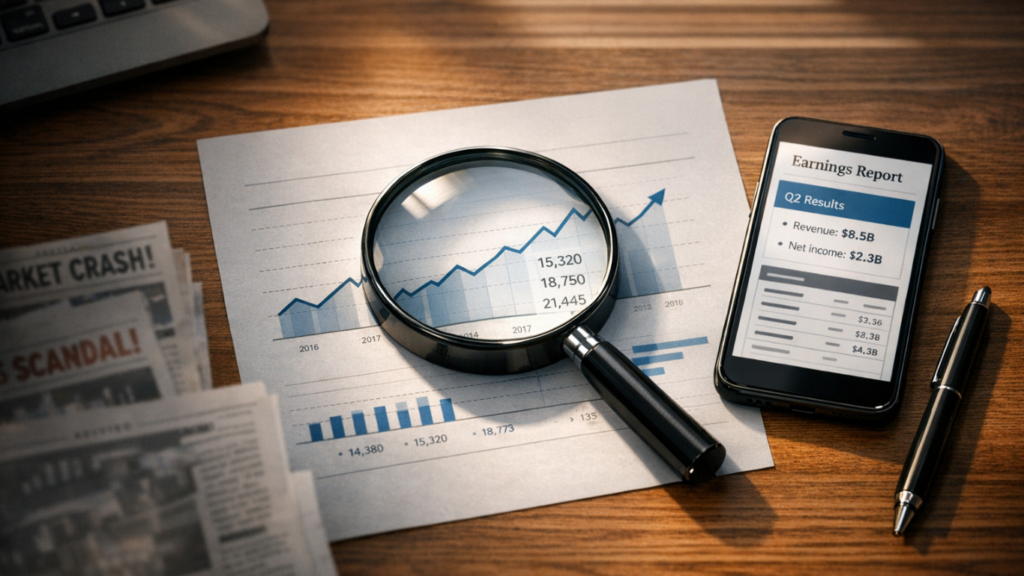
Fake news in financial markets can cost you big time. In Singapore, scams led to losses of S$320.7 million in 2024, with S$32.6 million lost in just January 2025 alone. Misleading information, like false stock tips or fabricated earnings, can manipulate markets and harm your investments.
Here’s how you can protect yourself:
- Verify sources: Stick to trusted platforms like SGX, Bloomberg, or MAS directories.
- Spot red flags: Watch for exaggerated claims, clickbait headlines, and “guaranteed” returns.
- Check timing: Be cautious of news released during low-liquidity periods or sudden price spikes without credible reasons.
- Use official data: Cross-check claims with company financials, such as income statements and balance sheets.
Fake news thrives on fear and greed. By staying informed, verifying your sources, and following a systematic trading plan, you can avoid falling victim to these tactics. Let’s dive into the details to help you trade smarter and safer.
sbb-itb-466c9b0
How to Spot Warning Signs in Financial News
Staying alert to warning signs in financial news is essential for safeguarding your investments, especially in an unpredictable market. By focusing on the source, language, and presentation, you can identify potential manipulation and avoid falling for misleading information.
Verify the Source’s Credibility
Begin by checking the URL for irregularities. Fake news sites often imitate legitimate ones with minor tweaks, such as adding unusual extensions – think “abcnews.com.co” instead of the genuine “abcnews.go.com”.
Look at the “About Us” and “Contact Us” sections. Reputable financial news outlets usually provide detailed information about their leadership, mission, and contact details. If these sections are absent or vague, it’s a red flag. Also, investigate the author’s credentials. Look for professional qualifications like Chartered Portfolio Manager (CPM) or Certified Financial Technician (CFTe) and verify their experience in financial journalism or analysis.
Cross-reference the reported information with mainstream sources. If an obscure site reports a major market event that isn’t covered by established outlets, it’s likely unreliable. A global survey highlighted how 44% of people have been misled by fake news, and false stories on social media are 70% more likely to be shared than accurate ones.
Once the source checks out, dive deeper into the article’s language and formatting for further inconsistencies.
Watch for Language and Formatting Problems
Exaggerated language is a hallmark of fake financial news. Be cautious of articles that overstate facts or use dramatic phrases to create a specific narrative. Pay attention to false attributions, like fabricated quotes or genuine statements taken out of context, as these are often used to mislead readers.
“A news report or commentary is not fake just because people do not like it, or find it inconvenient.” – Tham Yuen-C, The Straits Times
Review the site’s editorial standards. Legitimate outlets follow clear editorial policies, including transparent corrections and proper citations for data and official statements. If a site prominently features disclaimers about unverified, reader-submitted articles or mismatched charts and data, proceed with caution.
Finally, scrutinise headlines for clickbait tactics.
Avoid Clickbait Headlines
Headlines designed to provoke emotions like fear or greed are a common warning sign.
“News, by nature, is designed to grab attention. Headlines are crafted to provoke immediate responses, often pushing traders to act without fully analysing the situation.” – Collin Seow
Instead of reacting to dramatic headlines, verify claims with technical analysis tools such as RSI, MACD, or ADX indicators. Focus on stocks with real comparative strength rather than those hyped by social media or dubious news sources. Remember, 71% of retail client accounts lose money when trading CFDs, often due to the leverage risks exacerbated by unreliable information. Always conduct thorough research and stick to a systematic approach that matches your risk tolerance.
How to Verify Financial Claims with Trusted Data
Once you’ve identified warning signs, the next step is to verify financial claims using reliable, official data. This process helps you distinguish fact from fiction, ensuring your decisions are based on accurate information.
Compare Claims with Official Company Reports
Start by accessing official repositories. For companies listed in Singapore, the Singapore Exchange (SGX) website is a key resource. It offers access to official company announcements, corporate actions, and complete annual reports. To verify claims, compare them against the three main financial statements:
- Income Statement: Focus on revenues and expenses.
- Balance Sheet: Review assets, liabilities, and equity.
- Statement of Cash Flows: Analyse cash inflows and outflows.
Pay close attention to footnotes and disclosures. These often reveal important details like contingent liabilities or related-party transactions. The Management Discussion and Analysis (MD&A) section is another valuable tool – it can help you determine whether reported changes are part of a deliberate strategy or overstated.
Check financial metrics like liquidity ratios and debt-to-equity ratios using these official reports. Be alert for warning signs such as sudden earnings spikes, heavy dependence on a single customer, or overly complex transactions. It’s worth noting that financial statement fraud is particularly damaging, with a median loss of S$954,000 per incident.
For example, when unverified claims about reduced copper production led to a 3% pre-market drop in BHP Group‘s stock, it underscored the importance of verifying such news with official company reports.
Use Established Financial Platforms for Fact-Checking
Trusted financial platforms are another essential tool for verification. Bloomberg Terminal, for example, offers features like corporate filings (CF), earnings history (ERN), company news (CN), and executive profiles (MGMT). For U.S. companies, the SEC’s EDGAR database provides access to critical documents like 10-K annual reports and 8-K filings for major events. Singapore investors can turn to SGX Data Direct or the SGX Investor Portal for official market data.
Platforms like Koyfin and AlphaSense offer global dashboards and institutional-grade research. When a claim appears on less-known websites but is absent from reputable sources like Bloomberg or Reuters, it’s a strong indicator that the claim may not be trustworthy.
“Stock charts simply give you a visual representation of changes in share price and trading volume. They cut through all the rumours, headlines, hype and fear. They paint an objective picture of what is really going on with the market and individual stocks.” – Han-Sheng Chen
To stay on top of market changes, set up price alerts. These can significantly improve your monitoring efficiency, reducing missed opportunities from 65% to 15%. Lastly, ensure that accounting policies, such as GAAP or IFRS, are consistently applied across reporting periods. This helps you spot any attempts at “creative accounting”. By incorporating these tools and practices into your routine, you’ll build a disciplined and systematic approach to analysing market data.
How to Recognise Market Manipulation Tactics
Fake news isn’t just a nuisance – it can be a deliberate tool to manipulate markets. This section dives into how to spot direct manipulation schemes that often go hand-in-hand with fake news strategies. These tactics aim to sway market sentiment, making it crucial to stay vigilant and verify information.
Spot Pump-and-Dump Schemes
Pump-and-dump schemes are a classic manipulation tactic. Here’s how it works: fraudsters spread false or exaggerated information to drive up a stock’s price. Once the price skyrockets, they sell their shares, leaving unsuspecting investors to face the inevitable crash. This tactic often targets small-cap stocks with low liquidity – typically those trading fewer than 500,000 shares daily.
These schemes thrive on platforms like investor chat rooms, WhatsApp, WeChat, Telegram, and anonymous blogs. Scammers often use multiple accounts to create the illusion of widespread interest. They may build trust by offering free advice or creating appealing profiles before pushing for immediate stock purchases.
“Be especially sceptical of recommendations to purchase overseas listed shares with low liquidity, small market capitalisation or with high shareholding concentration. These shares are highly volatile and more susceptible to manipulation by fraudsters.” – Singapore Police Force
Take the case from August 2021: seven individuals in Singapore fell victim to an online “expert” who convinced them to buy over 49,000 shares in a U.S.-listed company. Within just 48 hours, the stock price plummeted by nearly 80%, resulting in combined losses of over USD 1.07 million. A glaring warning sign? The so-called “guru” asked victims for screenshots of their accounts to confirm they had followed his advice.
Be cautious of overly optimistic language, like promises of untapped markets, guaranteed returns, or lucrative partnerships. Always verify the credibility of the person or entity offering stock tips. The Monetary Authority of Singapore (MAS) provides a Financial Institutions Directory to check if they are regulated. Also, genuine price surges are usually backed by high trading volumes, while spikes on low volume could indicate speculative or manipulative activity.
Timing is another critical factor to watch – manipulative tactics often coincide with suspiciously timed news releases.
Notice Suspicious Timing of News Releases
The timing of news releases can be a subtle but telling sign of market manipulation. Fraudsters often exploit low-liquidity periods – like the SGX pre-opening phase (8:30 am to 9:00 am SGT) or after-hours trading – when even minor updates can trigger significant price movements on thin trading volume.
Be wary of price gaps exceeding 4% that lack any clear or verifiable catalyst, especially during these low-liquidity windows. To differentiate genuine trends from manipulation, use technical tools like Moving Averages or Heikin Ashi candlesticks. And always cross-check news shared exclusively on social media or anonymous blogs with reliable sources like Bloomberg or Reuters.
Another red flag is wash trading – transactions between related accounts that create the illusion of market activity without any real ownership change. Between January 2022 and June 2023, MAS took action against market misconduct, resulting in 39 criminal convictions and S$20.8 million in financial penalties, covering offences like insider trading and wash trading.
A notable case from 2023 involved Ms. Wang, an employee of Broadway Industrial Group Limited. She used insider information to buy 2.33 million shares ahead of a major announcement, earning S$188,895 in profits. Her actions led to a four-month prison sentence for insider trading. This example underscores how suspicious timing – like news aligning with unexplained price jumps or insider activity – can be a clear sign of manipulation.
Master Systematic Trading with Collin Seow
Learn proven trading strategies, improve your market timing, and achieve financial success with our expert-led courses and resources.
How to Build a Systematic Approach to Avoid Fake News
Avoiding fake news in trading requires a disciplined, rule-based strategy. By focusing on verified data and eliminating emotional responses, you can make better-informed decisions. This structured approach complements earlier techniques for spotting fake news by emphasising data-driven trading.
Use Verified Data Sources Only
Always base your trades on reliable and official data. Instead of relying on social media or anonymous blogs, turn to trusted sources like SGX data, official reports, and government statistics. For a clear picture of a company’s financial health, cross-check claims against their financial statements – Income Statements, Balance Sheets, and Cash Flow Statements. When dealing with economic data, stick to reputable sources such as the Department of Statistics (DOS) and the Monetary Authority of Singapore (MAS) for dependable metrics like GDP and inflation.
Educational platforms like Collin Seow Trading Academy offer resources such as free e-courses and books like The Systematic Trader v.2, which can help you prioritise verified data over market noise. Research underscores the importance of credible sources: models trained on SEC-indicted fake news datasets report false positive rates as low as 3.9%, a stark contrast to competitors with rates up to 23.3%. Before acting on any news, cross-verify it against multiple trustworthy sources and check if price movements align with trading volumes exceeding the 10-day average.
Follow a Systematic Trading Plan
A systematic trading plan revolves around predefined rules that incorporate technical indicators, risk management, and quantitative models. This removes guesswork and helps you avoid emotional trading, which fake news often exploits. For instance, limit your risk to 1–2% of your total capital per trade, and always set stop-loss and take-profit orders before entering a position. Following such a framework can reduce losses by up to 25%.
“The most important rule of trading is to play great defence, not great offence.” – Paul Tudor Jones
To separate meaningful trends from market noise, use tools like Moving Averages, Heikin Ashi Candlesticks, and Statistical Filters. Maintaining a trading journal is another essential step – it allows you to document the reasoning behind each trade, including the sources of your information. For a more structured approach, Collin Seow Trading Academy offers the TradersGPS system, which helps eliminate emotional decision-making and supports consistent profitability in any market condition.
Learn from Educational Resources
Enhancing your financial knowledge is key to avoiding fake news. Platforms like Collin Seow Trading Academy provide structured courses such as Market Timing 101 and Systematic Trading Profits, alongside live webinars and free video content. These resources equip you with the skills to identify manipulative tactics like pump-and-dump schemes and to rely on verified data for your trading decisions.
Pre-market preparation is another effective way to reduce impulsive trades – it can cut such trades by 40%. Disciplined traders often achieve win rates of 55–65% while risking only 1–2% of their account per trade. By dedicating time to education, you’re not just learning to spot fake news; you’re also building behavioural discipline that safeguards your capital and keeps you focused on long-term goals. As Benjamin Graham wisely said:
“The best way to measure your investing success is not by whether you’re beating the market but by whether you’ve put in place a financial plan and a behavioural discipline that are likely to get you where you want to go”.
Conclusion: Protecting Yourself in the Information Age
Fake news in financial markets has become increasingly sophisticated. Scammers now use tactics like deepfake videos impersonating prominent figures, including Singapore officials such as Prime Minister Lawrence Wong, and verified Google Ads that lead unsuspecting users to fraudulent forex platforms. In one alarming example from early 2026, 3,808 Singaporeans clicked on fraudulent ads within a single month, with 685 ending up on scam sites. This highlights how quickly misinformation can spread. The old red flags, such as poor grammar or obvious errors, are no longer reliable indicators – modern scams often feature professional-looking websites and verified advertising to appear credible.
In light of these advanced schemes, taking a systematic and disciplined approach to verifying information is essential. Cross-check claims with official sources like SGX announcements, MAS guidelines, and audited financial statements. Always compare news across multiple trusted platforms before making decisions, and resist the temptation to act on fear or greed. Research shows that fake news can temporarily manipulate stock prices, creating misleading spikes. By consistently verifying sources, ignoring sensational headlines, and sticking to your trading plan, you can reduce the risks posed by misinformation.
Continuous learning is another key to staying ahead. As misinformation tactics evolve – ranging from pump-and-dump schemes to AI-generated fake reports – keeping your knowledge up to date is critical. Platforms like Collin Seow Trading Academy offer valuable resources to sharpen your skills, including free e-courses like Market Timing 101 and tools such as The Systematic Trader v.2. These can help you build the discipline and expertise needed to navigate a landscape filled with manipulation. Remember, trading psychology plays a massive role in success – staying informed and maintaining emotional discipline will protect your investments far better than chasing every sensational headline.
FAQs
What are the quickest red flags of fake financial news?
The fastest ways to spot fake financial news include:
- Urgency to act now: Scammers often push for quick decisions to prevent scrutiny.
- Claims of unbelievable returns: Promises that sound too good to be true usually are.
- Unlicensed advisors or firms: Always check if the source is registered and legitimate.
- Odd transaction patterns: Transactions that seem unusual or out of place can be a warning sign.
- Irregularities in financial statements: Watch out for discrepancies or errors in reported figures.
If you come across these warning signs, take a step back, verify the details, and proceed cautiously.
How can I verify a market claim using SGX or MAS sources?
To ensure the accuracy of market claims, rely on official platforms like SGX and MAS for trustworthy financial data. The Singapore Exchange (SGX) provides access to company announcements, corporate actions, and annual reports, while the Monetary Authority of Singapore (MAS) offers economic statistics and regulatory updates. By cross-checking claims with these credible sources, you can steer clear of misinformation in financial markets. This practice not only enhances the reliability of your insights but also helps minimise risks when making trading decisions.
What should I do if a stock spikes on news but volumes look abnormal?
When a stock suddenly spikes on news, but the trading volumes look unusual, it’s time to tread carefully. This could be a sign of market noise or even manipulation. To make sense of it, compare the volume to its usual trading patterns and cross-check with other indicators or credible news sources.
A sudden jump in price paired with abnormal volumes often signals movements that might not be trustworthy. To cut through the noise, consider using technical tools like moving averages. And most importantly, always do your homework before making any decisions based on such spikes.