When transitioning to full-time trading, your mindset is your most critical asset. While technical strategies contribute to only 20% of success, trading psychology drives the remaining 80%. This guide highlights key mental challenges and preparation techniques to help you succeed in full-time trading.
Key Takeaways:
- Stress Management: Regularly assess your emotional state. Avoid trading under high stress (7/10 or above) to prevent impulsive decisions.
- Discipline: Stick to a written trading plan. Avoid revenge trading and follow risk management rules like the 1–2% capital risk per trade.
- Focus: Ensure proper sleep, hydration, and a distraction-free workspace. Use focused work blocks with short breaks to maintain attention.
- Resilience: Treat losses as learning opportunities. Backtest strategies to build confidence and avoid overconfidence after winning streaks.
- Preparation: Start your day with a pre-market routine, including reviewing economic events, technical analysis, and a psychological self-check.
Your mental readiness can make or break your trading career. By focusing on emotional stability, discipline, and resilience, you can approach the markets with clarity and control.
sbb-itb-466c9b0
Stress and Emotional State Assessment
Staying emotionally balanced is essential for making sound trading decisions. Your mental state at the start of the trading day can directly impact how well you execute your strategies. Before logging into your trading platform, take a moment to evaluate your emotional readiness.
Start by rating your stress level on a scale of 1 to 10. This simple exercise can help you approach volatile markets with a clear and disciplined mindset:
- 1–3 (Low Stress): You’re calm and focused. Go ahead with your usual trading routine.
- 4–6 (Moderate Stress): You might feel some tension or notice a slightly elevated heart rate. Pause for a moment, take a few deep breaths, and centre yourself before proceeding.
- 7–8 (High Stress): Signs like sweating, muscle tightness, or trouble concentrating may appear. Step away from trading for at least 10 minutes to recompose yourself.
- 9–10 (Extreme Stress): If your heart is racing and your thoughts feel scattered, it’s a clear signal to stop trading altogether.
Physical signs such as sweating, a rapid heartbeat, muscle tension, or mental fog often serve as early warnings that stress is taking over. If you notice these signals while monitoring your trades, it’s wise to pause and reassess.
To maintain clarity, ask yourself these critical questions before placing a trade:
- Am I in the right frame of mind?
- Is this trade motivated by frustration or revenge?
- Am I prepared to accept a potential loss on this position?
If you answer “no” to any of these, resist the urge to trade. Trading under financial pressure – like trying to earn a profit to cover bills – can cloud your judgement and lead to poor decisions.
Another helpful practice is keeping an emotional journal. At the start of each session, jot down a single word that reflects your mood. After the session, review how your emotions influenced your trading decisions. Over time, patterns may emerge – for example, you might find you overtrade when feeling overly confident or cut winning trades short when anxious. Recognising these tendencies can be a game-changer for long-term success.
Discipline and Plan Adherence Readiness
Commitment to Your Trading Plan
For full-time traders, having a written trading plan isn’t just helpful – it’s non-negotiable. Your plan should clearly outline your entry, exit, and risk management rules. Vague guidelines open the door to emotional decision-making, which can quickly turn trading into gambling. A solid plan keeps you grounded and systematic.
Backtesting is key to building trust in your strategy. By testing your approach with historical data, you gain confidence in its ability to perform across various market conditions. This confidence becomes your anchor during tough times, reducing the temptation to abandon your plan. Research even indicates that systematic trading reduces the standard deviation of intraday returns by 0.817 for every unit increase in algorithmic activity.
“The best way to measure your investing success is not by whether you’re beating the market but by whether you’ve put in place a financial plan and a behavioural discipline that are likely to get you where you want to go.” – Benjamin Graham
To strengthen your discipline, try taking on a 30-Day Discipline Challenge. Break it down into weekly focuses:
- Week 1: Stick to position sizing rules without fail.
- Week 2: Follow all stop-loss rules, no exceptions.
- Week 3: Only act on ideal setups.
- Week 4: Keep a detailed trading journal to track your progress.
This approach transforms discipline into actionable, daily habits. It’s these small, consistent actions that build the foundation for resisting impulsive decisions.
Avoiding Impulsive and Revenge Trading
Even with a well-crafted plan, managing your emotions in real-time is critical. Revenge trading – where you take aggressive positions to recover losses – can wreak havoc on your account. In fact, about 90% of traders lose money due to emotional decision-making and lack of discipline. If you feel the urge to “get back” at the market after a loss, it’s a definite sign to step back.
Start by tuning into your stress levels. If you notice physical signs like a racing heart, sweating, or muscle tension, hit pause immediately. Use the STOP method: Stop, Take a breath, Observe, and Proceed only when calm and focused. Recognising these warning signals can save you from costly mistakes.
“My worst trades – and there have been a few of them – have all been when my best laid plans are thrown out of the window when I lose discipline.” – Nick Cawley, DailyFX Analyst
Automation can be your ally. Tools like limit buy orders, stop-losses, and take-profit orders enforce your plan, shielding you from emotional impulses. Another tip? Scale down your position sizes during volatile periods. For instance, risking S$50 per trade instead of S$500 reduces the emotional weight of a loss, making it easier to stick to your strategy.
Discipline isn’t just about following a plan; it’s about building habits that help you manage both your trades and your emotions effectively.
Focus and Attention Capacity
After ensuring your emotional and disciplinary readiness, it’s time to evaluate your physical condition. This step is key to maintaining the focus needed for trading success.
Checking Fatigue and Mental Clarity
Your physical and mental state plays a significant role in your ability to trade effectively. For instance, poor sleep can directly affect your brain’s executive functions, such as decision-making and the ability to stick to your trading plan. That’s why getting enough quality rest isn’t just a suggestion – it’s a requirement.
A practical way to gauge your readiness each morning is to use a State Matrix. Here’s how it works:
- Green Zone: If you’ve had 7 or more hours of sleep, feel calm, and have a clear plan, you’re ready to trade at full capacity. This is the ideal state for tackling high-confidence setups.
- Yellow Zone: With only 5–6 hours of sleep or moderate stress, reduce your risk exposure to 50–75% and include breath resets during your session.
- Red Zone: If you’re running on less than 5 hours of sleep, feeling unwell, or highly agitated, it’s better to avoid new trades. Use this time to review past trades or journal your thoughts instead.
“Your body sets the ceiling for your mind. Fatigue narrows attention. Poor posture shortens patience. Irregular sleep distorts risk perception.” – Nathan Carter, Professional Trader
Beyond sleep, don’t overlook hydration and balanced nutrition – they’re essential for clear thinking. Also, double-check that your trading equipment is functioning properly to avoid unnecessary stress.
Managing Distractions and Screen Time
Trading from home comes with its own set of challenges, especially distractions from family, housemates, or even your surroundings. To stay focused, set up a dedicated workspace with defined “working hours.” Communicate these boundaries clearly to those around you. Keep your desk clutter-free, with only the essentials within reach, to minimise distractions.
To maintain concentration, work in focused blocks of 50–80 minutes, followed by a 5–10 minute break. These short resets help prevent mental fatigue and keep your attention sharp. You can also incorporate quick “state resets” lasting 60–120 seconds, such as slow nasal breathing or light mobility exercises, especially after a loss or at the top of each hour. These resets help reduce stress and restore clarity.
Ergonomics also matter more than you might think. Position your monitor slightly below eye level, keep your elbows at a 90° angle, and use indirect lighting to reduce strain. Physical discomfort drains mental energy, which can shorten your patience and narrow your focus. As Nathan Carter wisely notes:
“The less your body protests, the longer your prefrontal cortex can stay in charge”.
Finally, practise digital hygiene. Avoid news and social media during market hours and focus solely on objective data. Eliminating unnecessary distractions is crucial for maintaining consistent performance.
For more tips on staying mentally sharp and creating a strong trading routine, visit Collin Seow Trading Academy.
Confidence and Psychological Resilience
Once you’ve sharpened your focus, it’s time to evaluate your mental resilience. Trading full-time isn’t just about strategies and charts – it’s about managing losses and uncertainty without letting emotions take over. A good place to start is by setting realistic expectations to shape your mindset.
Setting Realistic Expectations
Here’s a hard truth: 90% of traders lose money. And it’s not necessarily because their strategies are bad – it’s often due to a lack of discipline and emotional control. Losses are not personal failures; they’re part of the trading game. As Collin Seow puts it, “Losing trades are part of the business, you can never avoid them”.
Think of losses as “tuition fees” for the lessons the market teaches you, rather than defeats. To build confidence in your strategy, consider backtesting it with 5–10 years of historical data. This can help confirm whether your approach is likely to deliver positive results over time. And when you hit a rough patch, try scaling back your position size – risking just 1–2% of your capital per trade can make losses easier to stomach emotionally.
“I’m always thinking about losing money as opposed to making money. Don’t focus on making money, focus on protecting what you have.”
– Paul Tudor Jones, Hedge Fund Manager
This cautious mindset aligns with the emotional and technical safeguards we’ve discussed earlier. Interestingly, traders who combine emotional awareness with technical analysis have reported a 23% improvement in profitability.
Balancing Confidence and Overconfidence
Confidence comes from preparation – thorough backtesting, experience, and sticking to a routine. But there’s a fine line between confidence and overconfidence, especially after a winning streak. Overconfidence can trick you into thinking your gut instinct is more reliable than your carefully crafted plan.
A confident trader sticks to their strategy even during tough times. Overconfident traders, on the other hand, might ignore critical risk-management rules, overleverage, or double down on losing trades. For example, consistently following the 1–2% risk per trade rule shows you’re in control. But if you start increasing your risk or chasing losses, it’s a sign that overconfidence might be creeping in. After a series of wins, take a step back to double-check your analysis and ensure arrogance doesn’t cloud your judgement.
“Trade according to your strategy, not your feelings.”
– Peter Hanks, Junior Analyst
One way to keep overconfidence in check is by maintaining a decision journal. Jotting down your emotional state for each trade can help you spot patterns and triggers that might throw you off course. Another helpful tool is using “if-then” logic for your trades. For instance, “If the price hits X, then I exit” ensures your emotions don’t override your exit plan.
These practices help you stay objective and in control, even under pressure, setting you up for the mental challenges ahead.
Master Systematic Trading with Collin Seow
Learn proven trading strategies, improve your market timing, and achieve financial success with our expert-led courses and resources.
Mental Preparation Techniques for Trading
Now that you’ve grasped the importance of psychological resilience, it’s time to dive into practical steps. Many seasoned traders swear by consistent mental preparation as a cornerstone of their success.
Creating Pre-Market Routines
How you start your morning can shape your entire trading day. Consider beginning with a quick workout, a 10-minute meditation, or even a brisk walk. These activities help clear your mind, setting you up to trade with focus and calmness.
Once grounded, review the economic calendar for major events, such as announcements from the Monetary Authority of Singapore (MAS) or updates from the US Federal Reserve. Keep an eye on market sentiment indicators like the VIX – if it’s above 30, it could signal heightened volatility. Follow this by conducting technical analysis across different time frames and revisiting your written trading plan. This step is crucial to avoid impulsive, FOMO-driven decisions once the market opens.
Before you begin trading, ensure your platform is up-to-date, your internet connection is stable, and your workspace is free from distractions. Finally, take a moment for a psychological self-check. Use your trading journal to note your current emotional state – this awareness can be a powerful tool to stay grounded during the trading session.
These steps create a strong framework for managing emotions during live trading with effective mental strategies.
Using Mental Cues and Reminders
Even with a solid pre-market routine, emotions can run high during live trading. This is where mental cues come into play. A simple yet effective strategy is the STOP technique: Stop, Take a breath, Observe, and Proceed. Saying your emotions out loud (e.g., “I notice fear”) can help you pause and prevent rash decisions.
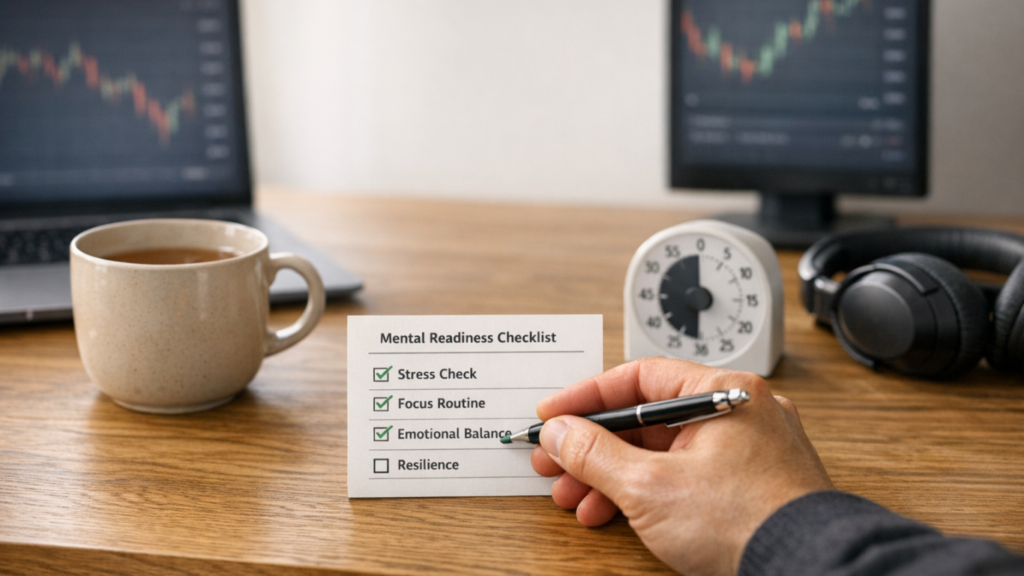
Keep visible reminders at your trading station to reinforce discipline. Phrases like “Don’t chase FOMO,” “Honour all stop losses,” or “Don’t trade angry” can act as mental guardrails during stressful moments. Alongside these, maintain a daily checklist with items such as “Reviewed my trading plan” and “Avoided revenge trading.” Over time, this routine not only strengthens discipline but also helps turn it into a habit, creating a positive feedback loop for long-term success.
Conclusion
Mental readiness forms the backbone of long-term trading success. The numbers don’t lie: around 90% of traders lose money due to emotional decisions, while trading psychology contributes to 80% of market success, leaving just 20% to technical knowledge. Clearly, your mindset holds more weight than any chart or strategy.
Approaching mental preparation with the same dedication as technical analysis can give you a real advantage. A mindset prioritising capital preservation over chasing profits captures the essence of trading discipline.
Incorporate daily mental check-ins to shift from reactive trading to a more strategic approach. Use a trading journal to track your emotional state, stick to pre-market routines, and take a break when your mental energy feels depleted. If stress or lack of sleep becomes a recurring issue, consider reaching out for professional guidance or mentorship.
From stress management to disciplined execution, mental resilience is your ultimate asset. Full-time trading success requires not just the right strategies but also the mental strength to apply them consistently. Resources like the Collin Seow Trading Academy provide structured trading tools and educational programmes to support both aspects of your journey. Start small, build good habits, and let your mental edge grow steadily over time.
FAQs
What are some effective ways to manage stress as a full-time trader?
Managing stress as a full-time trader calls for a mix of discipline, self-awareness, and practical habits. One of the first steps is to have a well-defined trading plan. This should include tools like stop-loss orders and proper position sizing to manage risk effectively. With these in place, you can minimise uncertainty and keep your emotions steady, even during unpredictable market swings.
Adding mindfulness techniques to your routine can also make a big difference. Practices like deep breathing or meditation help you stay calm and maintain focus under pressure. Another useful habit is keeping a journal to track your trades and emotions. Over time, this can reveal patterns in your behaviour, helping you make better decisions.
Equally crucial is maintaining a well-rounded lifestyle. Prioritise enough sleep, regular exercise, and time away from your trading screens. These habits not only support your mental health but also contribute to better trading performance.
What should I include in my pre-market routine to prepare for a successful trading day?
A solid pre-market routine lays the groundwork for successful trading. Begin by checking the economic calendar for any major announcements or events that could influence market movements. Then, take a look at pre-market movers to spot stocks or instruments showing unusual activity or volume.
Dive into technical analysis for your watchlist, and also review broader market charts to get a sense of the overall market direction. Define your risk parameters for the day, such as position sizes and stop-loss levels, and pinpoint key price levels or potential trade setups to guide your strategy. Lastly, take a moment to centre yourself mentally – staying focused and disciplined is just as critical as being prepared with your trading tools.
How can I tell the difference between confidence and overconfidence in trading?
Confidence in trading comes from trusting your own abilities, strategies, and preparation to make well-informed choices. It’s built on a foundation of experience, thorough research, and a solid grasp of risk management principles.
On the flip side, overconfidence is an inflated sense of your own skills. It often leads to reckless decisions, overlooking risks, or even overtrading. A confident trader understands and respects the market’s unpredictability, while an overconfident one might take unnecessary risks, believing they’re immune to mistakes.
To maintain a balanced approach, take time to assess your trading mindset regularly. Make sure your decisions stem from logic and well-thought-out strategies, rather than emotions or assumptions.